

If you’re looking for a clothing manufacturer in China, start with three things: what you want to make, how much you can order, and how much development help you need. Those answers will narrow your shortlist faster than a supplier’s claim to offer “low MOQ” or “full-service manufacturing.”
I’ve put together ten manufacturers with different product focuses and cooperation models. You’ll find options to investigate for branded basics, children’s clothing, streetwear, functional apparel, and continuing knitwear programs.
My advice is to choose around your collection’s full requirements. Below, I’ll explain where each company could fit, what you need to confirm, and how to move from a shortlist to useful quotations.
Why I Chose These Clothing Manufacturers in China
I chose these companies to give you useful starting points for different products, order sizes, and development needs. These eight advantages explain the selection; you’ll see which ones apply to each company in its profile.
- Product specializations you can match to your collection: You can investigate HAPA for children’s clothing, Yotex for functional apparel, and QYOURECLO for streetwear.
- Small starting orders for selected projects: If you’re testing a collection, Hongyu’s blanks and logo customization or MMS’s advertised small orders are worth exploring. Confirm the eligible products and materials first.
- Options to manufacture your own designs: Hongyu’s cut-and-sew services and Appareify’s OEM offer give you candidates to assess for production to your specifications.
- Help preparing a design for production: If you have an idea but lack technical files, you can discuss MMS’s design and tech pack support or Lezhou’s pattern and sample development.
- Different approaches to materials: You can compare Easson’s knit casualwear services, Yotex’s functional material development, and Shenzhou’s integrated fabric operations according to your garment’s needs.
- Branding services alongside the garment: Several companies offer labels, decoration, and packaging, so you can discuss how your finished collection will look and arrive.
- Support across development stages: Lezhou and QYOURECLO describe services covering materials, samples, production, and branding. That can help if you want several tasks coordinated within one project.
- A candidate for continuing production programs: If your brand already has substantial knitwear demand, you can assess Shenzhou alongside suppliers offering smaller starting orders. Confirm order acceptance and available capacity early.
If you’re unsure who operates a shortlisted factory or how its production is arranged, our supplier verification and factory audits can help you investigate before committing.
10 Clothing Manufacturers in China for Custom and Private Label Production
1. Hongyu Apparel — Blanks, Branding, and Custom Clothing
Website: hongyuapparel.com
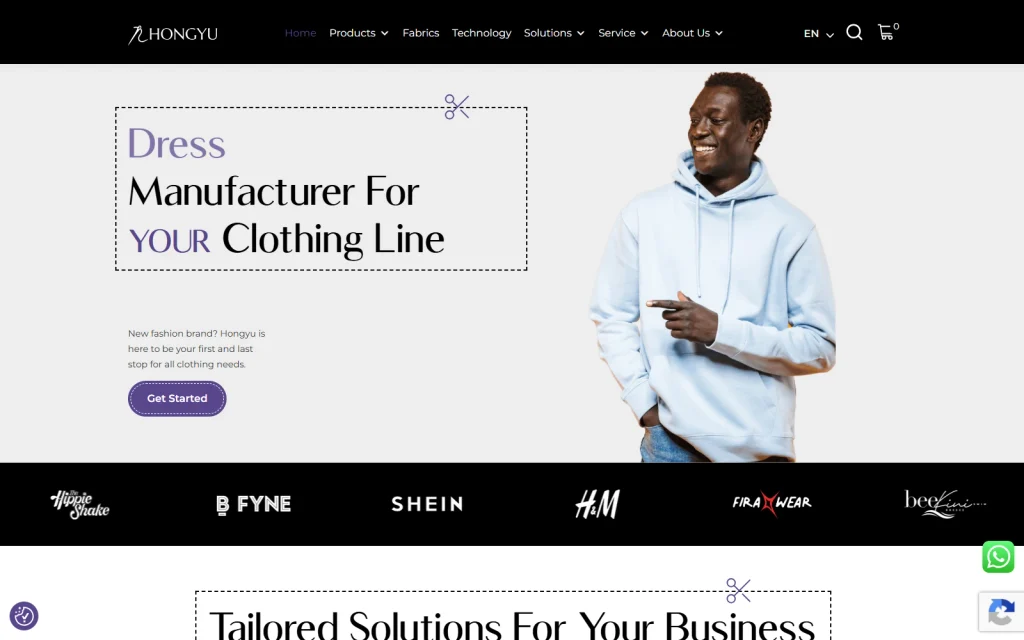
Hongyu Apparel traces its factory history to 2003 and lists its location in Humen, Dongguan, Guangdong. You’ll find T-shirts, hoodies, streetwear, dresses, and other casual garments in its range. Its offer separates blank wholesale, logo customization, and cut-and-sew production, so you can compare different levels of development.
I’d consider Hongyu if you’re deciding how much customization your first collection needs. You could add your branding to an existing garment or develop your own fit and fabric combination. Decide which route you need before comparing prices, because the minimum order changes with the production model.
- Main Products: T-shirts, hoodies, streetwear, dresses, and other casual apparel.
- MOQ: Advertised 50-piece mixed orders for blanks and logo customization; cut-and-sew starts at 100 pieces per style and color, subject to fabric conditions.
- Services: Blank wholesale, logo customization, cut-and-sew production, labels, and garment branding.
- Ideal For: You want to compare existing garments with custom development for an emerging casualwear brand.
Pros
- Choice of production models: You can assess blanks, logo customization, and custom construction against your budget and development needs.
- Small starting orders for selected services: You can explore the advertised 50-piece mixed offer for existing garments and decoration.
- Branding support: You can include labels and other customization in the same product brief.
Cons
- Higher minimums for custom construction: You can’t apply the 50-piece offer to cut-and-sew. Each custom style and color can increase your inventory commitment.
- Fabric conditions need checking: Confirm your preferred material and any additional minimums before paying for development.
2. Ninghow Apparel — Branded Basics and Casualwear Collections
Website: ninghowapparel.com
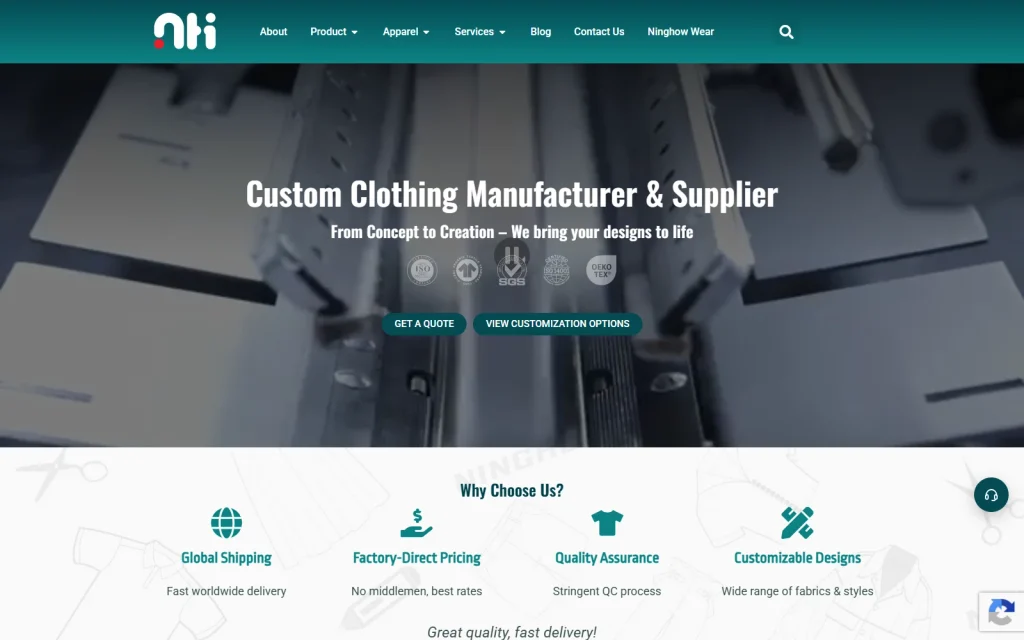
Ninghow Apparel dates its factory history to 1988 and identifies Shenzhen, Guangdong, as its business headquarters. Its website describes production hubs in Guangdong, Jiangxi, and Guizhou. If you’re building a collection around polo shirts, T-shirts, hoodies, or everyday basics, you’ll find relevant categories to explore.
Its printing, embroidery, and brand customization services give you several ways to develop a coordinated range. For repeat basics, I’d pay particular attention to fabric continuity and fit. Ask how the same collar construction, measurements, and materials will be retained when you reorder, and confirm which facility will handle each product.
- Main Products: Polo shirts, T-shirts, hoodies, shorts, trousers, and sportswear.
- MOQ: Confirm by project. Different offers mention 100 and 300 pieces; neither is a universal minimum.
- Services: Custom apparel production, printing, embroidery, brand customization, and production coordination through its network.
- Ideal For: You’re developing branded basics or a coordinated casualwear collection.
Pros
- Related basics in one range: You can evaluate polo shirts, T-shirts, and hoodies for the same collection.
- Decoration options: You can discuss printing and embroidery when developing your brand’s designs.
- Production coordination: You can discuss garment production and customization through a common business contact, with responsibilities agreed in writing.
Cons
- Different minimums across offers: Get a written quantity breakdown before planning your inventory.
- Factory assignment needs clarification: Establish where each product will be made and who handles inspection and corrections.
3. Shenzhou International — Integrated Knitwear Production
Website: shenzhouintl.com
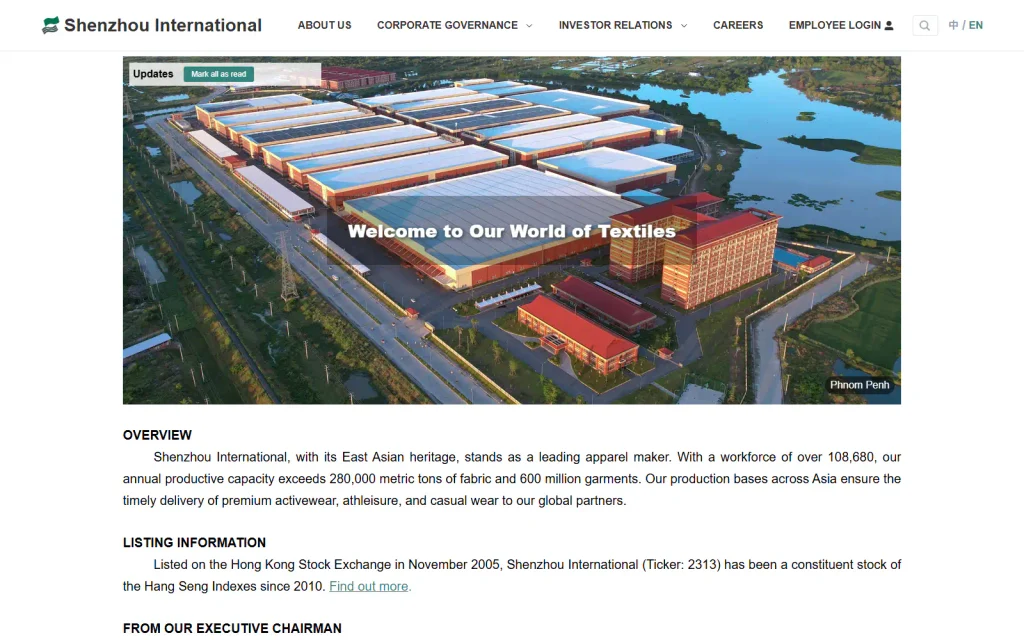
Shenzhou International’s manufacturing history dates to 1988, while its listed holding company was incorporated in 2005. Based in Ningbo, Zhejiang, the group combines fabric and garment manufacturing. Its 2025 annual report describes production operations in China, Cambodia, and Vietnam.
I’d put Shenzhou on your research list if you have substantial, continuing knitwear demand. Its integrated model gives you a fabric-and-garment producer to assess for sportswear and casualwear programs. Before detailed development discussions, establish whether it accepts your volume and whether your order would be manufactured in China.
- Main Products: Sportswear, casualwear, lingerie, and other knitted apparel.
- MOQ: Confirm order acceptance and starting volume with the group before beginning development.
- Services: Fabric and garment manufacturing within a vertically integrated production model.
- Ideal For: You need to evaluate a partner for substantial, repeat knitwear production.
Pros
- Integrated production: You can assess fabric development and garment manufacturing within the same group.
- Clear knitwear focus: Its disclosed product mix gives you relevant categories to investigate for sportswear and casualwear.
- Detailed business information: You can examine its annual report to understand products and operations beyond a general sales introduction.
Cons
- Small-order fit is unclear: If you’re launching a first collection, confirm that your quantity is acceptable before investing time in development.
- Chinese production needs agreement: Its international footprint means you must specify the production country and assigned site.
4. Lezhou Garment — Apparel Development and Production Support
Website: lezhougarment.com
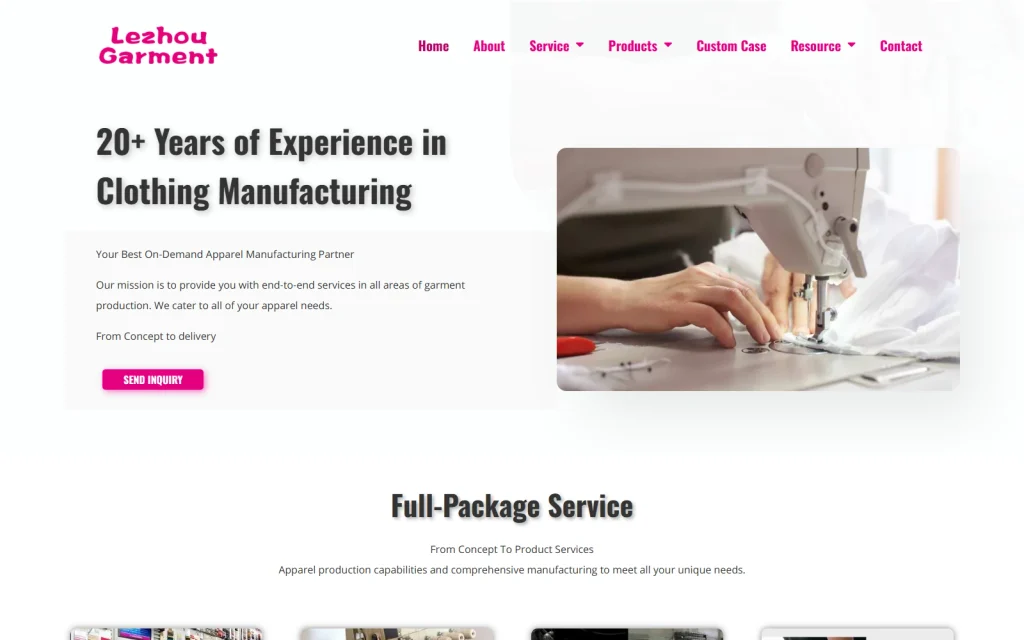
Lezhou Garment lists its location in Humen, Dongguan, Guangdong, and states that it was founded in 2004. You can explore T-shirts, hoodies, tracksuits, and women’s fashion in its catalog. Its services extend from fabric and trim sourcing through patterns, samples, finished garments, and shipping support.
If you want several stages coordinated, Lezhou is worth comparing. I’d ask for an itemized package before accepting a total price. That lets you see which patterns, sample revisions, decoration, labels, packaging, and transport are included, so you can budget for the whole project.
- Main Products: T-shirts, hoodies, tracksuits, polo shirts, pants, shorts, and women’s fashion garments.
- MOQ: Homepage: 200 pieces per style, with size and color mixing conditions. Women’s fashion: 100 pieces per simple, regular style, with up to four sizes; complex styles require negotiation.
- Services: Fabric and trim sourcing, pattern development, sampling, garment production, printing or embroidery, labels, packaging, and shipping support.
- Ideal For: You need several stages of casualwear or women’s fashion development coordinated.
Pros
- Development support: You can discuss materials, patterns, and samples before moving into production.
- Branding services: You can include decoration, labels, and packaging in your collection brief.
- Category-specific offers: You can compare its casualwear and women’s fashion services against your intended product.
Cons
- Minimums vary by offer: Confirm that the quoted quantity applies to your garment; the 100-piece women’s fashion offer doesn’t cover every product.
- Limited sustainable fabric selection: Its women’s fashion FAQ acknowledges this limitation, so confirm your material requirements before sampling.
5. MMS Clothing — Design Support and Small Starting Orders
Website: mmsclothing.com
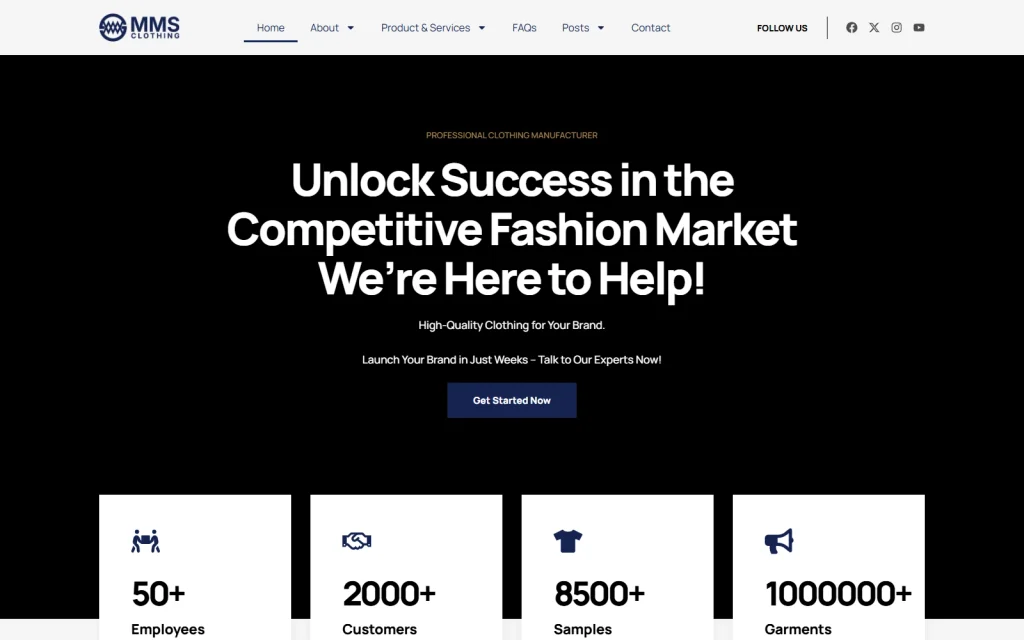
MMS Clothing identifies itself as a manufacturer and wholesaler based in Chengdu, Sichuan, founded in 2018. Its offer includes custom apparel, ready-stock clothing, and design support. You’ll find casual garments, dresses, jackets, and other categories in its product range.
MMS is worth exploring if you have a product idea but need help making it production-ready. Its tech pack service helps record materials, measurements, and construction details. Combined with its advertised small starting orders, that gives you an option for early development; agree on the files you’ll receive and the terms for later production.
- Main Products: T-shirts, hoodies, sweatshirts, pants, dresses, jackets, and other custom apparel.
- MOQ: Advertised as low as one piece per style and color. Confirm eligible products, development charges, and whether this is a sample or repeatable production offer.
- Services: Custom garment production, design support, tech pack preparation, branding accessories, and ready-stock clothing wholesale.
- Ideal For: You need help turning ideas into manufacturing specifications or want to explore a small initial development order.
Pros
- Design preparation: You can discuss how to turn your idea into a clearer manufacturing brief.
- Small starting quantities: You can investigate its one-piece offer for initial development, subject to product and material conditions.
- Different sourcing routes: You can compare custom development with ready-stock wholesale.
Cons
- Low quantity doesn’t settle unit cost: Ask what you’re paying for development, production, and materials before judging the offer.
- File rights need agreement: Specify which patterns and technical records you receive, and how you may use them.
6. HAPA — Children’s Clothing and Decorative Kidswear
Website: hapagarments.com
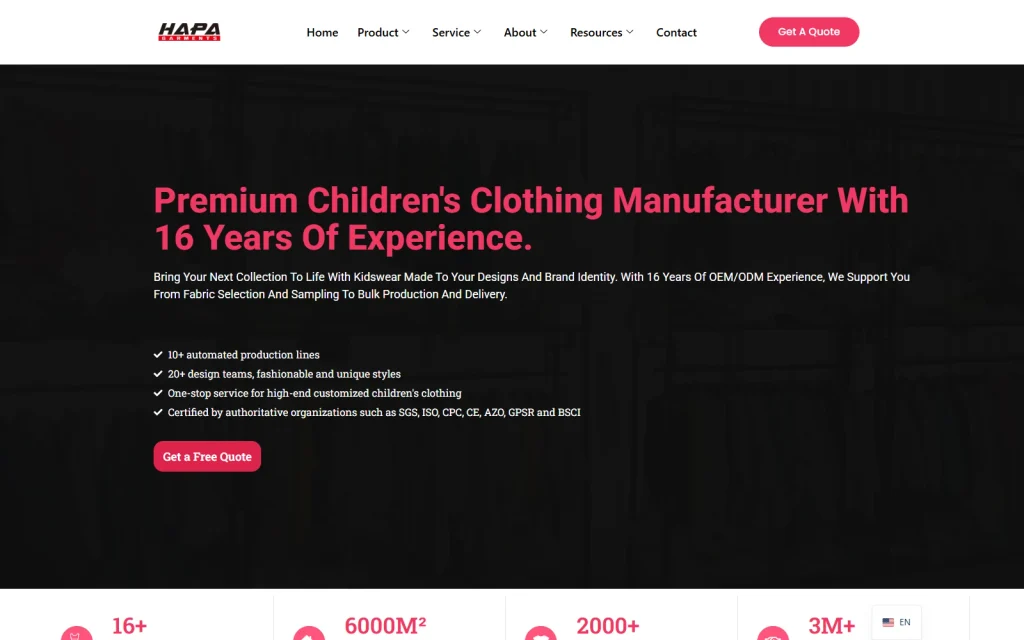
HAPA is the export brand of Guangzhou Happy Credit Apparel Co., Ltd., based in Huadu, Guangzhou, Guangdong. Its timeline dates the factory to 2010 and separately records a foreign trade company established in 2017. You can explore children’s dresses, sets, tops, and outerwear in its range.
If you’re developing kidswear with embroidery or embellishment, HAPA gives you a focused candidate to assess. I’d start with your age group and size chart, then look at fit, closures, trims, and decoration. Those details matter just as much as the appearance of the sample, and your product documents need to match the destination market.
- Main Products: Children’s dresses, sets, T-shirts, hoodies, jackets, pants, and pajamas.
- MOQ: Listed as 150 pieces for a single style or color, with mixed sizes. Confirm how this applies to your style-and-color breakdown.
- Services: OEM and ODM development, custom children’s clothing, embroidery, and garment embellishment.
- Ideal For: You’re building a kidswear collection with everyday styles, dresses, sets, or decorative details.
Pros
- Kidswear focus: You can assess several children’s garment types within its range.
- Decorative customization: You can discuss embroidery and embellishment for more detailed designs.
- OEM and ODM options: You can explore your own designs or a supplier development proposal, with the deliverables agreed first.
Cons
- Other categories need separate evidence: If you need adult or technical clothing, request relevant examples before assuming the same suitability.
- Product documents still need checking: Confirm evidence for your garment, age group, and destination instead of relying on general certification names.
7. Easson Apparel — Custom Knit Casualwear
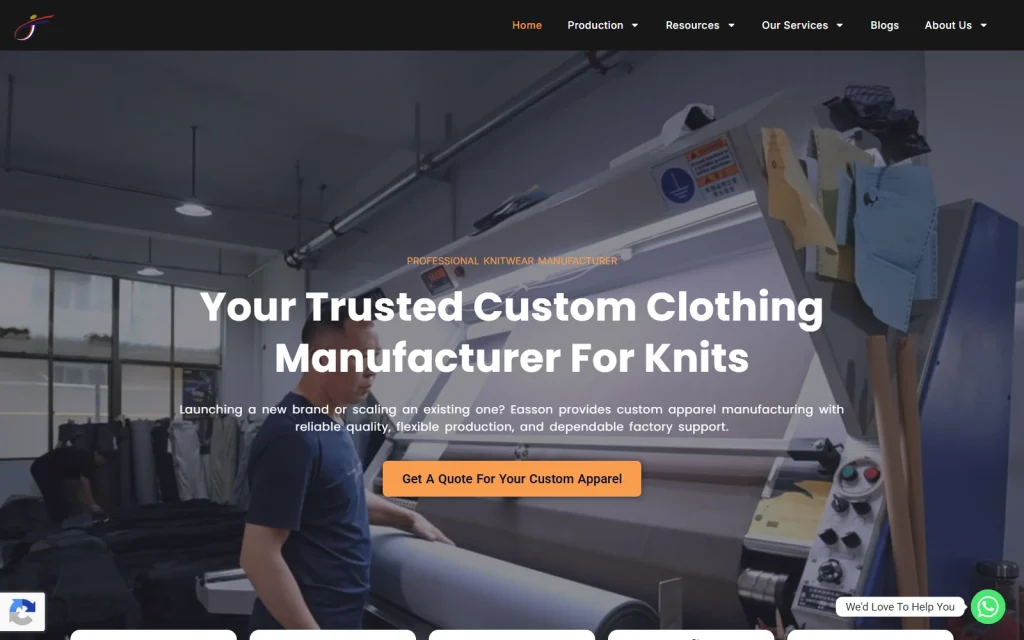
Website: eassonapparel.com
Easson Apparel describes knit casualwear production in Humen, Dongguan, Guangdong. It identifies Easson as an international brand associated with the Jutao factory, whose history begins in 2005. T-shirts, hoodies, sweatshirts, and joggers are central to its garment offer.
You can discuss fabric, samples, labels, and packaging within the same project. I’d consider Easson for a collection where hand feel and fit are part of your selling point. For a hoodie, go beyond “cotton fleece”: specify the composition, weight, finish, and wash requirements so you and the supplier are discussing the same product.
- Main Products: T-shirts, hoodies, sweatshirts, polo shirts, joggers, and loungewear.
- MOQ: Around 100 pieces per color in its FAQ; 50–100 pieces may be possible for selected projects, depending on fabric and customization.
- Services: Fabric sourcing, sample development, OEM/ODM production, labels, and packaging.
- Ideal For: You’re developing T-shirts, hoodies, and joggers with defined fabric and fit requirements.
Pros
- Related knit casualwear products: You can compare relevant styles for a T-shirt, hoodie, and jogger collection.
- Material and sample support: You can discuss fabric choices and development together.
- Branding services: You can specify labels and packaging alongside garment construction.
Cons
- Smallest orders have conditions: Confirm that the 50–100-piece option applies to your materials and decoration.
- Timing needs a project schedule: Its public timing statements vary; get agreed approval dates and a clear starting point for bulk production.
8. Yotex Apparel — Functional Sportswear and Activewear
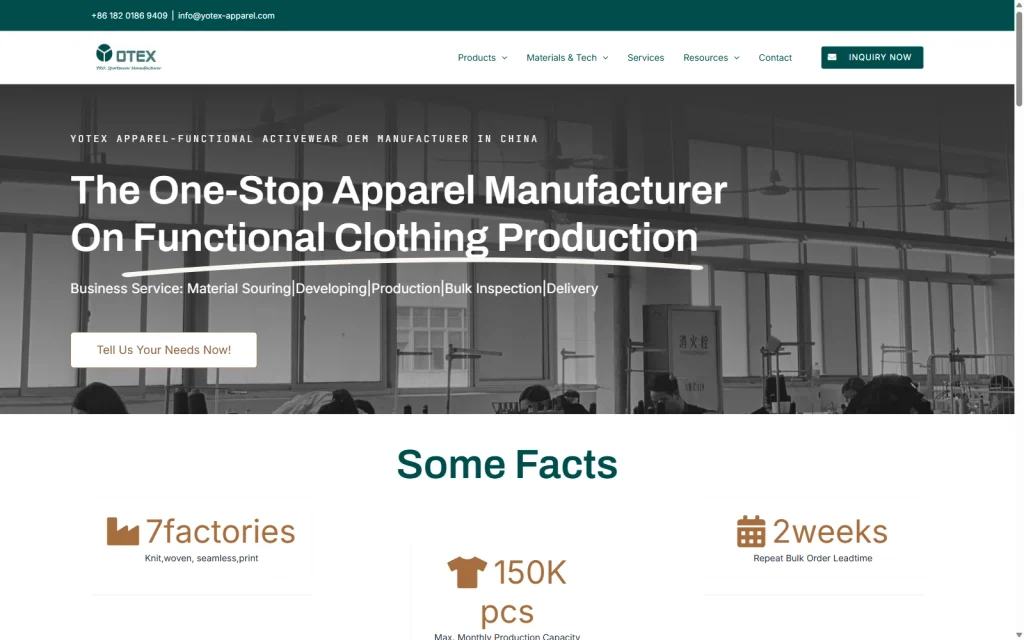
Website: yotex-apparel.com
Yotex Apparel was founded in 2015 and lists Shanghai as its business headquarters. Its range covers sportswear, activewear, outdoor apparel, and related functional products. You’ll need to confirm the manufacturing arrangements and assigned facility for your order.
If your garment has performance requirements, Yotex gives you specific capabilities to investigate. Its services describe material development, bonded tape, heat sealing, and seamless construction. For leggings, define opacity and stretch recovery; for outdoor clothing, define the seam or fabric performance you need before discussing samples.
- Main Products: Sportswear, activewear, outdoor apparel, swimwear, seamless garments, and related accessories.
- MOQ: Request a project-specific minimum and confirm the applicable product and production conditions.
- Services: OEM/ODM development, functional material sourcing, garment production coordination, inspection, branding, and delivery support.
- Ideal For: You have clear material and garment performance requirements for sportswear, activewear, or outdoor clothing.
Pros
- Functional apparel focus: You can start with categories relevant to your performance needs.
- Material development services: You can discuss specific fabric properties with the supplier.
- Specialized processes: You can request examples of bonded tape, heat sealing, or seamless construction relevant to your product.
Cons
- Entry terms need clarification: Confirm current MOQ and the actual production site before assessing the commercial fit.
- Performance needs evidence: Agree on material information, sample checks, and any necessary testing for your garment.
9. Appareify — Custom Apparel Across Multiple Categories
Website: appareify.com
Appareify states that it was founded in 2017 and publishes a contact address in Yuexiu District, Guangzhou, Guangdong. Its catalog includes casualwear, activewear, loungewear, and other custom apparel. You can explore cut-and-sew, private label, and OEM services alongside its described sourcing network.
If your collection spans several categories, you can use Appareify for an initial comparison. My next step would be to evaluate each product separately. A sweatshirt and stretch leggings need different materials and construction, so ask for relevant samples and establish who handles development and production for each one.
- Main Products: T-shirts, hoodies, activewear, loungewear, and other custom apparel.
- MOQ: Request minimums by style and color, together with material requirements.
- Services: Cut-and-sew production, OEM manufacturing, and private labeling.
- Ideal For: You want to compare custom production support across several apparel categories.
Pros
- Multiple categories: You can discuss different parts of your collection in one initial enquiry.
- Custom construction: You can explore production to your approved design and specifications.
- Private label support: You can include branding needs and clarify whether the garment is existing or custom developed.
Cons
- Factory arrangements need explanation: Establish which facility makes each product and how it relates to the supplier.
- Inventory planning needs a quote: Get written minimums by style, color, and material before committing to a collection size.
10. QYOURECLO — Custom Streetwear and Branded Casualwear
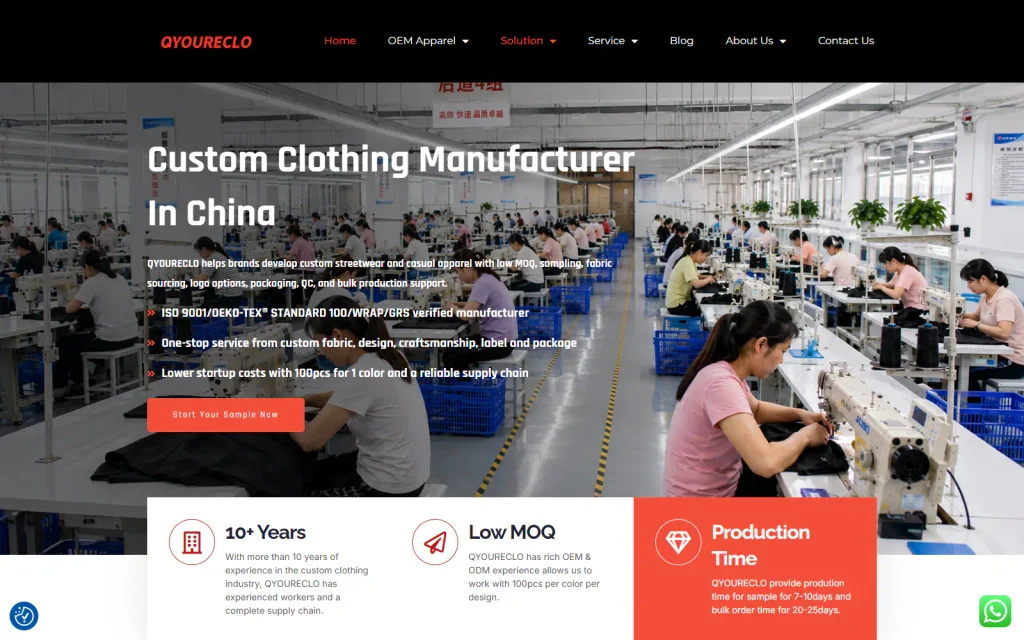
Website: qyoure.com
QYOURECLO dates its founding in Dongguan, Guangdong, to 2013 and publishes a contact office in Nancheng District. Its range centers on streetwear and casual garments, including hoodies, T-shirts, tracksuits, and jackets. Its described process covers design review, materials, sampling, decoration, and branding.
You can explore QYOURECLO if fit, fabric weight, and graphics define your streetwear collection. Include measurements and artwork dimensions with your reference images. I’d judge a printed hoodie on placement, surface feel, and agreed wash performance as well as its fit, then keep the final sample and specifications aligned.
- Main Products: Hoodies, T-shirts, tracksuits, pants, shorts, and jackets.
- MOQ: Listed as 100 pieces per color and design. Fabric, washing, trims, or decoration may add minimums; confirm in the quote.
- Services: Design review, fabric sourcing, sampling, custom decoration, garment production support, labels, and packaging.
- Ideal For: You’re developing streetwear or casualwear with your own fit, fabric choices, and graphic details.
Pros
- Streetwear-oriented range: You can explore hoodies, T-shirts, and tracksuits for a casual collection.
- Garment customization: You can discuss fabric, fit, and decoration beyond applying a logo.
- Brand presentation support: You can include labels and packaging in the finished product specification.
Cons
- Colorways increase the total order: At 100 pieces per design and color, several variations can mean substantial inventory; agree separately on any smaller test.
- Process minimums need checking: Special materials, washing, trims, or decoration may change your quantity requirements.
Before contacting your shortlisted manufacturers, explore our China sourcing guides for advice on supplier checks, samples, and order preparation.
Clothing Sourcing in China: OEM, ODM, Private Label, or Ready-Stock Wholesale?
Before you compare factories, decide what you need them to do. Do you already have a design? Do you want to adapt a supplier’s style? Or would you prefer to buy finished clothing and start selling?
Private label means selling under your own brand. OEM and ODM describe who provides the design and development. You can combine these arrangements, so I focus on the actual work included when discussing a project.
| Sourcing model | What you prepare | What you can customize | What to confirm |
|---|---|---|---|
| OEM | Your design and production specifications | A product made to your approved requirements | Development, files, samples, and responsibilities |
| ODM | Product direction and changes to a supplier proposal | A supplier design or development starting point | Modification limits and design-use conditions |
| Private label | Brand files and product requirements | Branding, sometimes broader garment changes | Product source, labels, and customization scope |
| Ready-stock wholesale | Selected products and quantity breakdown | Existing stock; changes need permission | Live stock, sizes, and replenishment |
OEM: Manufacture Clothing from Your Designs
Choose OEM if you want a factory to make your design. You’ll need measurements, material requirements, construction details, artwork, and quantities so the supplier can understand the job.
If you only have a sketch, you can still ask for development help. I’d agree on who prepares the pattern, what revisions cost, and which files you receive. Put design use and file ownership in writing. Calling the arrangement OEM doesn’t answer those questions.
ODM: Start with a Supplier’s Designs and Development Support
ODM can work if a supplier’s design is close to what you want. You might select a silhouette and change the fabric, color, or decoration.
I would first check how much needs changing. Small adjustments may use the existing development base; extensive changes can require new patterns and samples. Ask whether other buyers can use the same design and what an exclusive arrangement would involve.
Private Label: Sell Clothing Under Your Own Brand
You can use private label services for neck labels, logos, hang tags, and packaging. The garment underneath might be an existing style or something developed through OEM or ODM.
Be clear about both parts: the garment you want and the branding you need. Confirm label content, placement, artwork approval, and minimum quantities. If exclusivity matters to your brand, agree on it separately.
Ready-Stock Wholesale: Buy Finished Clothing for Resale
If you accept existing styles and want to reduce development work, explore ready-stock wholesale. Check how many units are available in each color and size, and whether you can reorder.
I’d check live stock before promising a delivery date to your customers. If you want to replace labels or add decoration, get permission and a separate quote; that work may change the dispatch date.
Where to Find Clothing Manufacturers in China
You can build a shortlist through B2B platforms, Google, trade shows, referrals, or a sourcing agent. I’d choose the route according to your product, time, and ability to manage the follow-up.
Search B2B Platforms for Apparel Suppliers
Start with Alibaba.com or Made-in-China.com if you want to compare product ranges and supplier profiles. Search by garment type, material, and customization needs, then send the same brief to relevant companies.
When an assessment report is available, check its company name, location, date, and scope. I would also ask whether the supplier makes your product itself or coordinates another factory. That tells you who you need to investigate next.
Use Google and Manufacturer Websites
Make your searches specific. “Private label hoodie manufacturer China” or “kidswear manufacturer Guangzhou” will give you a more focused starting point than a broad clothing search.
Read the product pages, development process, contact information, and company background. Compare those details with the supplier’s platform profile. Use search results to build your shortlist, then use samples and production evidence to narrow it.
Meet Suppliers at Apparel Trade Shows
You can meet potential suppliers at events such as the Canton Fair. Check the organizer’s current exhibitor directory before making travel plans.
Take your product brief and inspect samples close to what you want to make. I’d record the contact person and discussion, then follow up with a written quote and company details. You still need to establish how your own order will be produced.
Ask for Referrals from Industry Contacts
Ask other brands, fabric suppliers, or industry contacts for introductions. A useful follow-up is: “What did you order, when, and what did this supplier actually handle?”
I’d give more weight to a referral for a product similar to yours. Then check whether the current team, materials, and order conditions still fit your needs.
Work with a China Sourcing Agent
If you need local support, an agent can help you find candidates, compare quotations, coordinate samples, and arrange checks within an agreed scope.
Before you start, ask about fees, supplier relationships, deliverables, and approval responsibilities. Our sourcing and procurement services include supplier matching and quotation comparison, with the work agreed around your project.
How to Choose a Clothing Manufacturer in China for Your Brand
I compare shortlisted manufacturers on six points: MOQ, capacity and lead times, price, ethical and sustainability practices, documentation, and workmanship. At Hinsourcing, this is how we help overseas buyers assess factories beyond simply placing an order on 1688.
Confirm MOQ by Style, Color, and Material
The first question I’d ask is: “Does that minimum apply per style, per color, or to the whole order?” A quote saying “100 pieces” isn’t enough to plan your stock.
For example, suppose you want three styles in two colors. At 100 pieces per style and color, your collection requires 600 garments. Sizes change the allocation, but may not change the total. Custom fabric, dyeing, labels, and trims can have separate minimums.
Ask about reorders at the same time. Can you repeat the approved product in a smaller quantity? Will the original fabric still be available? Your first order should give you a workable path to replenishment.
Check Production Capacity and Delivery Commitments
A factory’s monthly output doesn’t tell you whether it has room for your order. I’d ask which facility or line will handle the work and how your schedule fits its existing commitments.
Get dates for:
- Material confirmation and availability.
- Sample revisions and final approval.
- Cutting and production.
- Finishing, inspection, and packing.
- Dispatch and transport.
If printing, embroidery, or washing happens elsewhere, ask who coordinates that stage and how you’ll receive progress updates.
Give every delivery promise a clear starting point. Does production time begin after your deposit, material approval, final sample approval, or all three? Also separate the production completion date, dispatch date, and arrival date.
If you’re planning a launch, work backward from when you need saleable stock. I’d allow room for sample changes, inspection findings, and transport arrangements as well as sewing time.
Compare Prices Using the Same Product Specifications
I only find a price comparison useful when the specifications match. A lower quote could use lighter fabric, simpler decoration, or less packaging.
For a hoodie, write down the composition, fabric weight, fit, artwork, decoration method, labels, sizes, and packaging. Ask every supplier to identify exclusions and alternatives.
Use this table to check the whole cost:
| Cost or term | What you need to establish |
|---|---|
| Development and samples | Patterns, revisions, decoration, sample shipping |
| Bulk garment price | Approved specifications and quantity breakdown |
| Labels and packaging | Included items and extra charges |
| Testing and inspection | Required work, fees, and responsibility |
| Delivery | Collection point, freight scope, and import responsibilities |
| Payment | Deposit, balance trigger, currency, and quote validity |
When a supplier offers a lower price, ask what changes. You may be happy with a simpler package, but a change in fabric or construction needs your approval.
For shipping, check which costs and responsibilities the quote includes. Our shipping and customs coordination can help you clarify documents and delivery arrangements with the relevant freight and clearance professionals.
Assess Ethical and Sustainable Manufacturing Practices
If ethical or sustainable production matters to your brand, turn that priority into specific questions. I’d discuss working conditions and environmental practices separately.
For labor conditions, ask about working hours, wages, workplace safety, and any audit issues that needed correction. Check whether the evidence covers subcontractors too, with employee records handled through a process that protects privacy.
For environmental claims, follow your product’s actual processes. If dyeing or washing is outsourced, ask about that partner’s controls and the supplier’s oversight. Discuss waste handling and material sourcing where relevant.
Before marketing a garment as organic or recycled, check the evidence for the actual material you’re ordering. You need to know the supplier, supporting documents, and scope of the claim.
I would look for specific answers and documented corrective work. That gives you something useful to assess when choosing a production partner.
Verify Required Certifications and Supporting Documents
Start with what your product and destination market require, including any retailer requirements. Then ask for the documents that match your materials and production site.
Check:
- The certificate or report holder and named facility.
- The products, materials, or processes covered.
- The issue date, validity conditions, and issuing organization.
- The identification number and verification method.
- Whether the document applies to your proposed order.
I wouldn’t approve a supplier based on certificate logos alone. Certification, a factory audit, and a product test report answer different questions; you need the relevant documents.
For an OEKO-TEX claim, request the certificate or label number and check it through the official OEKO-TEX Label Check. Look at the covered product or material as well as validity.
Before paying, make sure you understand the relationship between the website brand, contracting company, invoice issuer, payment beneficiary, and factory. If the names differ, ask for an explanation and supporting records.
Evaluate Craftsmanship and Bulk Production Consistency
I’d start with a sample close to your intended product. If you want a heavily embroidered hoodie, a plain T-shirt tells you little about that work.
Check fit, measurements, seams, panel matching, decoration placement, closures, and the agreed performance after washing. If you’re ordering several sizes, assess the size range before approving it.
Turn your approved sample into instructions the factory can follow:
- Record materials and trims.
- Set measurement points and acceptable tolerances.
- Approve decoration size, color, placement, and finish.
- Keep an identified approval sample and current specification version.
- Require approval before changing materials or construction.
- Agree on production checks and defect handling.
My key question is: “How will you reproduce this sample across the whole order?” Ask about operator instructions, inspection points, and what happens to garments outside your agreed requirements.
Our production follow-up and quality control can help you coordinate progress checks and inspections against approved specifications. Use the findings to decide whether to approve, correct, or investigate further.
Before moving to production, use this checklist to resolve unanswered points:
| Selection area | What to request | What you need to decide |
|---|---|---|
| MOQ | Written quantity breakdown | Does the collection fit your inventory plan? |
| Capacity and delivery | Assigned facility and milestones | Can the schedule meet your arrival date? |
| Price | Itemized quote against your specifications | What is included, excluded, or substituted? |
| Ethics and sustainability | Relevant records and corrective actions | Which facilities and activities are covered? |
| Certificates and documents | Current, project-relevant documents | Do the holder and scope match the work? |
| Craftsmanship | Relevant samples and inspection arrangements | Are your approval criteria clear and reproducible? |
What Labeling Requirements Should You Confirm with Your Chinese Clothing Factory?
I’d discuss required product information when you prepare your brand labels. Getting the content right before approving artwork helps you avoid changes later.
If you sell covered textile products in the United States, use the FTC’s textile and wool labeling guidance to check requirements for fiber content, country of origin, and the manufacturer or another responsible business.
For garments covered by the U.S. Care Labeling Rule, the FTC’s care labeling guidance requires care instructions with a reasonable basis. Make sure your instructions suit the finished garment, including decoration and trims.
Approve the wording, placement, and attachment before bulk production. If your supplier uses factories in several countries, confirm the manufacturing arrangements when determining origin information.
For children’s clothing, check additional requirements for the age group and garment. If you sell elsewhere, check your destination-market rules. Include these needs in your brief so you and the supplier agree on the required product documents.
FAQs About Sourcing Custom and Private Label Clothing from China
Can Clothing Manufacturers in China Accept Small Orders?
Yes, some suppliers offer small orders, depending on your product and customization. I’d start by asking about existing styles, available fabrics, and fewer colorways if you want to test a collection.
Send your quantity breakdown and ask which requirements set the minimum. Then check that the proposed solution keeps the features you care about and lets you reorder.
What Is the Minimum Order Quantity for Clothing Manufacturers in China?
There is no single MOQ for every Chinese clothing manufacturer. Your minimum may apply per style, color, material, or production arrangement.
Ask whether you can mix sizes and whether labels or trims have separate minimums. I’d calculate the whole collection quantity, then confirm that breakdown in the quotation and purchase order.
How Much Does It Cost to Manufacture Clothing in China?
Your cost depends on materials, construction, decoration, quantities, and packaging. Send a clear specification and ask for an itemized quote.
When budgeting, I would include development, testing, inspection, transport, and applicable import costs. You’ll get a more useful comparison when you know what each supplier’s price actually covers.
Can a Chinese Clothing Manufacturer Develop My Designs?
Some manufacturers offer patterns, fabric sourcing, and technical development alongside production. Ask what they need from you and what the development fee includes.
If you start with reference images, agree on measurements and construction before approving the sample. I’d also confirm revision fees, file delivery, and your right to use the patterns and specifications.
How Much Do Clothing Samples Cost, and Are Sample Fees Refundable?
Sample fees depend on your garment, materials, decoration, and development work. Ask whether the price includes patterns, revisions, labels, and courier charges.
If you want the fee credited against a bulk order, agree on the conditions in writing. I would budget for the sample cost until the supplier confirms a refund or credit for your project.
How Long Does Clothing Production Take in China?
Your schedule depends on material availability, development, approvals, quantity, and the factory’s workload. Ask for separate timing for samples, revisions, production, inspection, and shipping.
For a launch, I would plan backward from your required arrival date. Confirm what starts each stage and allow time to resolve problems before dispatch.
Should I Contact Chinese Clothing Factories Directly or Use a Sourcing Agent?
You can contact factories directly if you have clear specifications and can manage supplier checks, samples, and production follow-up. If you need more local coordination or comparison support, you can assess an agent.
Compare the agent’s fees and responsibilities with your own available resources. In either arrangement, decide who approves samples, specification changes, and key commercial terms.
How to Request Quotes from Clothing Factories in China
Once you’ve found a few suitable candidates, send each the same request for quotation, or RFQ. That’s how you’ll get replies you can compare.
Include:
- Your designs, reference samples, or tech pack.
- Fabric requirements and anything you need help developing.
- Quantities by style, color, and size.
- Decoration, labels, and packaging.
- Destination market and required arrival date.
- Target budget and the delivery costs it should cover.
- Sample requirements and supporting documents.
Ask each supplier what is missing, what alternatives it proposes, and what assumptions sit behind the cost and schedule. I would pay attention to its questions: they show which parts of your brief need more work.
Clear up the specifications before comparing final prices or approving a deposit. Then sample the relevant candidates and use those results to decide where to continue verification and production discussions.
If you’d like help with your shortlist or quotations, tell us about your clothing sourcing project. Share your products, quantities, and delivery needs so we can agree on the sourcing, verification, or production support your project requires.