
China Sourcing Agents: A Practical Guide for Buyers
You found suppliers — now what? Where exactly do two quotes differ? How do you turn an approved sample into consistent mass production? And who follows up when a problem surfaces before shipment?
I am Hin Gao, founder of Hinsourcing, based in Guangzhou with over 10 years of sourcing experience. I help international buyers find and verify suppliers, compare quotes, manage samples and production, and coordinate inspections and shipping. To me, the value of a sourcing agent is not just finding a factory that “can do it” — it is helping you judge whether that factory is right for your order, and making sure every detail lands correctly.
This guide walks through the 7 most important questions to ask before working with a China sourcing agent. You will learn what an agent actually does, how fees work, how to judge reliability, and how we approach real projects. You may not need a full-service agent — sometimes verifying a single supplier or arranging one inspection is the right level of support.
Start by deciding what kind of help you need
No supplier yet, or developing a custom product? Start by exploring full-service sourcing.
Already have a factory, but need supplier verification, inspection, or production follow-up? Consider support for that specific task first.
Have reliable suppliers and a team that can manage orders independently? Buying directly may be the better choice.

What Is a China Sourcing Agent?
A China sourcing agent is an individual or company that helps overseas buyers handle purchasing activities in China. Depending on the agreement, an agent may find suppliers, compare quotes, arrange samples, negotiate terms, monitor production, check quality, and coordinate shipping.
Think of an agent as your local sourcing partner. Hinsourcing, for example, has offices in Guangzhou and Yiwu to help buyers find the best-fit factories. But the role should involve more than passing messages between you and a supplier. It means turning “what I want” into requirements that a factory can follow and both parties can check.
Before working together, ask at least the following questions:
- Who is the legal seller under the purchase contract?
- Who receives payment for the goods?
- Can you see the factory’s original quote?
- Does the intermediary earn income from suppliers, freight forwarders, or both?
- If the relationship ends, can you obtain the supplier details, samples, specifications, and order history?
These questions are not a sign of distrust. They are basic arrangements that both parties should clarify before working together.
Why Use an Agent When You Can Find Suppliers Online?
You may wonder why you need a sourcing agent when Alibaba, 1688, trade shows, and search engines make it easy to find suppliers in China.
Finding contact details and confirming that a supplier is right for your order are two different things. Online listings can introduce a product, but you still need to check where it is actually made, who handles the key processes, and whether bulk production can meet the requirements established by the sample.
Here is a simple example: two factories show products that look similar, but one quotes a lower price. I would not immediately decide which offers better value. First, I would check the materials, packaging, minimum order quantity, inspection arrangements, and delivery terms. Price differences only mean something when you are comparing the same requirements.
Verifying information you cannot yet confirm and following up on work you cannot easily handle in person—that is why we are here, rather than simply finding you just any factory.
The Same “Agent” Label Can Cover Different Business Models
Some agents charge buyers a service fee, some add a markup to the goods, and others sell the products themselves, operating more like a trading company. Before you begin, clarify at least these three points:
- Who signs the contract, and who gets paid? Who is the seller under the purchase contract? Who receives payment for the goods, and who receives the service fee?
- Where does the income come from? Can you see the supplier’s original quote? Apart from the fees you pay, does the agent also earn income from suppliers or logistics providers?
- How will records be handed over? If the relationship ends, can you continue to access and use supplier information, samples, specifications, tooling records, and past order records?
Whether you are considering Hinsourcing or another company, I recommend clarifying these arrangements before deciding to work together.
What Does a Sourcing Agent Actually Do?
Hiring a China sourcing specialist does not mean following a fixed service package or process. At Hinsourcing, for example, we can support the entire order or just one stage. Before choosing, consider what your team already handles well. Hiring an agent does not mean you have to hand over everything.
Full-Service Sourcing or Support for a Specific Task?
Full-service sourcing suits buyers who want one local contact to coordinate the main purchasing activities. It usually begins with clarifying requirements and selecting suppliers, then continues through samples, ordering, production, inspection, and shipping coordination.
Support for a specific task suits buyers who already have a factory or an internal purchasing process. Examples include verifying a supplier, accompanying a factory visit, consolidating and forwarding samples, arranging an inspection, or following up on a delayed order.
Even with full-service sourcing, supplier selection, sample approval, contract terms, major changes, and shipment approval should remain the responsibility of you or someone you authorize. The agent’s role is to provide information, make recommendations, and follow through on the agreed work.
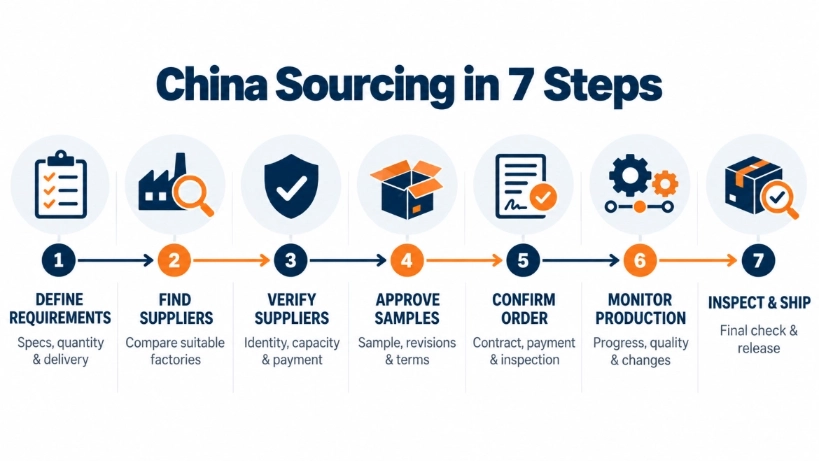
How I Structure a Sourcing Project
I divide a sourcing project into the seven stages below. The scope may vary, but whenever a task is assigned, both parties should agree in advance on what will be done and what will be provided when it is complete.
Stage | Main Tasks | Results or Records to Keep |
1. Define requirements | Confirm materials, dimensions, intended use, quantity, target market, packaging, and delivery timing. | Approved brief, specifications, drawings, or reference samples; a bill of materials and testing requirements where applicable. |
2. Find suppliers | Compare potential factories using the same request for quotation. | Shortlist, quotes, inclusions and exclusions, and reasons for recommendations. |
3. Verify suppliers | Check the company, payment account, production capabilities, and outsourcing arrangements. | Verification records, on-site or documentary evidence, and unresolved questions. |
4. Approve samples and terms | Compare samples, confirm revisions, and agree on commercial terms. | Sample reference numbers, revision lists, test results, and the approved version. |
5. Confirm the order | Align specifications, contract, packaging, payment, and inspection requirements. | Purchase order, contract or pro forma invoice, and production and payment schedules. |
6. Monitor production | Check materials, initial production samples, progress, and approved changes. | Dated updates, photos, issue records, and corrective-action records. |
7. Inspect and hand over | Inspect as agreed, resolve issues, and confirm whether to ship. | Inspection and re-inspection results, shipment approval, packing list, shipping documents, and other required records. |
Records should be traceable to the order number, product, batch, date, and person responsible. Important changes agreed by phone or chat should also be documented in a version confirmed by both parties. Otherwise, everyone may say “the changes are done” while working from different understandings.
Which Buyers Benefit Most from a Sourcing Agent?
When deciding whether a project needs an agent, I do not look only at the value of the goods. I first ask: where are you getting stuck, and what could it cost if that stage is not handled properly?
First-Time Importers Unsure What to Check Before Paying
You may already have quotes but still be unsure whether the supplier is reliable, what to check in a sample, or when to arrange an inspection. At this point, mapping out supplier checks, product approval, payment, and delivery matters more than rushing to find the “lowest price.”
If a mistake on your first order would seriously affect cash flow, local support may be worth considering. But be clear about which tasks the agent will handle and which still need confirmation from you or a specialist organization.
Small Trial Orders Held Back by Minimum Order Quantities
Suppose you want several colors of the same product but have a limited budget for your first order. I would first ask the factory whether its minimum order quantity applies to the whole order or to each color separately. Is the restriction driven by materials, production, or packaging? Then I would assess whether to adjust the plan or keep looking for a better-fit factory.
Project snapshot: make the trial order workable before scaling up. In the Indonesian pet supplies project we have shared publicly, the client wanted to launch an online business with a small order. We first screened suppliers around the client’s budget and trial-order needs, then coordinated a trial production run with a manufacturer in Zhongshan and followed the order through to delivery. The priority was not to push the client into a large order, but to find a cooperative factory with terms suited to a first purchase.
This does not mean every product can be sourced at the same low minimum order quantity. For more on the selection process, see our small-batch pet supplies sourcing case study.
Custom Products with Samples That Never Quite Meet the Brief
Private-label and custom projects may involve materials, colors, tooling, dimensions, labels, packaging, and several rounds of samples. The issue is often not simply “revise it again,” but exactly what does not meet the requirements, which version the factory is revising, and which details must be approved before bulk production.
I focus on making revision requests specific and ensuring that the final sample, specifications, and production requirements all match, rather than accepting something that “looks close enough.”
Multiple Factories with Conflicting Production and Shipping Schedules
For example, the products may be finished while the packaging is still awaiting approval, or a delay at one factory may disrupt the planned consolidation of goods. Sourcing then involves more than chasing each factory. You need to check the quantities, progress, inspections, and documents for each style, color, and size.
An agent can provide consolidated updates and coordinate goods consolidation or shared-container shipping as agreed, so you do not have to confirm the same details repeatedly with different contacts.
Established Suppliers, but Not Enough Local Follow-Up
As your business grows, you may need backup suppliers, fresh cost comparisons, help with quality problems, or supplier checks when you cannot visit in person. An agent can fill those gaps without necessarily replacing your existing factory.
Live video can help communication, but complex, customized, or safety-related orders may still require on-site checks or independent inspections based on the risks involved.
When Is Buying Directly the Better Option?
If your specifications are established, the factory has consistently delivered several batches, and your team can handle communication, quality, contracts, and logistics, working directly may be more suitable. If only one stage needs support, pay only for that service.
Whether you hire an agent should depend on the gaps it can fill, not on how comprehensive its service description sounds.
Sourcing Agent, Trading Company, or Factory Direct?
There is no single ranking that works for every order. The key differences are who supplies the goods, how much effort you need to put in, and which contractual relationship governs the response when something goes wrong.
Working Model | Best Suited To | What to Confirm First |
Factory direct | Established specifications, reliable suppliers, and a team able to manage orders. | Who handles verification, quality, contracts, and logistics. Buying directly does not remove the need for checks. |
Sourcing agent | New suppliers, custom products, multiple factories, or limited local staffing. | Service fees, supplier disclosure, the agent’s authority, and the records to be delivered. |
Trading company | Consolidating different products or simplifying supply and payment arrangements. | The actual seller, product sources, production information, and after-sales responsibilities. Order-specific terms still need to be negotiated. |
Factory direct + independent inspection | Buyers who can manage sourcing and only need stronger checks at a particular stage. | Inspection scope and acceptance criteria. Inspection does not replace product development or contract management. |
A trading company is not automatically unreliable, and an agent is not inherently more transparent than a factory. What you should avoid is a mismatch between a company’s label and its actual role that has not been clearly explained.
With a direct purchase, the contractual seller is usually the factory. When buying from a trading company, the trading company is the seller. When using an agent, you need to examine the goods purchase contract and the service agreement separately.
Before signing, I recommend documenting who issues invoices and receives payments, whether the actual production site can be checked, who approves changes, and how samples, tooling, drawings, and order records will be handed over if the relationship ends. The question is not simply whether there is an intermediary, but what responsibility each fee pays for.
How Do China Sourcing Agents Charge?
There is no standard fee structure for China sourcing agents. A repeat order for a standard product and a custom project requiring several rounds of samples can involve very different workloads, even when the order values are the same. Product complexity, the number of suppliers, travel, inspections, and the extent of ongoing follow-up all affect the quote.
Common Fee Structures and What to Check
Fee Structure | How It Works | Key Questions to Ask |
Percentage commission | A percentage of an agreed amount. | Is it based on the goods value or another amount? Does it include tooling, freight, or other costs? |
Fixed project fee | One fee for a clearly defined project. | Which tasks and how many revision rounds are included? What happens to the fees if the project is canceled? |
Time-based fee | Charged by the hour, day, or month. | How is time recorded? Is there a minimum commitment? What results must be provided? |
Individual service fee | Separate quotes for verification, factory audits, inspections, or other tasks. | What is the inspection scope, what does the report include, and how are re-inspections and third-party costs charged? |
Combined fee model | A fixed fee plus commission, or separate charges for different services. | When does each fee apply, and are there other sources of income? |
A Simple Fee Calculation Example:
Suppose the goods cost US$10,000 and the agreed service fee is 5% of that amount.
Service fee = US$10,000 × 5% = US$500.
Next, confirm what the US$500 covers. Are samples, travel, inspections, re-inspections, and shipping charged separately?
These figures illustrate the calculation only. They are not an actual Hinsourcing quote or a standard industry rate.
This example explains how a commission is calculated, but not which agent offers better value. You still need to compare the scope of service and total spending.
Compare Total Cost, Not Just Unit Prices and Commission
I first check product, packaging, tooling, and development costs, then confirm whether sourcing services, testing, inspections, domestic transport, international freight, insurance, duties and taxes, customs clearance, and delivery at the destination are included. That is how you compare delivery costs on the same basis.
You should also separately consider capital tied up in the order, exchange-rate movements, and potential losses from defective goods or delays. When calculating the actual cost per sellable unit, divide costs by the final number of accepted, sellable units—not simply the quantity originally ordered.
Beyond the fee calculation basis, ask whether you can see original quotes; whether the agent earns income from suppliers or logistics providers; which exchange rate applies; what is charged separately; how refunds work if the project stops; and whether third-party expenses are supported by receipts or other records.
At Hinsourcing, we explain product costs and service fees separately. Before work begins, we confirm the scope, what is included and excluded, and the applicable fees, so you know what work your budget covers.
How Can You Tell Whether a Sourcing Agent Is Reliable?
I suggest assessing every agent by the same standards, including Hinsourcing. A website and initial communication can help form a first impression, but deciding whether to work together also means checking the company’s identity, examining its work, and seeing whether it explains problems clearly.
1. Verify the Company and the Payment Arrangements
Ask for the company’s Chinese name, Unified Social Credit Code, business license, contracting entity, and bank account details. Check its registration through China’s National Enterprise Credit Information Publicity System. A registered company does not necessarily have the product experience or production capabilities you need.
The contract, invoices, and payment arrangements should be consistent. If you are given a personal account or an unrelated company’s account without a clear explanation, verify the arrangement first. Do not pay based only on a salesperson’s verbal assurance.
2. Check Category Experience, Not Just “We Can Do Everything”
Ask the agent to explain which materials, processes, or stages of bulk production commonly cause problems for this product; which requirements need laboratory verification; and what should happen if a factory changes a material. Specific answers make it easier to judge whether the agent genuinely understands the project.
You can also ask who will visit the site, who makes quality assessments, and which tasks will be assigned to third parties. Neither the company’s location nor its team size is a substitute for answers to these questions.
3. Review Actual Work Records, Not Just Promotional Videos
Ask for quote comparisons, sample revision records, or inspection reports that the agent is authorized to share, with sensitive client information removed. The point is not how polished they look, but whether they include dates, product and batch details, original photos or data, and clear recommendations on what to do.
Before work starts, agree on the reporting frequency, project lead, and how you will be notified of major issues. You need to know what has been completed, what remains unresolved, and who is responsible for the next step.
4. Clarify Fees and Supplier Disclosure Rules
Find out whether the agent earns income from suppliers, inspection companies, warehouses, or logistics providers, and whether it has business relationships with recommended parties that should be disclosed. Record the disclosure arrangements in the agreement. Also confirm how much factory information will be shared and whether you can commission an independent inspection separately.
Confidentiality can be discussed, but you should not discover after paying that you and the agent have completely different expectations about transparency.
5. Look for Quality Requirements That Can Actually Be Checked
“Good quality” and “the same as the sample” are not specific enough. Materials, dimensions, tolerances, appearance, packaging, and test methods should be defined as clearly as possible.
Also confirm who sets the inspection requirements, who carries out the inspection, which sampling method is used, and who follows up if the goods fail. Simply saying “we inspect the goods” does not explain what will actually be checked.
6. Start with a Small Project Before Expanding the Relationship
A supplier check, one round of sample development, or a trial order can help you assess how the agent works. Look beyond the final result: were revisions implemented, were problems reported promptly, and did the agent respect your decisions when approval was needed?
To compare agents, you can score six areas from 1 to 5: fee transparency, supplier information, product experience, quality management, reporting, and records handover. Serious payment, contract, or integrity concerns cannot be offset by high scores elsewhere.
My Recommendation
The Pearl River Delta and the Yangtze River Delta are major industrial centers in China and important hubs for global manufacturing. I recommend choosing a sourcing company with an office in Guangzhou, Yiwu, or Shenzhen, as these locations put it closer to manufacturers. Access to ports and logistics services also makes consolidating and shipping goods more convenient, helping reduce logistics costs.
If you are still unsure where to start when judging whether a sourcing company is capable, I have put together the quick scorecard below to help you screen candidates.
Quick Sourcing Agent Scorecard
Assessment Area | What Good Performance Looks Like |
Commercial transparency | Original quotes, disclosed service fees and third-party costs, and no unexplained mismatch between the contract party and the payment account. |
Supplier transparency | Clear legal identity, production location, actual manufacturing role, subcontractors, and contact records. |
Product expertise | Knowledge of relevant processes, proactive questions about risks, familiarity with testing requirements, and an understanding of practical limitations. |
Quality control | Clear specifications, inspection criteria, measurement evidence, and a process for handling nonconforming goods. |
Reporting | Dated records, clearly assigned responsibilities, and prompt escalation of major issues. |
Exit arrangements and records ownership | Continued buyer access to project records, samples, tooling information, and supplier history after the relationship ends. |
You can use this framework directly, scoring each area from 1 to 5 during your initial assessment. However, even a high total score cannot outweigh serious legal, payment, compliance, or integrity concerns.
What Warning Signs Should You Watch For?
A reliable agent will not always tell you that everything is fine, but should help you understand the problems clearly. If you encounter any of the situations below, I recommend pausing to verify the details.
Warning Sign | What to Do |
The actual factory is not disclosed, with no reasonable explanation. | Confirm the scope of disclosure and production checks before placing the order. |
Goods, service fees, and logistics costs are combined into one figure. | Request an itemized breakdown and clarify markups and other income. |
The receiving bank account does not match the company on the contract. | Pause payment and verify the relationship through independent channels. |
A sudden request to change bank accounts just before payment. | Confirm through previously established contact details and arrange a payment review. |
A promise of the lowest price before reviewing product requirements. | Provide the same quotation requirements and check materials and omitted items. |
Only the same familiar factories are recommended, without an explanation. | Ask how candidates were found, how they were compared, and why others were excluded. |
The agent resists an independent inspection by a qualified third party. | Confirm inspection arrangements and the authority to commission inspections before working together. |
Key specifications and revisions appear only in chat messages. | Create formal, versioned documents confirmed by both parties. |
For more detailed verification steps, see our guide to avoiding scams when sourcing from China.
Agree on Standards Before Production, Not During the Inspection
When approving a sample, keep more than the physical item. Record its reference number, materials, dimensions, test results, and packaging. Changes to important materials, components, tooling, production sites, outsourced processes, and packaging should follow the agreed approval procedure.
A factory audit examines a supplier’s capabilities and management. An in-process inspection checks for problems during production. A pre-shipment inspection assesses a finished batch. Laboratory testing verifies characteristics that cannot be confirmed by visual checks alone. These activities do not replace one another.
AQL is a measure used in sampling inspection, not a guarantee of the defect rate across an entire batch. Inspectors should select a plan based on lot size, inspection level, and other relevant conditions. ISO 2859-1:2026 has replaced the 1999 edition and can be used as a reference for these arrangements. Products involving safety or complex performance requirements also need an assessment of whether more targeted testing and controls are required.
Base Payments and Shipment Approval on Clear Evidence
There is no deposit-and-balance split that suits every order. I recommend agreeing on project-specific payment milestones, documenting what records should be available before each payment, and linking the balance to inspection and corrective-action results where both parties accept that arrangement. Any change of bank account should be verified separately.
Shipping terms are not a substitute for product requirements, either. Incoterms® allocate delivery tasks, costs, and risks; they do not automatically determine ownership or replace the sales contract. State the applicable edition, specific rule, and exact named place in the contract.
An agent can coordinate documents and testing, but buyers still need to confirm target-market requirements and their own responsibilities. For example, CE marking applies only to products for which it is required; it is not a blanket “EU approval.” Manufacturers and importers may have separate obligations.[3] An agent arranging shipment does not mean every compliance issue has been resolved.
If an Inspection Fails, Resolve the Problems First
First, hold shipment and document the issues. Identify the affected batches and quantities, and the requirements that have not been met. Keep photos and measurement data, and ask the factory to isolate the affected goods and investigate the cause.
Then agree on corrective action and re-inspect. Discuss rework, replacement, or retesting in line with the contract, and document who is responsible and the schedule. Re-inspection should use random samples of the corrected goods, rather than only a few pieces selected by the factory.
Finally, make an acceptance decision. Obtain written approval from an authorized person. If accepting a deviation, specify exactly what is accepted and the remaining risks, then update the inspection priorities for the next order. Issues involving safety, legality, or critical performance should be reviewed by the appropriate professionals before shipment.

Hinsourcing’s Services: More Than Finding a Factory—Helping You Manage Your Order
As the founder, I want you to choose Hinsourcing because you can see what we do, not simply because we say we are experienced. Compared with services that only provide contact details or forward messages, we place greater emphasis on supplier fit, clear information, and following issues through to an outcome.
Our support can include supplier selection and verification, quote comparisons, sample management, production follow-up, inspections, and shipping coordination. The specific work, records, and responsibilities are agreed for each project. You can also engage us for only part of the process.
We Explain Why a Factory Fits Your Order, Not Just Recommend It
We compare potential suppliers against your product, quantity, budget, and delivery requirements, then document our reasons for recommending them and any questions that still need checking. You should receive more than a list of contacts: you should understand why each option is suitable and where its limitations lie.
Project snapshot: sequin childrenswear—more than looks and unit prices. In the North American childrenswear brand project we have shared publicly, our team screened five manufacturers in Guangzhou, focusing on sequin craftsmanship, sampling capabilities, consistency in bulk production, and commercial terms. After selecting the factory, we coordinated materials, sizing, embellishment details, and sample revisions, helping move the first collection through production.
This project reflects how I approach custom sourcing: a factory’s ability to make one attractive sample still needs to be followed by an assessment of whether it can produce consistently at scale. You can read more in our custom sequin childrenswear sourcing case study.
We Clarify What Your Budget Covers, Not Just the Unit Price
When comparing quotes, we first align materials, quantities, packaging, and delivery terms, then review the goods price, service fees, and other expenses. We distinguish what is already included from what still needs a separate quote.
That helps you understand where a lower price comes from and decide which requirements are worth keeping and which can be adjusted, rather than discovering after payment that essential items still cost extra.
We Carry Approved Sample Requirements Through to Production
Sample revisions need version and approval records. Before production starts, we check the specifications, materials, packaging, and final sample within the agreed scope. If major changes arise later, we explain their impact and identify the decisions that need your approval.
You can check what changed in this version, who approved it, and which requirements production must follow—not just receive a message saying the new sample has been sent.
We Follow Up on Corrective Action and Re-Inspection, Not Just Report Problems
When quality deviations or schedule problems arise, we establish the extent of the issue, help you agree on a solution with the supplier, and follow up on responsibilities, timing, and results.
A factory agreeing to rework the goods does not mean the problem is solved. We focus on the inspection results after correction and distinguish confirmed outcomes from unresolved issues, so you can decide whether to accept the goods, pay, or approve shipment. Responsibility for specific remedies remains subject to the contract and the circumstances.
Use the Support You Need, While Keeping Key Decisions in Your Hands
If you already have a stable factory relationship, you can engage us only for verification, inspection, or issue follow-up. When several suppliers are involved, we can coordinate progress, goods consolidation, and handover through one contact, as agreed.
We provide information, advice, and execution support, but supplier selection, sample approval, major changes, and shipment approval should not be taken out of your hands without your authorization. We also discuss how project records will be retained and handed over before we begin.
What Makes a Progress Update More Useful?
The fictional sample follow-up below illustrates the information structure only. It is not a client project record and does not mean that every service package includes these tasks.
Update Item | Example Wording |
What has been completed? | The second sample version has arrived. Dimensions and packaging requirements have been checked; photos and measurement records are attached. |
What remains unresolved? | The label placement still differs from the approved requirement and needs to be adjusted by the factory. |
What do you need to decide? | Please approve the packaging artwork. It is not yet approved and must not be treated as confirmed. |
Who handles the next step? | The sourcing lead will coordinate revisions with the factory and confirm the timing, then check the revised sample and records. |
An actual project update should also include the order number, batch, date, document version, and person responsible. The point is not how long the report is, but whether it helps you decide what happens next.
For the scope of available support, see Hinsourcing’s sourcing services. To me, good service means less time spent chasing answers and more clear information to base your decisions on.
Frequently Asked Questions
Is a Sourcing Agent Worth It for a Small Order?
Sometimes. The key factors are complexity and risk. A small order involving customization, several suppliers, or strict packaging requirements may need substantial coordination, while a straightforward purchase may only need one supplier check or inspection. Finding a suitable minimum order quantity also depends on the product and the supplier’s terms.
How Do I Distinguish a Sourcing Agent from a Trading Company?
Start with the actual transaction structure. An agent usually provides sourcing services for a buyer, while a trading company usually resells goods as the seller. Checking who signs, who receives payment, whether factory details are shared, and how the intermediary earns income is more useful than relying on the company’s name.
Should I Pay the Supplier or the Agent?
First, check the contractual seller, invoice, and actual transaction arrangements. Paying the contractual seller’s business account is usually easier to verify. If an agent collects payment on someone else’s behalf, or another entity receives it, clarify the basis for the arrangement, how the funds will be used, and who is responsible for refunds and claims. Do not transfer funds based only on chat instructions.
Can a Sourcing Agent Guarantee There Will Be No Quality Problems?
Sourcing services should not be understood as a zero-defect guarantee. Confirming specifications, monitoring production, and inspecting goods help manage risk, but sampling has limitations and cannot replace all product testing and compliance work. The contract should explain how quality problems will be handled.
Can I Ask for Factory Information?
Discuss this before working together and record the disclosure scope in the agreement. Confirm whether the actual production site can be checked, whether you can retain supplier information, and whether future purchases will be restricted. Do not wait until after ordering to discover that the information is unavailable.
How Long Does It Take from Finding a Supplier to Receiving the Goods?
There is no fixed timeline that applies to every product. Plan separately for requirements confirmation, supplier selection, sampling, tooling or testing, production, inspection, corrective work, shipping, and customs clearance. Holidays, material availability, and product complexity also affect timing. I would review the project requirements first, then discuss a workable plan.
Contacting Hinsourcing: Tell Me Where You Need Help
You do not need to finalize every specification before contacting us. For our first conversation, start with three things: a product photo or link, your expected quantity, and the problem you most want to solve. Include your contact details so we can follow up.
We will first look at what you have already completed and which conditions are still unclear. Then we can discuss whether you need full-service sourcing or should start with a supplier check, sample follow-up, or a single inspection. Before formal work begins, we will confirm the scope, fees, responsibilities, and next step.
Ready for a More Detailed Assessment? Add the Following Information
Information Category | What to Provide |
Product and specifications | Photos, links, drawings, or samples; requirements for materials, dimensions, function, appearance, and packaging. |
Use and target market | Intended use and destination market; known testing, certification, and labeling requirements. |
Quantities and variants | First-order quantity, estimated annual demand, and differences in styles, colors, sizes, or models. |
Customization | Private-label, OEM, or ODM requirements; existing designs and development progress. |
Budget and delivery | Purchasing budget or target delivered cost, desired delivery date, destination, and required shipment documents. |
Current stage | Idea stage, supplier identified, samples received, order placed, or an order with unresolved problems. |
You may not need a new factory or full-service sourcing. Let’s first understand your order and the challenges you face, then decide which support is genuinely worth paying for.