If you are comparing sourcing markets, labor and production costs may be lower in India or Southeast Asia for some products and orders. Trade rules keep changing too. Yet many businesses still use China as a major sourcing base. The factory price matters, but so does China’s mix of broad manufacturing, industrial clusters, component networks, product development, production capacity, and export infrastructure. Finding that same mix in one alternative market can be difficult.
Working in China sourcing has taught me not to treat China as the automatic answer. Some Chinese suppliers will fit your product; others will not, and certain orders are better placed elsewhere. The advantages only show up in the final order when the product fits the local supply chain and someone keeps the specifications, samples, quality, payments, and shipping under control.
Why do businesses still source from China when it is not always the cheapest option?
In my view, the main reason is China’s large, established manufacturing base. It helps you find suppliers for different products, development needs, and stages of growth, while leaving room to customize, scale production, and arrange exports. The advantages become clearer when you compare capability and total landed cost instead of the lowest quote alone.
| Advantage | What it means for you | What can weaken it |
|---|---|---|
| Broad manufacturing coverage | More product and supplier options | Weak supplier screening |
| Specialized industrial clusters | Deeper category knowledge and process experience | Searching in the wrong production region |
| Dense component networks | Faster access to parts and supporting processes | Unclear product specifications |
| Product development capabilities | More options for sampling and iteration | Poor version and change control |
| OEM, ODM, and private label | More room to differentiate your product | Unclear tooling and intellectual property terms |
| Capacity for growth | Better support for repeat and larger orders | Unverified production capacity |
| Multiple manufacturing and quality levels | More price and quality choices | Choosing by price alone |
| Established export infrastructure | Access to mature shipping routes and services | Changes in freight rates and tariffs |
| Multi-supplier consolidation | Simpler coordination for complex orders | Incomplete warehouse records |
These factors affect your product, costs, lead time, and ability to grow. Figures from the World Bank, WTO, UN Trade and Development, and WIPO describe China’s overall manufacturing, trade, shipping, and innovation, but they cannot tell you whether an individual supplier suits your order. You still have to check each candidate. If your team lacks the time or experience, a sourcing agent can help with screening and coordination before payment and production.

1. A broad manufacturing base gives you more choice
China makes a broad range of products, including apparel, furniture, packaging, electronics, household goods, machinery, components, and promotional items. You can usually explore several options in one market instead of entering an unfamiliar country for every category.
According to the World Bank’s manufacturing value added data, China’s manufacturing value added was about US$4.82 trillion in 2025. The WTO trade outlook published in March 2026 put merchandise exports at US$3.77 trillion in 2025. That scale gives you more alternatives, but it also makes screening more important. Your shortlist may mix factories, trading companies, and wholesalers. A structured supplier verification and factory audit helps you confirm the supplier’s production role and actual capabilities instead of relying on self-descriptions.
2. Specialized industrial clusters concentrate category knowledge
Manufacturing is not spread evenly across China. Many cities cluster around particular products and processes, placing finished product factories, material and component suppliers, packaging companies, and equipment services nearby. Common starting points include Foshan for home appliances, Guangzhou for clothing, and Yiwu for small consumer goods. These locations can narrow your search, but you must still assess suppliers against your exact product.
Clusters speed up comparisons of materials, tolerances, tooling, finishes, and order capabilities. They also make substitute parts and outsourced processes easier to find. In WIPO’s 2025 ranking, the Shenzhen-Hong Kong-Guangzhou innovation cluster ranked first worldwide, while China had 24 clusters in the global top 100. Location alone does not qualify a supplier. Check its materials, processes, capacity, and export experience.
3. Dense component and service networks can shorten development time
A finished product may involve injection molding, metalwork, electronics, fabric, printing, surface finishing, packaging, labels, and testing. When these resources share one supply network, factories have more ways to solve problems. A replacement connector, coating, fastener, fabric weight, or packaging insert may be available nearby.
This density cuts the time spent searching across regions and makes it easier to carry sample changes into production. That matters when your launch window is tight. Total lead time still depends on complexity, material availability, factory schedules, and your approval speed. Record every specification, version, and approval so the sample and bulk order do not use different versions.
4. China’s supply chain supports faster sampling and product iteration
Private-label development usually involves confirming materials, adjusting dimensions, adapting packaging, and testing the logo application. China’s supplier base lets you compare processes, sample with several candidates, or source the packaging separately. That flexibility helps when you need to test an idea quickly.
I once helped an Indonesian client source home appliances from China. His samples arrived in just 7 days, much faster than he expected. That is not a standard lead time: material availability, customization, and shipping method all affect the schedule.
5. OEM, ODM, and private label give you room to differentiate
Private label usually puts your brand on an existing product. ODM adapts a supplier’s design, while OEM follows the design and specifications you provide. Depending on the product and supplier, you may customize colors, materials, dimensions, functions, labels, and packaging.
Deeper customization has a greater effect on minimum order quantity (MOQ), development time, and upfront investment. New tooling, special materials, testing, and custom packaging can change the quote. Before work begins, agree on the ownership and use of drawings, molds, artwork, and production files, including what happens when the relationship ends.
6. A large supplier base gives your business more room to scale
A new brand and an established importer often need different factories. Early orders call for flexible communication and manageable quantities. Growth may require more mature equipment, quality systems, production planning, and capacity. China’s large supplier base improves your chance of finding a partner for your current stage.
Avoid changing factories simply because more options exist. Each move can require new samples and material adjustments, while losing knowledge built over previous orders. To assess scaling, check the production steps, outsourcing, equipment, schedule, and peak-season workload. Advertised maximum capacity is not the capacity available during your order window.
7. You can choose from different manufacturing and quality levels
“Made in China” does not describe one quality level. Suppliers differ in materials, equipment, processes, workforce skills, and quality systems. Two products that look alike in photos may vary in weight, internal parts, tolerances, finish, durability, and packaging. This range lets you match the product to its market position.
First, define what you need. A request for the “lowest price” may produce quotes based on different materials or constructions. Use the same specifications, packaging, trade terms, and quality requirements for every supplier. Inspection can only check agreed standards; it cannot fix an unclear product definition. Regulatory testing and destination-market compliance also require separate confirmation.
8. Established export and shipping networks support global delivery
China has many freight forwarders, consolidation warehouses, export packing providers, ports, and container routes. UN Trade and Development’s Liner Shipping Connectivity Index shows that China remained well ahead of other economies as of June 2026. This gives you more established routes, but not necessarily lower freight rates.
Experienced exporters are usually more familiar with routine documents and packing. But a supplier’s past shipments to one country do not prove that a new product meets your market’s rules. Specify the Incoterm and named place in every quote, then include freight, insurance, duties, customs clearance, destination charges, and final delivery.
9. Multi-supplier consolidation can simplify complex orders
Wholesalers, retail project buyers, and ecommerce sellers often buy from several suppliers. Separate exports mean multiple freight bills, delivery dates, customs clearances, and receiving schedules. Origin consolidation allows the goods to be collected, counted, checked, repacked, and shipped together.
Consolidation does not always save money. Domestic pickup, handling, storage, and repacking add costs, while one late supplier can delay everything. The warehouse should record each purchase order, SKU, carton, quantity, and batch. Clear records make handovers easier and help you spot discrepancies before the goods leave China.
Where can you source products from China?
You can find Chinese suppliers through online B2B platforms, trade fairs, industrial clusters, and wholesale markets, or work with a sourcing agent. Choose based on whether the product is standard or custom and whether you can verify suppliers and follow the order yourself.
| Sourcing channel | Best suited to | What you need to watch |
|---|---|---|
| Alibaba.com | Initial searches, quote comparisons, and routine customization | Profiles and badges are screening clues; verify the supplier and product |
| Canton Fair | Meeting suppliers and comparing categories quickly | Plan target categories and meetings; exhibiting does not equal a full audit |
| Industrial clusters and wholesale markets | Exploring a category, more styles, or supporting processes | Confirm that the region matches your product and quality requirements |
| China sourcing agent | Custom development, several suppliers, or local follow-up | Define scope, fees, supplier disclosure, and responsibilities in advance |
Once you have a shortlist, verify each supplier’s legal identity and production role before paying. Confirm the sample against written specifications, and document the quality, delivery, and change control terms.
Is sourcing from China always cheaper?
Not always. For some products and orders, the landed cost from China may be higher than the cost of sourcing from India or Southeast Asia.
A low factory price can rise after tooling, packaging, transport within China, inspection, international freight, duties, customs services, warehousing, and final delivery. Delays, rework, returns, and unsellable stock add more. Compare total landed costs under the same specifications and terms before choosing a country or supplier.
| Cost layer | What to include |
|---|---|
| Product costs | Unit price, tooling, custom packaging |
| Costs within China | Domestic transport, consolidation, warehousing |
| Risk control | Samples, testing, inspection |
| International transport | Freight and insurance |
| Import costs | Duties, customs clearance, port and destination charges |
| Cost of failure | Rework, delays, returns, and slow-moving inventory |
In my experience, when prices are close, China’s supply chain often provides more options for production, supporting services, and delivery. I am describing the market as a whole. Individual products still have to be judged by their specifications, approved samples, and the supplier’s actual capabilities.
When is sourcing from China a poor fit?
For a very small order or a deadline measured in days, a local wholesaler is usually more practical. Large, low-value goods may lose their price advantage after freight and destination handling. A nearby supplier can also be better for products that need installation, rapid repairs, or local spare parts.
Regulated products may require market-specific testing, technical documents, labels, or approvals; visual inspection cannot prove compliance. Deposits, production, shipping, customs clearance, and safety stock also tie up cash before a sale. If you cannot carry that cycle or want less dependence on one country, consider local sourcing or a “China+1” strategy.
Do you need a China sourcing agent?
If you have suitable suppliers, an internal team that can manage orders, and reliable quality and logistics processes, you may not need an agent. Direct sourcing can work well for repeat products with stable specifications.
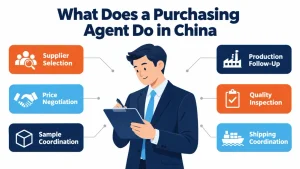
A China sourcing and procurement service can help when you enter a new category, compare suppliers, develop a custom product, consolidate orders, or need coordination in China. A supplier list is only part of the service. The agent can organize requirements, standardize quotes, keep sample and approval records, and assign responsibility at each stage.
The Alibaba buyer guide explains the platform’s supplier search, communication, payments, and Trade Assurance orders. An agent can handle work across suppliers and outside the platform. The two solve different problems and can be used together.
Frequently asked questions
Why is China such a popular product sourcing market?
China combines a large manufacturing base, specialized clusters, component suppliers, product development, and an established export network. That gives you more options, but every supplier and product still needs a separate assessment.
Which products are best suited to sourcing from China?
A product may fit when China has a mature supplier base for its category, its value supports international shipping, its specifications can be documented, and the quantity suits the process. Products with several components, custom requirements, or steady repeat demand often gain more from China’s supplier density.
Is it safe to source from China?
You can manage the risks, but not remove them. Verify the supplier, define the product, set payment and approval stages, inspect against written standards, and confirm destination-market requirements.
Can small businesses source from China?
Yes, if your order meets the supplier’s MOQ and you can cover sampling, shipping, import costs, and the cash cycle. For tiny quantities or urgent replenishment, a local wholesaler may be more practical.
Should you use Alibaba or a sourcing agent?
Alibaba helps you find suppliers and transact on the platform. An agent is more useful for local comparisons, product development follow-up, order coordination, or consolidation. Choose according to your experience, product risk, order complexity, and internal resources, or combine the two.
Is China the right sourcing market for you?
China may suit you if you need wider supplier choice, specialized processes, custom development, scalable capacity, or multi-supplier coordination. It may be a poor fit when freight is high, delivery is urgent, local support is essential, or the inventory cycle would strain your cash flow.
Compare markets using four details: product specifications, order quantity, destination, and target landed cost. If you want help assessing the fit, send your requirements and current challenges to Hinsourcing before supplier selection.