How Long Does Sea Freight Take from China to the USA?
Table of Contents
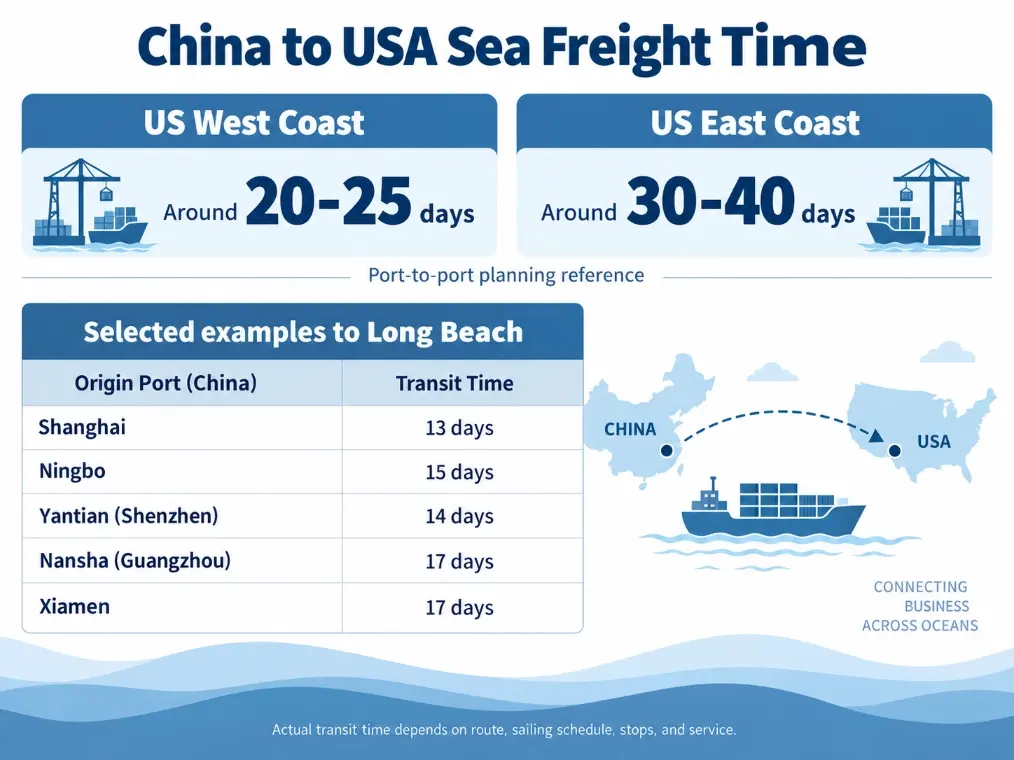
For bulk orders with flexible deadlines, sea freight is usually cheaper than air. Based on our China sourcing experience, allow roughly 20–25 days port-to-port to the US West Coast or 30–40 days to the East Coast. Timing depends on the ports and the carrier’s service.
Hinsourcing has worked with more than 500 US clients. When planning your order, add time for production, shipment preparation, customs clearance and warehouse delivery. Start with these ranges, then work out your expected delivery date using the sailing you book.
How Long Does Sea Freight Take from China to the USA by Route?
For the ocean leg, count from the day the ship leaves China to the day it reaches the US port. Production, getting the goods ready to ship and delivery after arrival need their own time in your plan.
Destination
Port-to-port planning reference
US West Coast ports
Around 20 to 25 days
US East Coast ports
Around 30 to 40 days
We use these ranges for initial planning. Your port pair, the ship’s stops along the way and the service you choose determine the sailing time. As the examples below show, some services are considerably quicker.
China to the US West Coast
Some expedited sailings are considerably shorter. Matson’s September–October 2026 vessel schedule lists MATSON WAIKIKI 028E (CLX) departing Ningbo September 28 and Shanghai September 30, with Long Beach arrival October 11. The local calendar dates give approximately 13 and 11 days, respectively.
That gives you a useful example of a fast crossing. The schedule was checked September 28, 2026; check the latest departure before booking. Once the ship reaches Long Beach, your goods still need to be available for collection and delivered to the warehouse.
When a forwarder offers “fast sea freight,” ask which service they’re quoting and when it leaves. For warehouse delivery, we also recommend checking the expected pickup date at the port and whether the price includes the final truck journey.
China to the US East Coast and Inland Destinations
For an East Coast delivery, compare an ocean route to an eastern port with a West Coast discharge followed by inland transportation. A shorter sea crossing may still involve a substantial rail or truck journey.
Use our 30-to-40-day reference for the sea journey to an East Coast port. If you’re considering a West Coast arrival followed by inland transport, compare both options all the way to your warehouse, including connections and handling.
Sea Freight Times from Major Chinese Cities to the USA
Here’s how five departure ports compare on selected services to Long Beach, California. These are sailing times for the named services, so they can be shorter than our opening planning ranges. Add the time needed before loading and after arrival to work out warehouse delivery.
The examples use COSCO SHIPPING’s April 2026 OCEAN Alliance DAY10 service guide, checked September 28, 2026. Use them to compare options, then ask your forwarder for the current departure and arrival dates when you’re ready to book.
Shipping from Shanghai to the USA
For a Shanghai departure, you can compare the CEN service below with the Matson option discussed earlier. Look at both the voyage length and the next available sailing.
Departure port: Shanghai, with Long Beach, California, as the destination in this example.
Sea freight time: A scheduled 13-day crossing on the CEN (PSW2) service, port to port.
Planning tip: Compare arrival dates; an earlier departure can beat a shorter voyage that leaves later.
Shipping from Ningbo to the USA
If you’re choosing between Ningbo and Shanghai, compare the journey from your supplier to your warehouse. The sea crossing is only one part of that decision.
Departure port: Ningbo, with Long Beach, California, as the destination in this example.
Sea freight time: A scheduled 15-day crossing on the AAC4 (PSW9) service, port to port.
Planning tip: Include the time needed to collect your goods and move them to port.
Shipping from Shenzhen (Yantian) to the USA
For Shenzhen shipments, this example uses Yantian as the loading port. Give your supplier and forwarder the same port details so they can arrange the handover.
Departure port: Yantian in Shenzhen, serving Long Beach in the example shown here.
Sea freight time: A scheduled 14-day crossing on the SEA3 (PSW11) service, port to port.
Planning tip: Specify Yantian when arranging terminal delivery, rather than using only the city name.
Shipping from Guangzhou (Nansha) to the USA
For a Guangzhou departure through Nansha, work backward from the terminal’s cargo deadline to arrange pickup. Include local transport when comparing it with another departure port.
Departure port: Nansha in Guangzhou, serving Long Beach in the example shown here.
Sea freight time: A scheduled 17-day crossing on the SEA (PSW6) service, port to port.
Planning tip: Allow enough time between supplier pickup and the terminal’s deadline for accepting cargo.
Shipping from Xiamen to the USA
For Xiamen, check which service your forwarder has priced. If the proposed route includes a connection, ask for the full journey time, including the wait between sailings.
Departure port: Xiamen, with Long Beach, California, as the destination in this example.
Sea freight time: A scheduled 17-day crossing on the AAC (PSW10) service, port to port.
Planning tip: For other routings, include any connection time rather than counting only the final crossing.
What Does Door-to-Door Sea Freight Time Actually Include?
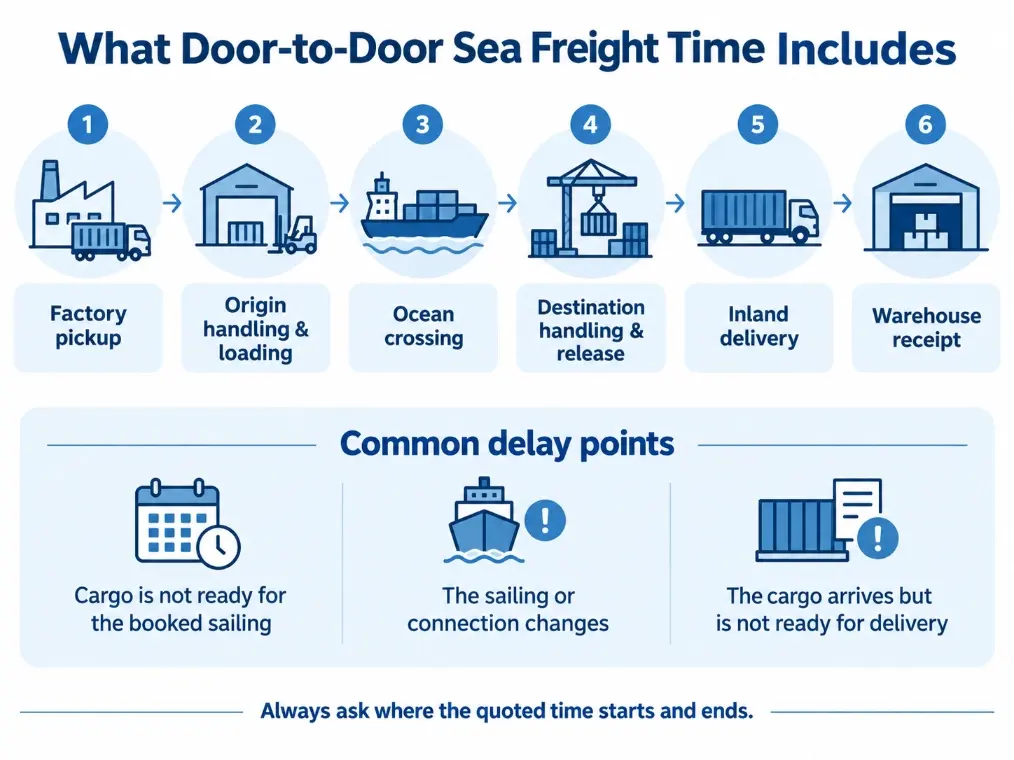
For inventory planning, you need to know when the goods will reach your warehouse. Ask your forwarder where the quoted time starts: factory pickup, arrival at the consolidation warehouse or another agreed handover. Give them the exact pickup and delivery addresses.
The sequence shows the stages your goods generally pass through. Some work overlaps: documents can be prepared during packing, and delivery planning can begin before arrival. Build your warehouse estimate around the specific route rather than combining timing references from different services.
Manufacturing normally sits outside the shipping estimate. If you’re still approving samples or buying wholesale from China, establish the production and packing dates separately. Don’t start a transport countdown from the day you pay the supplier unless your agreement explicitly uses that starting point.
Sea Freight vs. Air Freight from China to the USA: Which Should You Choose?
For planned bulk orders, we’d usually start by pricing sea freight. When stock is running low or a launch is approaching, air freight deserves a closer look. The decision comes down to how much an earlier delivery is worth to your business.
For sea freight, use the port-to-port examples above, then add the work before departure and after arrival. To choose between the two, ask for expected delivery dates to the same warehouse. Comparing a flight duration with a complete sea shipment tells you very little.
Cost and Cargo: When Does Each Option Make Sense?
Sea freight generally makes more sense for larger orders that can wait. Air freight costs more but can suit urgent replenishment or higher-value goods. DHL’s air-versus-ocean guide makes the same distinction: the value of faster delivery needs to justify the extra freight cost.
Compare the full shipping bill for the same cargo, including pickup, handling and final delivery. For bulky, low-margin products, look closely at the freight cost per unit. For urgent stock, compare the extra air freight charge with the profit you expect to lose while waiting.
Replenishment: Send the Urgent Portion by Air
You don’t have to send the whole order the same way. Suppose you’ve ordered 1,000 units and need 200 to cover a short stock gap. You could price air freight for those 200 units and send the remaining 800 by sea.
We’d first check whether that smaller shipment would arrive in time and cover the gap. Then compare the combined shipping costs, including separate handling and delivery. If it works, you get some stock sooner without paying air freight rates for the entire order.
Is FCL Faster Than LCL from China to the USA?
FCL means full container load: you book the container for your shipment, even if you don’t fill every space. With LCL, or less than container load, your goods share container space with other shipments.
LCL involves combining shipments at origin and separating them at destination. Those handling stages can extend delivery time. When comparing FCL vs. LCL shipping time, ask about departure frequency and destination availability, not just the vessel’s sailing duration.
FCL doesn’t remove every source of waiting. Suppose you’re buying from three suppliers and putting all their goods into your own container. That shipment can still wait for the last supplier, even though you aren’t sharing space with another importer.
Compare the actual options offered for your cargo. An earlier departure and well-organized destination handling may matter more than the container label. Don’t pay for FCL solely because someone says it is always faster; ask what changes in your specific delivery plan.
Why Do China-to-USA Sea Freight Shipments Get Delayed?
When a date changes, first identify the affected stage. A late factory handover needs a different response from a missed connection or a destination release issue. “Shipping delay” is too broad to tell you what to do next.
Cargo Is Not Ready for the Booked Sailing
“Production finished” can leave several tasks outstanding: inspection, corrections, packing, labels, or accurate carton measurements. A booking based only on the factory’s completion estimate may leave too little time for those tasks.
Before agreeing to a collection date, check where the order stands against these milestones:
Manufacturing is complete, with the ordered quantities available for the agreed product checks.
Inspection findings are resolved, and packaging and labels meet your approved requirements.
Cargo and shipping information are ready for handover before the relevant booking deadlines.
Production follow-up and quality control can help identify unfinished work before the collection date. If something fails inspection, agree on the correction and revised readiness date before deciding whether to change the shipment.
The Sailing or Connection Changes
Weather, congestion, schedule adjustments, or cargo not loading as planned can change the arrival estimate. A booking confirmation is useful, but it isn’t evidence that the goods have departed on that vessel.
If the itinerary changes, find out which vessel now carries your goods and whether you still have the same connection. Request a revised arrival estimate and the next update. Adding the departure delay to the old arrival date may give the wrong answer.
The Cargo Arrives but Is Not Ready for Delivery
After arrival, your shipment may still need unloading, release, or LCL separation before collection. A customs release alone doesn’t establish that every carrier or terminal requirement has been met.
Ask the forwarder what specifically prevents pickup and who must act. If documents or an examination are involved, your customs broker should clarify the status. If the goods are available, check the transport booking and warehouse receiving appointment instead.
How Do Chinese Holidays Affect Sea Freight from China to the USA?
Around Chinese New Year and Golden Week, check working arrangements with each supplier and logistics provider. Maersk’s September 2026 market update notes the effect of Golden Week staffing reductions and factory closures on production and logistics. A public holiday calendar doesn’t tell you your supplier’s actual schedule.
To plan around Chinese New Year shipping delays, confirm when finished, checked and packed goods can leave the factory. Then check the receiving warehouse’s last acceptance date and the intended sailing. These dates may differ, so an early production finish alone doesn’t settle the shipment plan.
Who will handle a packing correction or missing document during the break? Agree on a contact before people leave. Check the current holiday notice for your specific route too; sailing changes announced for another trade lane don’t tell you whether your booking is affected.
How Can You Plan Sea Freight Around Your Required Delivery Date?
Start with the date your warehouse needs to receive the goods. If stock must also be checked, assembled or listed for sale, allow for that separately. Your launch date and your required delivery date may not be the same.
Compare Quotes Using the Same Start and Finish Points
Imagine two providers both quote 25 days. One means the ship’s journey to port; the other means pickup through to warehouse delivery. Before comparing prices, put those quotes side by side and check where each one starts and ends.
Before comparing China-to-USA sea freight transit time, send both providers the same information:
Product description, pickup address, final warehouse address, and any special cargo handling requirements.
Required delivery date and the collection, clearance, and inland services you want included.
Have each provider write down whether it counts calendar or working days, includes consolidation waiting time, and ends at the port, a freight station or your warehouse. With those details beside the price, you can see what you’re buying and which assumptions need checking.
Work Backward from Warehouse Receipt
Consider a hypothetical order of independently sold notebooks, tote bags and keychains from three suppliers. You want one delivery to a US warehouse. Before picking a sailing, build the following plan with the parties handling each stage.
Planning checkpoint
What you need confirmed
Who should confirm it
If the plan changes
Warehouse receipt
Address, receiving hours and appointment requirements
Buyer and receiving warehouse
Recheck the delivery slot and inventory impact
Destination movement
Expected release, cargo availability and inland transport
Forwarder, broker and delivery provider
Identify the hold or transport constraint
Ocean leg
Intended vessel, route and estimated arrival
Carrier or forwarder
Obtain a revised itinerary and delivery estimate
Origin handover
Cargo acceptance and document deadlines
Forwarder and receiving facility
Check the next feasible departure
Supplier readiness
Approved goods, packing, quantities and unresolved issues
Each supplier and the agreed inspection team
Correct, wait or request buyer approval to split
Fill this example with dates for your own shipment. Beside each date, note what’s still outstanding and who will update you. That gives you a working plan you can follow when a supplier or sailing schedule changes.
How much room should you leave? A seasonal launch with no replacement stock deserves more protection than routine replenishment with healthy inventory. Discuss the least predictable stage with your logistics provider, then choose a buffer that reflects both the route and the consequences of arriving late.
Decide Whether to Wait, Split, or Expedite
In the hypothetical order above, suppose the notebooks and keychains are approved and packed, but the tote bags need correction. Waiting keeps the shipment together. It also postpones receipt of the products that are already ready.
You have several options to price and assess:
Wait for all approved goods when keeping the shipment together outweighs the inventory delay.
Ship the ready products separately when they can be sold independently and extra costs are acceptable.
Request an expedited option for a limited urgent quantity, subject to product eligibility and a revised quote.
If you’re selling those items as a gift set, receiving only the notebooks and keychains may not help. Check that before splitting the order. Then agree on revised packing records, charges and responsibilities. Necessary product checks still apply, even when a departure is approaching.
How Can You Track Sea Freight from China to the USA?
Ask your forwarder which tracking number and portal apply to your shipment. Depending on the system, you may use a booking, bill of lading or container number. LCL buyers should confirm the appropriate reference because their shipment shares a container.
Separate estimated events from completed ones. An updated ETA predicts arrival; a recorded departure confirms a different milestone. Maersk also provides a separate way to check freight and customs release status. A vessel’s position alone won’t tell you whether your goods are ready for delivery.
When an ETA changes, request the revised warehouse delivery estimate, the reason for the change, and when the next update is expected. Keep your receiving team informed so they can adjust appointments without treating every provisional port date as a confirmed delivery booking.
How Hinsourcing Helps You Prepare for Shipment
At Hinsourcing, we help you connect purchasing decisions with shipment preparation. Within the agreed scope, our team follows supplier progress, coordinates inspections and corrections, and checks packaging and cargo information. You remain responsible for approving the important commercial decisions.
For orders involving several suppliers, our shipping and customs coordination support can bring completion dates, collection arrangements and logistics updates together. We help clarify outstanding work and coordinate with the relevant providers. Carrier schedules and customs decisions remain outside our control.
If you’re planning a US shipment, share your sourcing and delivery requirements, including product details, quantities, supplier locations, readiness dates and the final address. We can review the support you need before you commit to an order or shipment plan that doesn’t fit your deadline.
FAQs About Sea Freight from China to the USA
Can Sea Freight from China Reach the USA in Two Weeks?
Yes, some expedited port-to-port services can. The Matson schedule example above shows 11 days from Shanghai to Long Beach. That excludes factory preparation and final delivery. Confirm the current sailing and the exact endpoint before relying on a two-week claim.
Does Sea Freight Transit Time Include Manufacturing?
Usually not. Manufacturing, sample approval and packing belong in your purchasing schedule unless the agreement explicitly includes them. Check whether the transport estimate starts at pickup, warehouse receipt or vessel departure before calculating your overall order lead time.
How Long Does US Customs Clearance Take for Sea Freight?
There is no fixed clearance time for every shipment. Documentation, product requirements and examinations can affect release. Ask your customs broker about your shipment’s status, and confirm cargo availability separately with the forwarder before arranging collection.
What Information Do I Need for a Reliable Shipping Estimate?
Provide the product description, pickup and delivery addresses, cargo-ready date, carton count, dimensions and weight. State your required receiving date and service scope. The provider should identify the route and what the estimate includes, then reconfirm arrangements when you book.
The Author
Hin Gao
China Sourcing Expert with 10+ Years of Experience
Hey, I’m Hin, founder of Hinsourcing. With hands-on China sourcing experience, I help overseas buyers compare suppliers, follow production, check quality and coordinate shipping. Planning a sourcing project? Share your requirements and let’s discuss the next step.
Explore practical guides from Hinsourcing on sourcing products from China. We cover supplier selection, product development, sampling, production follow-up, quality control, shipping and the decisions buyers face throughout the sourcing process.