A supplier sends you its business license, factory photos, and an attractive quotation, and it may seem like you’re ready to order. Before you pay, though, ask two questions: Do all these materials come from the same company? How is the factory in the photos connected to the actual production plan for your goods?
You don’t need to be an investigator to work through these questions step by step. In this guide, I’ll draw on my past sourcing experience to explain how to verify Chinese suppliers, what different types of evidence can prove, and when it makes sense to arrange local help in China.
What to confirm when verifying a Chinese supplier
I break verification into three parts: company registration records confirm who is quoting and accepting the order, a factory assessment looks at operations and production capabilities, and product inspection checks the actual goods. Each part serves a different purpose, so one result cannot replace the others.
A real company can still be the wrong supplier for your order. For example, it may make this type of product but outsource the surface finishing you care about most. It may also be unable to schedule enough production time right now to meet your delivery deadline.
By the end of the verification, I want you to be able to explain which claims have been confirmed, what is still unclear, and why you’re willing to take the next step. Answers grounded in evidence will help you make a better decision than simply saying, “This supplier looks professional.”
This guide starts after you’ve found a candidate supplier. If you’re still building your shortlist, read how to find manufacturers and suppliers in China first. Finding a supplier and verifying one are different jobs. I don’t assume a polished product page means the supplier has already passed an assessment.
What to request before verifying a supplier
Before I start checking, I collect the information needed to identify the company accurately. An English store name is often not enough because it may be a brand rather than the registered company name. These are the basics I ask for:
- Business identity: The full registered Chinese company name and Unified Social Credit Code.
- Business license: A complete, clear license that can be checked against official records.
- Office and production addresses: The sales office address and the production site planned for your order.
- Company name used for the transaction: The company name that will appear on the quotation, order documents, and payment instructions.
- Product documents: Certificates, complete test reports, and sample information for the product in question.
I also ask for a clear summary of your product requirements, including the material, intended use, target market, quantity, customization, and expected lead time. Without that context, even confirming that the company exists tells us little about whether it can handle your order.
Verification needs evidence relevant to the order, not all of the supplier’s business records. Customer names and unrelated commercial details can be redacted. If a record is difficult to share, we can discuss another document or verification method that answers the key question without exposing confidential information.
Websites for verifying a Chinese supplier
I decide what needs checking before choosing where to search. Company databases can help confirm identity and business background. Confirm the authenticity of a certificate or report through the issuing body’s official channel. Separate evidence is still needed to establish who will make this batch and where it will be made.
- Company registration: Search the National Enterprise Credit Information Publicity System using the company’s Chinese name or Unified Social Credit Code.
- Company background: Use Qichacha or Tianyancha for background research, then trace important findings back to their original sources.
- Certificates and reports: Use the issuing body’s own verification channel. Don’t rely only on screenshots from the supplier.
In my search notes, I keep the company’s original Chinese name and record the source and date. Even if you use a translation tool to view a page, don’t leave out the Chinese name. If two websites show different information, compare their update dates before deciding that the discrepancy points to false information.
If a search temporarily returns no result, don’t rush to conclude that the company is fake. Websites differ in their access rules and paid features, and you should use the appropriate registry for the jurisdiction where the company is registered. For example, a company registered in Hong Kong should be checked through the appropriate Hong Kong registry.
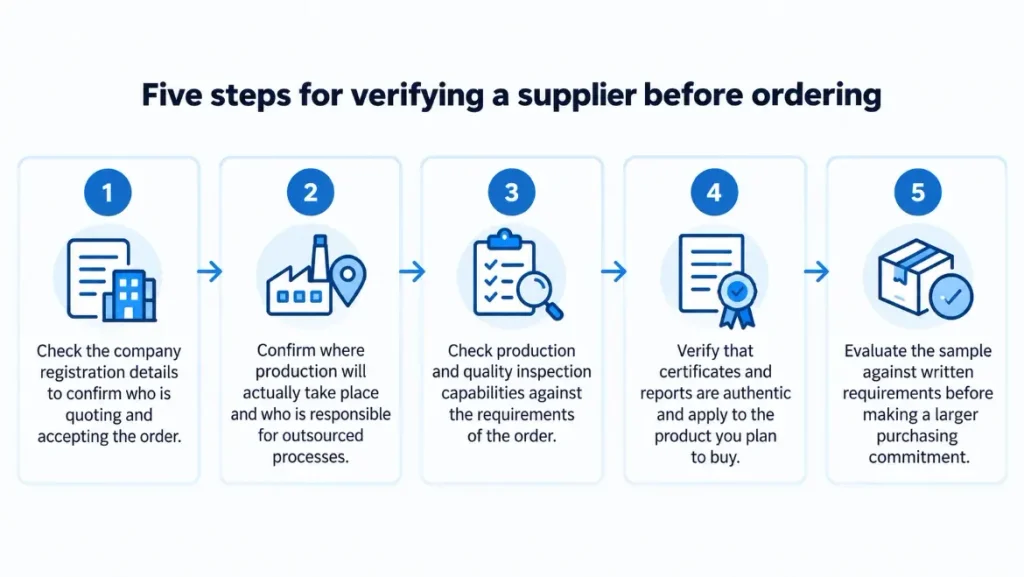
Five steps for verifying a supplier before ordering
- Check the company registration details to confirm who is quoting and accepting the order.
- Confirm where production will actually take place and who is responsible for outsourced processes.
- Check production and quality inspection capabilities against the requirements of the order.
- Verify that certificates and reports are authentic and apply to the product you plan to buy.
- Evaluate the sample against written requirements before making a larger purchasing commitment.
Step 1 Confirm the company quoting and accepting the order
Search public records using the company’s registered Chinese name or Unified Social Credit Code. Compare the company information, registration status, and operating details in the public record against the license, item by item. I save the result and search date so I can refer back to them rather than rely on memory.
Next, put the search record, quotation, and proposed order documents side by side and check whether they name the same seller. If another company will invoice you or receive payment, ask how the two companies are related. If the names don’t match and there is no reasonable explanation, I recommend verifying the relationship before paying. A better price isn’t a reason to skip this step.
You can also review the company’s establishment date and any public records of business irregularities or penalties. If you find such a record, check what happened, when it happened, and its current status. Registered capital does not show how much cash the company has available for your order. The absence of a public irregularity record does not guarantee smooth delivery.
An export agent or an arrangement involving a related company may explain a name mismatch, but you should ask for supporting documents and, where possible, verify the relationship through an independent channel. For payment detail changes and account security, read how to avoid scams when sourcing from China. I check these issues separately instead of treating a company registration search as the end of the verification process.
Step 2 Confirm where the goods will actually be made
When discussing the production location, I ask the supplier to explain where this batch will be made, who operates each site, and what work happens there. It is not unusual for the office, showroom, and factory to have different addresses. What matters is whether each site’s role in the order is clear.
Suppose we are buying a batch of custom keychains. Metal forming, surface finishing, and assembly may take place at different sites. After seeing the assembly workshop, I would keep asking: Where is the surface finishing done? Who coordinates it? Who handles any defects? Seeing one part of production does not mean you understand the production arrangement for the whole order.
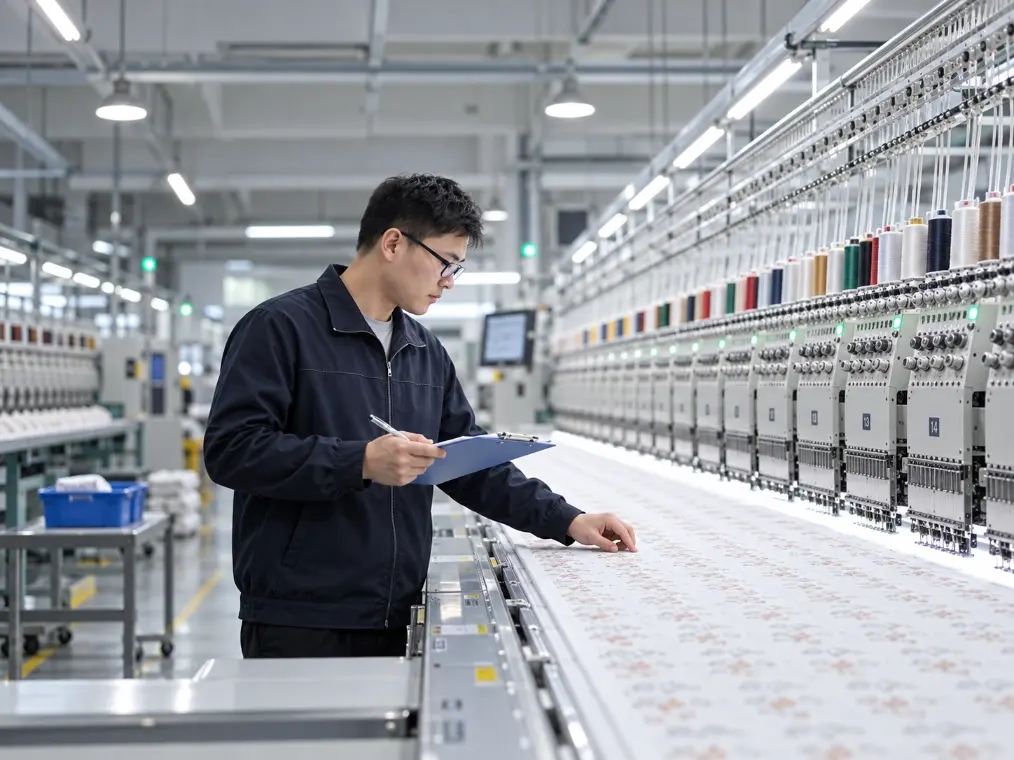
During a live video walkthrough, you can start at the site entrance, then ask to see the work areas related to your product and continue asking questions as the camera moves. Video helps you understand what is happening on site, but it cannot prove on its own who owns or actually manages the site or each process.
I care about the production site actually assigned to this batch, not the most impressive factory shown in the promotional material. If outsourcing is involved, clarify which processes are outsourced and whether the supplier can change the production arrangement without your approval.
Step 3 Check production and inspection capabilities against the order requirements
A simple “we can make this product” is not enough for me. I want the supplier to explain the details that are hardest to get right. In our keychain example, that might include the strength of the attachment, surface finish, color consistency, and packaging. Evidence related to those requirements is more useful than another general factory introduction.
I also look at how the supplier carries out its quality checks. I ask for a demonstration tied to the product, then follow up: What counts as a defect? Where do rejected pieces go? If your team cannot judge whether the process or proposed test method is suitable, bring in a professional with the right expertise.
When assessing lead time, separate “how much the factory can produce each month” from “when this order can be scheduled.” I would ask which process could slow the order down and whether the schedule accounts for it, especially if an outside factory handles that process.
With permission, you can also speak with customers who have bought similar products. Don’t just ask whether everything went smoothly. Ask how the supplier handled problems. Keep the order context in mind: success with a stock product does not fully show that the supplier can handle a custom order with more demanding technical requirements.
Step 4 Verify certificates and reports and confirm they apply
When I review documents, I first ask for the complete version, especially the pages identifying the product and test scope. Documents bearing SGS’s name can be submitted through its official document verification channel. For other documents, use the official channel of the relevant issuing body rather than relying only on contact details shown in the PDF.
After confirming that a document is authentic, compare it with the order. Do the company or applicant, relevant site, product model, material, and tests performed match? If the model in the report differs from the product you plan to buy, you need an explanation. Ask the issuer or an appropriate specialist to assess any difference you cannot resolve.
Authenticity and applicability are separate checks. ISO distinguishes management system certification from product certification, and an ISO 9001 certificate does not certify the product itself. If a supplier answers a product-specific question with a management system certificate, I keep checking rather than treating the matter as settled. See ISO’s explanation for more detail.
I also don’t assume that every test report has the same validity period. Changes in materials, design, standards, or target-market requirements may affect whether a report still applies. Ask an appropriate specialist to confirm the requirements for the market in question. A complete folder of documents does not settle the issue on its own.
Step 5 Evaluate the sample against written requirements
When I receive a sample, I first clarify what it represents. Is it an existing stock item, a development sample that is still being revised, or a version made using the process planned for bulk production? I also record any remaining differences between the sample and the final product you intend to buy.
Continuing with the hypothetical keychain order, you may have approved the shape but not the surface finish or the backing card used in the packaging. In that case, I would record, “Shape approved; surface finish and backing card still pending,” rather than the vague “sample approved.” The wording changes what the factory understands to be approved.
Sample approval should clearly state what bulk production must match. Record the material, dimensions, surface finish, packaging, and sample version, and keep photographs. Where practical, both sides should retain a sample. Functional or safety questions may also require professional testing; appearance and feel alone may not be enough.
Before you decide on a small trial order, we agree on what it needs to prove. A trial order can show how the supplier performs, but it costs money and may not suit a product that requires a large tooling investment. A successful small-batch delivery also does not show that a larger order can be completed on the same schedule.
Verifying a Chinese supplier without visiting the factory
Yes. My advice is to list the questions you need answered, then choose the right method for each one. Start with documents when they can provide the answer. If a production arrangement cannot be confirmed remotely, consider asking someone locally in China to help. You do not have to travel to China yourself to complete every check.
- Desk research: Check the company’s identity and public records, and identify inconsistencies that need an explanation.
- Live video: View the current site and continue asking questions about specific production activities.
- On-site assessment: Examine the relevant facilities, processes, and records more closely within the agreed scope.
An on-site check is worth considering when an unresolved production question could materially affect the order. Photographs of finished keychains, for example, cannot show how an outsourced coating process is managed. Before anyone visits, define what they need to establish instead of arranging a general factory tour.
You can also continue working directly with the supplier and commission only the verification work you need. Our comparison of using a purchasing agent versus buying direct explains this arrangement. Whoever carries out the checks should have expertise that matches your product.
Why an Alibaba Verified Supplier badge cannot replace supplier verification
I treat the badge as a starting point for reviewing the evidence, not as a reason to place an order. Alibaba’s explanation of Verified Supplier describes independent third-party assessments and also states clearly that Alibaba does not guarantee the authenticity of sellers’ products or certificates.
When reading the report, first check which company and site were assessed, when the assessment took place, and what it covered. Compare those details with the business you are speaking to and the proposed production site. Relevant findings can save you from repeating checks, but you will still need evidence for anything the assessment did not cover.
Suppose the assessment report covers an assembly operation, while your order requires a new surface finish. I would keep asking for evidence about that process. The report may help you understand the assembly capability without answering the questions raised by the new process. You do not need to dismiss the report completely, but you should not assume it covers every requirement.
Common export certifications and compliance documents for Chinese suppliers
When verifying a supplier, I start with the product type, intended use, and market where it will be sold. Those details determine which documents to check. The number of certificates alone tells me little. The list below is for reference, and not every Chinese supplier needs all of them.
– ISO 9001 Quality Management System Certification: Used to assess a company’s quality management system across a range of industries. It is a voluntary management system certification and cannot replace product-specific test reports or market-access documents.
– CE Marking and the EU Declaration of Conformity: Relevant to toys, electrical and electronic equipment, machinery, and other products covered by applicable EU legislation. Check the declaration of conformity and related technical documentation. A so-called “CE certificate” alone does not establish that the product can be sold.
– RoHS Compliance Documentation: Mainly relevant to electrical and electronic products sold in the EU that are subject to the applicable rules, with a focus on restrictions on hazardous substances such as lead and mercury. Check the product materials, the supplier’s declaration, and any necessary test documentation together.
– REACH Compliance Documentation: Relates to the EU’s regulation of chemical substances and may also affect products such as clothing, furniture, and plastic goods. Confirm the applicable requirements based on the product’s materials and intended use. Do not assume that one test report covers every REACH obligation.
– FCC Equipment Authorization Documentation: Relevant to certain electronic devices and wireless products sold in the United States, with a main focus on radio-frequency compliance. Depending on the device category, the applicable procedure may be certification or the Supplier’s Declaration of Conformity (SDoC). The Federal Communications Commission does not use one standard “FCC certificate” for every device.
– Children’s Product Certificate (CPC): Applies to products sold in the United States that are subject to relevant children’s product safety rules. For imported products, the U.S. importer generally issues the certificate based on test results from a CPSC-accepted laboratory. The CPSC does not issue it directly, and any applicable testing exemptions must also be considered.
– FDA Registration, Listing, or Market Access Documentation: For food, cosmetics, medical devices, and other products sold in the United States, check the requirements that apply to each product category. The regulatory approach differs by product. A company registration or product listing does not mean the product has received FDA approval.
– UL/ETL Product Safety Certification: These certifications are common for electrical appliances, lighting, and related equipment intended for the North American market. They are used to show that a product meets the relevant safety standards. Confirm whether certification is needed and which standards apply based on the specific product, its intended use, and the buyer’s requirements. Also check that the certification covers the model you plan to buy.
– OEKO-TEX® STANDARD 100 Certification: Used to test textiles and related accessories for harmful substances, including fabrics, garments, buttons, and zippers. Check whether the product you plan to buy falls within the certificate’s scope, rather than simply confirming that the factory displays the certification mark.
– GOTS Certification (Global Organic Textile Standard): Applies to organic fiber textiles that meet its requirements. It covers environmental, chemical, and social responsibility requirements during processing. When buying a GOTS product, check the certification scope and relevant transaction certificates. A claim that the product uses organic cotton is not enough on its own.
– FSC Chain of Custody Certification: Applies to supply chains involving wood, paper, and other forest-based materials. When buying a product with an FSC claim, check the supplier’s certification scope and relevant transaction records to confirm that the claim applies to the goods you are purchasing.
– amfori BSCI/SMETA Social Responsibility Audit Reports: Used to understand a factory’s performance in areas such as working conditions, working hours, wages, and health and safety. These are audit systems, not product certifications, and they do not replace product safety testing.
My advice is to separate the regulatory requirements of the target market from any additional purchasing requirements set by your customer, then check each document one by one. Once you receive the paperwork, confirm the company name, product model, scope, and whether changes in materials or standards affect its applicability. An authentic document is not necessarily applicable to this order. A testing or compliance professional familiar with the target market should confirm the requirements for the specific product.
Red flags that need immediate verification
Red flags that need immediate verification
Some inconsistencies can be discussed and clarified. Others directly affect whether you should pay or approve production. If you see any of the following, pause the relevant payment or production approval until the issue is clarified:
Last-minute changes to bank details. The bank details suddenly change just before payment, and the supplier pressures you to transfer the money immediately.
An unexplained payment recipient. The beneficiary is an unrelated business or individual, and the supplier cannot provide documents explaining the arrangement.
Unverifiable or incomplete reports. The issuer cannot confirm a report, or the supplier refuses to provide the pages that identify the tested product.
Changing information about the factory. The supplier’s explanation of the production arrangements keeps changing, and it refuses reasonable ways to verify the proposed production site.
Pressure to skip agreed checks. The supplier offers a lower price or better delivery schedule only if you skip the agreed sample approval or independent checks before payment.
A warning sign calls for verification, not an automatic accusation of fraud. Ask for evidence that addresses the specific mismatch. If payment instructions change, call the company using a number you verified earlier or contact details you found independently, as the FBI’s payment-fraud guidance recommends.
If you have already transferred the money and suspect fraud, contact your bank immediately. Ask whether it can recall the transfer or take any other action, and keep the invoices, messages, and payment records. Recovery is not guaranteed, so do not send another payment just to receive a promised refund.
Turning verification findings into a buying decision
When I organize the findings, I separate “confirmed facts,” “the supplier’s explanation,” and “evidence still needed.” I also record who performed each check and when. This keeps you and your team from treating a reassuring conversation as a confirmed fact.
Illustrative example: Supplier A is a fictional candidate for a custom keychain order. I use it below to show how verification findings lead to different next steps. This is not a real supplier investigation or the result of a Hinsourcing client project.
| Check | Evidence obtained | Still unresolved | Next action |
| Company identity | The Chinese registered name and Unified Social Credit Code match the public record | Whether the salesperson is authorized to represent the company | Confirm the salesperson’s identity using company contact details verified independently |
| Production location | Live video shows assembly at the site | Surface finishing is outsourced, and the exact location has not been confirmed | Obtain details of the outsourcing arrangement and decide whether on-site verification is needed |
| Product report | The issuer confirms that the report is authentic | The model in the report differs from the proposed product | Ask the issuer or a specialist whether the report applies to this product version |
| Sample approval | The shape and dimensions meet the buyer’s requirements | The surface finish and backing-card design remain unapproved | Confirm the surface finish and backing-card design before bulk production, and record the final approved version |
| Delivery plan | The supplier has provided an assembly schedule | The surface-finishing subcontractor has not confirmed its available schedule | Confirm the timing for this process before accepting the delivery plan |
I do not decide whether to proceed by counting how many checks passed. Unconfirmed packaging details and an unexplained mismatch in company identity do not carry the same risk. Some findings may support moving into sampling, while other problems must be resolved before you invest further. The decision depends on what could happen if you are wrong.
Assign each open issue to someone and define the next step. If important evidence remains unavailable or the supplier’s explanation keeps changing, I would recommend pausing further investment or considering another supplier. Even a very good price cannot replace confirmation of who is taking the order and who is actually making the goods.
How Hinsourcing can help verify a supplier in China
At Hinsourcing, verification is meant to support a clearer sourcing decision, rather than simply produce another report. Depending on the agreed project scope, we can coordinate supplier screening, document checks, factory visits, and follow-up questions. You still make the key purchasing decisions, while we handle the agreed local work.
For a Nepalese client, we visited the relevant factories and shortlisted five suppliers for comparison. This left the client with a smaller group to evaluate, without having to find factories and arrange visits from scratch. This project reflects how I see local support: narrowing the field so the next comparison is more focused, rather than adding more names to the list.
Before we start, we agree on the scope of the verification and the findings you expect to receive. Local coordination can keep the work moving, but specialist testing or legal review may need to be arranged separately with people who have the right expertise. You can first read about what a sourcing agent does, then confirm each party’s responsibilities with us.
If you already have a candidate supplier, send me the company’s name, your product requirements, and the issue that concerns you most. Hinsourcing’s supplier verification and factory audit service can help define the next steps, starting with the questions that need answers before you place the order.
Frequently asked questions about verifying Chinese suppliers
Checking a Chinese supplier for free
You can check some public company information yourself, so you may not need to pay for a verification report. I suggest starting with the information you can access, while allowing time to find and understand it. Free research does not include a site visit, a technical process assessment, or product testing.
Trading companies and factories
I would not decide from the label “trading company” or “factory” alone. Check the registered entity, production arrangement, and responsibility for the order, then see whether the claims are supported by evidence. A trading company may suit you when its role is clear and the arrangement can be verified. Claiming to own a factory it does not control is a separate issue that needs checking.
How long supplier verification takes
Before discussing timing, I check whether the documents are complete, what needs to be verified, how a site visit can be arranged, and how quickly the relevant people or organizations respond. Set separate timelines for preliminary findings and full completion. Finding the business registration record does not mean the production and product checks are finished.
Rechecking a supplier before a repeat order
I focus on what has changed for the new order, such as the seller, payment arrangements, production location, materials, or a significant change in quantity. You do not need to repeat every check from scratch each time, but any change that affects the order needs to be verified again. A previous order that went smoothly does not validate a new arrangement.
Check the most important issue before you commit
When you are ready to proceed, I suggest placing the quotation beside the evidence you already have and identifying the unresolved question most likely to affect the order. Whether the next step is paying a tooling fee, approving a sample, or starting bulk production, decide how to resolve that question before making the corresponding commitment.
I want you to be able to say clearly what you checked, what you still do not know, and why you are willing to take the next step. With that record, the decision no longer rests only on the supplier’s verbal promises. You have evidence you can review and a clear list of what still needs follow-up. That is what supplier verification should give you.