The price on 1688 can look remarkably attractive. You find a product that resembles one sold elsewhere, contact the seller, and receive a quote that seems difficult to beat. The risk is not always that the seller disappears. Sometimes the goods arrive, but the material, color, finish, or quantity is not what you thought you had ordered.
A low price and clear listing photos cannot confirm a material’s actual color or texture. If those details matter to your product, check an appropriate physical sample against written requirements before placing a larger order.
Is 1688 Legit and Safe for International Buyers?
1688 is legitimate, but the safety of a purchase depends on the individual transaction. Alibaba Group identifies 1688 as its integrated domestic wholesale marketplace in China. That tells you who operates the platform; it does not verify the supplier behind every listing or promise that the goods will meet your specifications.
International buyers can purchase through suitable accounts and payment arrangements, or work with a purchasing agent. Whichever route you take, confirm who holds the order, who receives your payment, who inspects the goods, and who handles problems. A legitimate supplier can still make production mistakes or misunderstand an overseas buyer’s requirements.
If you are still deciding between platforms, read our Alibaba.com vs. 1688 comparison. Their purchasing workflows and protections are not interchangeable.
Why Are More Overseas Buyers Choosing 1688?
1688 was originally built for China’s domestic wholesale market, but its extensive supplier network and competitive prices also attract overseas wholesalers, online sellers, and small businesses. Compared with some international sourcing platforms, it can offer buyers more opportunities to connect with suppliers in China’s domestic supply chain.
There are four main reasons buyers explore 1688:
- Competitive wholesale prices: With many China-based suppliers selling on the platform, buyers may find quotes that fit their budgets and, in some cases, avoid additional intermediary markups.
- A wide product selection: Categories range from clothing and electronic accessories to home goods and packaging materials, making it easier to compare sources for different products.
- Flexible order quantities: Some suppliers accept small wholesale orders or allow buyers to mix product variations, which can be useful for online sellers and smaller retailers testing new products.
- Access to domestic manufacturers: Buyers can find suppliers offering OEM/ODM services and discuss customization, packaging, and larger production runs.
A lower listed price does not always mean a lower total purchasing cost. International payment, supplier communication, quality checks, and cross-border shipping still need to be managed. Understanding those responsibilities is just as important as finding an attractive quote.
Why Can Buying From 1688 Be Risky for Overseas Buyers?
1688 primarily serves China’s domestic market. For an international order, several jobs may fall outside the seller’s quoted price:
- Communication: Translated messages can miss details about composition, dimensions, tolerances, labeling, or packaging.
- Payment: Not every payment option is available to every buyer or order. You need a workable route before agreeing to purchase.
- Export requirements: A supplier may be able to deliver within China without handling the documents or product requirements for your destination.
- Receiving and forwarding: If delivery ends at a Chinese warehouse, someone else must count, inspect, consolidate, store, and forward the goods.
- After-sales handling: Resolving a problem is harder after an international shipment, especially when the goods need to be returned to China.
A warehouse status reading delivered does not tell you whether anyone opened the cartons. Before paying, assign responsibility for each step between the seller and your final destination.
What Should You Check Before Buying From 1688?
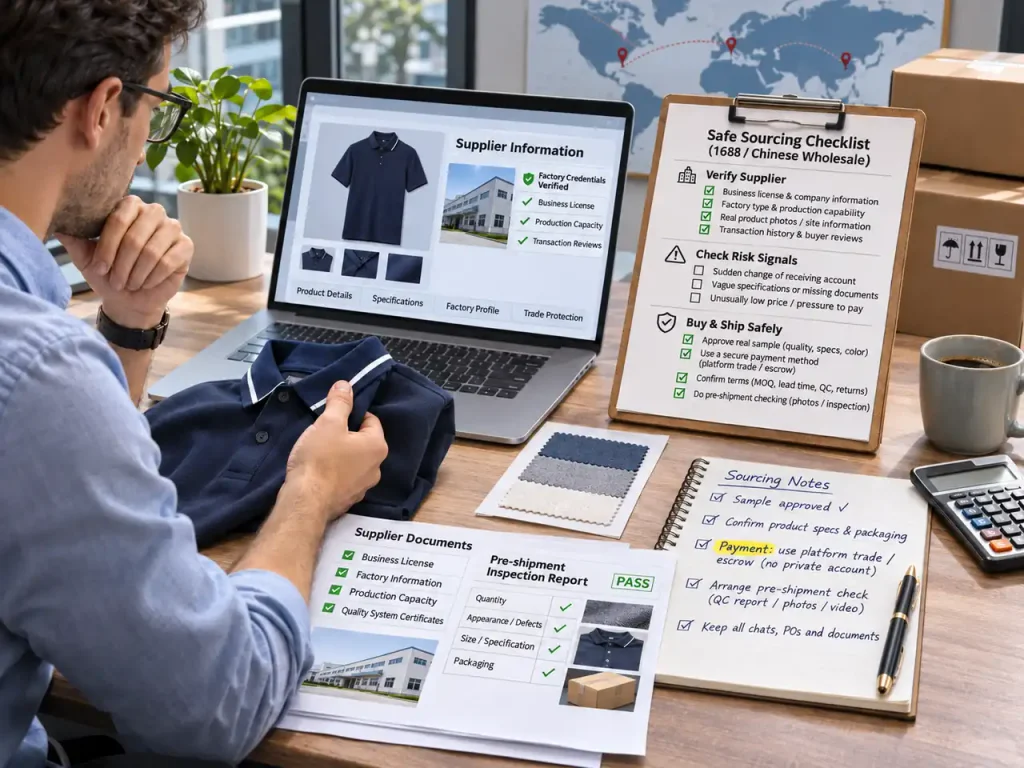
Use these eight checks to move from an attractive listing to a purchase you can evaluate with evidence. Keep quotations, approvals, photos, and changes under the same order reference so they can be checked later.

1. Verify the Company Behind the 1688 Store
Start with the supplier’s registered Chinese company name. Request its business license and, where available, its Unified Social Credit Code (USCC). A trading name on a storefront may differ from the legal company that operates it.
You can use China’s National Enterprise Credit Information Publicity System to look up the company name or code and compare available registration information. Access to some records may require registration or identity verification.
A practical verification sequence is:
- Identify the legal entity. Save the 1688 store URL, Chinese company name, business license, and order contact.
- Check the registration. Compare the legal name, company status, registered address, and relevant business information with the documents received.
- Match the commercial records. Check whether the seller on the quotation, the business behind the store, and the proposed payment recipient have a clear relationship. Investigate unexplained differences before transferring funds.
- Confirm the supplier’s actual role. Ask whether it manufactures, trades, or does both. If it claims to be a factory, find out which production steps happen on-site and which are outsourced.
This is a starting point, not a full factory assessment. A valid business license cannot prove a supplier has the equipment, production capacity, or quality controls needed for your particular order.
2. Look Beyond Badges, Store Age, and Reviews
Store badges, operating history, and reviews can help you shortlist sellers. They should not make the decision for you.
Check what a verification badge actually covers. If an assessment report is provided, look at the named company, site, assessment date, and scope. A report about the business is not an inspection of your future shipment.
Read reviews for the exact product variation you want, especially comments about incorrect specifications, inconsistent finishes, or delayed dispatch. A seller may have a long history and still be a poor fit for a specialized order.
A useful test is to ask a question that requires evidence. Can the supplier show a requested measurement, explain two material options, or identify the packaging included in the price? Specific, consistent answers tell you more than an impressive-looking profile alone.
3. Confirm Product Specifications, MOQ, and the Quoted Price
The cheapest quote is not necessarily for the same product. For example, one fabric seller may quote per meter while another quotes per kilogram. You cannot compare those prices fairly without knowing the composition, usable width, weight, and quantity involved.
Ask the seller to confirm these details in writing:
- Exact SKU or product version, material, dimensions, and color reference.
- Quantity, selling unit, and whether the MOQ applies per order, color, size, or variation.
- Whether mixed variants are allowed at the quoted price.
- Stock status: ready stock, made to order, or presale.
- Packaging, dispatch date, delivery address in China, and charges excluded from the quote.
For a fabric purchase, I would rather ask, “Please confirm the composition, usable width, weight, color reference, and quantity included in this quote” than “Is the quality good?” One question produces details you can verify; the other usually produces a sales answer.
Mark dimensions on images when language is a barrier. Then make sure the final specification and all agreed revisions appear in the actual order documents.
4. Approve a Physical Sample Before a Larger Order
If color, texture, fit, function, or finish matters to your business, request a physical sample before committing to bulk stock. Lighting can distort colors, and a photograph cannot tell you whether fabric feels coarse or a component fits correctly.
When evaluating a sample:
- Label it with the supplier, product reference, and sample version.
- Record the material, dimensions, color, finish, and other characteristics you approved.
- Identify any remaining changes and have the supplier confirm them in writing.
- Ask whether the sample represents current stock or the intended production specification.
Treat the approved sample as the reference for later inspection. It is not proof that every unit in a future batch will match. When product performance or composition matters, agree on suitable testing rather than relying only on appearance.
5. Check Payment Options and Buyer-Protection Terms
Before sending money, verify how the payment will be made, who will receive it, and what the order terms provide if something goes wrong.
For eligible buyers and transactions, WorldFirst’s official instructions for purchasing on 1688 explain how to connect a 1688 account and select the secured-transaction option followed by World Pay during checkout. Check availability for your account and order rather than assuming this method is universally supported.
Confirm the following before payment:
- The seller, product, quantity, and agreed specifications shown on the actual order.
- The identity of the payment recipient, especially if it differs from the contracting supplier.
- Applicable order protection, complaint procedures, and filing deadlines.
- Who can access order records and submit a dispute.
- Which receipts and transaction details an agent will provide if they buy on your behalf.
Do not assume Alibaba.com Trade Assurance covers a 1688 purchase. The marketplaces are separate. Also, paying an agent and the agent paying a seller are two different transactions; establish each party’s responsibilities in advance. Keep order changes in a written record rather than relying on chat promises alone.
6. Check Requirements for Your Destination Market
A product that can be sold domestically in China may still need different labeling, documentation, testing, or other checks for your target market. Tell the supplier where you intend to import and sell it before approving production.
Request product-specific information such as model identification, materials, labeling details, and relevant test reports. Check whether each report actually corresponds to the goods you are purchasing, including the named product, issuer, date, and tested specification.
A factory-level certificate does not automatically establish that the finished product meets every rule for your market. Requirements differ across children’s products, electrical goods, cosmetics, food-contact products, and other categories. Arrange appropriate specialist advice or testing when the product calls for it.
7. Arrange Receiving and Quality Checks Before Goods Leave China
Ask what the supplier or receiving warehouse means when they say, “We’ll check the goods.” Counting boxes is different from opening cartons, confirming SKUs, measuring products, or testing functions.
Specify the inspection scope before the shipment arrives:
- Quantity: Total cartons, units, sizes, and product variations to be counted.
- Identity: Product references and labels to compare with the order.
- Quality: Measurements, appearance, functionality, or other agreed acceptance criteria.
- Evidence: Photos and findings tied to the affected SKU, batch, or carton.
- Decision: Who can approve release, request corrective work, or hold the goods.
Decide whether inspection will be sampled or cover every item. Give the inspector the approved sample reference and written requirements. Do not treat a few warehouse photographs as a complete inspection report.
If you cannot inspect goods yourself, our production follow-up and quality-control service can help coordinate checks and document issues before shipment, within the agreed service scope.
8. Calculate Total Costs and Agree on Problem Handling
The number on a listing is only part of the cost of bringing usable stock to your destination. Compare suppliers on the same delivery basis, separating confirmed charges from estimates.
Include:
- Product costs, samples, and customization.
- Domestic delivery in China, payment fees, and currency conversion.
- Any sourcing, inspection, storage, consolidation, or repacking charges.
- International freight, import-related charges, and destination delivery.
- Possible rework, returns, storage delays, or repeat-inspection costs.
For multi-supplier purchases, decide what happens if one delivery is late: will the shipment wait in storage or be split into separate shipments? Agree on who approves additional costs and who deals with rejected goods.
A lower unit price is worthwhile only if the total cost of receiving sellable goods still makes sense.
How We Verify a 1688 Supplier Before Placing an Order
At Hinsourcing, we work with overseas buyers who need more information than a 1688 store page can provide. Our Guangzhou-based team can review supplier documents remotely and, when the project calls for it, arrange checks at the supplier’s premises. The scope depends on the product and the verification work agreed with the client.
Our supplier-verification process focuses on four questions:
- Who is the business? We review its legal identity and available registration information, then compare these with the store, quotation, and payment details.
- What does it actually do? We clarify whether it manufactures or trades, where relevant production takes place, and which processes may be outsourced.
- Can it handle this order? Where required, we assess available production evidence, facilities, capacity, quality procedures, and documents that matter to the product.
- What still needs the buyer’s approval? We organize the findings, supporting photos where available, and unresolved questions so the buyer can decide whether to proceed, request a sample, or arrange a more detailed audit.
This distinction matters. A supplier may be genuinely registered but unsuitable for a particular material, quantity, or deadline. Equally, a trading company may be a workable partner when its sourcing role and responsibilities are transparent.
For buyers who already have a shortlist, we can focus on the uncertain supplier rather than restart the entire sourcing process. See how our supplier verification and factory audit support works.
Which Products Need Extra Caution on 1688?
The checks you need depend on what you plan to buy and where you will sell it. Some small orders still carry significant compliance, authenticity, or transport risks.
| Product type | What to check | When specialist help may be needed |
|---|---|---|
| Branded goods | Authenticity, source, and permission to sell or use the brand | The seller cannot substantiate its claims or authorization |
| Children’s products | Age suitability, materials, construction, labels, and market rules | Required tests or documents are unclear |
| Electrical or battery-powered products | Specifications, compatibility, reports, and transport conditions | Technical evidence or carrier acceptance is uncertain |
| Cosmetics and food-contact products | Ingredients or materials, intended use, documents, and labels | Suitability for your destination market is unconfirmed |
| Fragile or oversized goods | Protective packaging, dimensions, handling, and damage terms | Standard packaging or shipping arrangements are unsuitable |
A supplier’s willingness to ship an item does not establish that it is suitable to import or sell. Match the checks to the actual product and destination.
What Are the Red Flags of a Risky 1688 Supplier?
When buying from 1688, a low price should not be your only consideration. If a supplier gives conflicting information about payments, product specifications, or delivery, or repeatedly fails to explain important changes, take a closer look. These six warning signs deserve particular attention:
- The payment recipient changes just before you pay. If a supplier suddenly asks you to send money to a different company or an individual’s account, verify the reason through a contact channel you had already established. Confirm how the new recipient is connected to the order. Do not transfer funds if you cannot verify that relationship.
- The seller refuses to confirm product specifications in writing. A suitable supplier should be able to clarify the product version, material, quantity, and acceptance criteria. If the seller responds vaguely but keeps asking for payment, pause until the order details are documented.
- Stock or sample information keeps changing. For example, a seller may first claim the item is in stock, then say it must be produced, or the sample may differ noticeably from the listing. Reconfirm availability, production arrangements, and the proposed dispatch date before proceeding.
- The seller cannot support brand or certification claims. If your order depends on brand authorization, a certification, or a test report, request the complete documents and check whether they apply to the actual product. Do not rely on an unsupported verbal assurance for a critical requirement.
- The seller pressures you to pay before resolving important questions. If questions about quality, delivery, or pricing remain unanswered while the seller repeatedly cites a limited-time offer, low stock, or an urgent deadline, reconsider whether you have enough information to approve the purchase.
- A suspicious link asks for your password or verification code. If a seller sends an unfamiliar link asking for your 1688 login password, SMS code, or other sensitive details, stop and access the official service independently. Never share login verification codes with a seller.
These warning signs do not necessarily prove fraud. However, it is better to delay payment until the inconsistencies have been reasonably explained.
Purchasing tip: Save the original product listing, quotation, chat records, and confirmed order changes. They can help establish what was agreed if the listing changes or a dispute arises later.
How Can You Test a 1688 Supplier With a Small First Order?
A small trial order helps you learn about the supplier’s actual delivery process, not just the quality of a single sample. Choose a quantity your business can afford to evaluate; there is no universal safe order size.
- Limit the range. Test the SKUs and variations that matter most without adding unnecessary items just to reach a price tier.
- Use realistic requirements. Order with the materials, packaging, payment route, and delivery arrangements you would expect to use again.
- Record actual performance. Compare promised and actual dispatch dates, received quantity, consistency, packaging, and the supplier’s response to problems.
- Decide based on evidence. Increase the order if results justify it, request correction and another check if needed, or choose another supplier.
An acceptable first order does not guarantee later batches. Maintain version-controlled specifications and make sure important changes are approved before production or dispatch.
A Fabric Buying Scenario: What to Check Before Ordering
Consider a fabric order based mainly on a listing’s price and photographs. The delivered fabric could look different in color or feel rougher than expected. A product page alone cannot establish whether the material will suit the intended use.
Start with the buyer’s actual fabric requirements, then compare several supplier options. Where practical, a local representative can examine the material in person instead of relying only on listings. Photographs and a written comparison can help the buyer review the options before ordering.
A physical check cannot guarantee every future shipment, but it gives the buyer clearer information for the decision.
The useful difference is the evidence behind the choice. Compare the real color and feel of the material with the written requirements, supported by photographs and inspection notes. Such a check can reveal differences that listing images do not show.
The lesson for 1688 buyers: If a material characteristic could determine whether you can sell the product, confirm it with an appropriate sample or physical inspection before committing more money.
What Should You Do if Your 1688 Order Goes Wrong?
Move quickly and describe the issue precisely. A message saying “poor quality” is less useful than an order reference, the approved specification, and photos showing the difference.
- Record affected SKUs, quantities, carton references, labels, photos, and videos.
- Compare the goods with the written requirements and approved sample. Separate confirmed defects from details that were never clearly agreed.
- Contact the seller through the recorded order channel. Check the applicable support process and deadlines; if an agent placed the order, coordinate through the account that holds the transaction.
- Ask for a written remedy covering replacement, rework, refund, or another solution, including related costs and timing.
- If the goods are still in China, ask whether the affected shipment can be held while you agree on the next step.
Do not let a verbal promise to fix the problem later cause you to miss an applicable dispute deadline. Keep evidence of the resolution and confirm that the agreed action happened.
Can Hinsourcing Help You Buy From 1688 More Safely?
You do not have to outsource the whole purchase to get local support. Depending on what you have already arranged, Hinsourcing can assist with specific stages of an order:
- Identifying and comparing suitable suppliers.
- Verifying business information and production claims.
- Clarifying quotations, specifications, packaging, and order changes.
- Coordinating samples, receiving checks, and inspections.
- Following up on discrepancies and preparing shipments from China.
Before engaging any sourcing company, including us, clarify the service scope, fees, records you will receive, and who is responsible for decisions, returns, and disputes. Our guide to what a sourcing agent does explains the difference between simply forwarding a parcel and managing purchasing tasks.
Already found a product on 1688? Send Hinsourcing the product link, expected quantity, destination country, and your main concern. We can discuss whether you need supplier verification, a sample check, an inspection, or broader sourcing support.
FAQs About Buying Safely From 1688
Is 1688 a Legitimate Website?
Yes. 1688 is an Alibaba Group wholesale marketplace primarily serving China. However, a legitimate marketplace can still have unsuitable sellers, misleading listings, and orders that fail to match the buyer’s requirements.
Is 1688 a Scam?
No, 1688 itself is not a scam. The risk lies in individual transactions, including misrepresented products, unverified sellers, off-platform payment requests, and unclear delivery or refund arrangements. Verify the seller and order rather than judging safety from the platform name alone.
How Do I Verify a Supplier on 1688?
Request the registered Chinese company name and business license. Cross-check available records in China’s official enterprise information system, compare the store and payment details, and confirm whether the business manufactures or resells the goods. For a significant order, consider supplier verification or an on-site audit.
Does 1688 Offer Buyer Protection?
Protection depends on the payment route, actual order terms, and eligibility. Check the dispute procedure and deadlines for your transaction before paying. Do not assume the same protections available on Alibaba.com automatically apply to 1688.
Are Cheap Products on 1688 Always Low Quality?
No. The price may reflect different materials, specifications, quantities, packaging, or selling units. Compare like-for-like quotes and examine a sample when appearance or performance matters. Price alone proves neither good nor poor quality.
Can I Buy From 1688 Without an Agent?
Yes, if you have an eligible payment method and can manage communication, supplier checks, product requirements, receiving, and shipping. An agent is optional, and you can hire help for only the tasks your team cannot manage.
Can I Return 1688 Goods After They Reach My Country?
Possibly, depending on the seller agreement, order terms, timing, and available return arrangements. Confirm the return address, authorization, shipping cost, and customs implications before sending anything back. International returns may be expensive, making checks before export especially valuable.