Importing small home appliances from China can give wholesalers, retailers, and private-label brands access to a wide range of products and manufacturing options. But a low factory quote is only useful when the appliance can be sold in your market, performs as expected, and arrives with the right documentation and after-sales support.
The scale of the supply base is substantial: the China Household Electrical Appliances Association (CHEAA) reports that China’s total home appliance exports reached US$111.41 billion in 2025, down 0.9% year on year. That figure covers large and small home appliances, not small appliances alone. For an importer, it points to a broad sourcing market—but says little about whether a particular model is right for your customers.
Two electric kettles or blenders may look identical online while using different motors, heating elements, plugs, components, or packaging. Before committing to a bulk order, identify the exact version you intend to sell and agree on how the supplier will prove it meets your requirements.
This guide explains how to import small home appliances from China in eight practical steps, from choosing suppliers and checking compliance to approving samples, calculating landed costs, inspecting goods, and arranging shipment. It is written for commercial importers, not personal purchases.
Which Small Home Appliances Can You Import from China?
Start with a product category that fits your customers, sales channel, and ability to provide warranty service. Kitchen appliances may be familiar products to sell, but they can also raise questions about food-contact materials, electrical safety, cleaning, and replacement parts. A low unit price cannot compensate for high returns or an unsuitable electrical version.
| Product category | Common products | Questions for your shortlist |
|---|---|---|
| Kitchen appliances | Electric kettles, blenders, air fryers, coffee makers | Which food-contact materials and heating or motor components are used? |
| Cleaning and garment care | Vacuum cleaners, garment steamers, irons | Are filters, seals, attachments, and other wear parts available? |
| Personal care | Hair dryers, clippers, electric shavers | What protective functions, plug versions, and service arrangements apply? |
| Home comfort | Fans, humidifiers, portable heaters | What operating conditions, seasonal demand, and storage needs should you plan for? |
For a first shipment, a narrow product range is easier to manage. Each additional color, motor, plug type, or retail package creates another stock-keeping unit (SKU) and another set of specifications to verify.
What Should You Check for Different Types of Small Home Appliances?
The details that matter vary by product. These examples help you prepare a more useful sourcing brief; they are not substitutes for electrical safety testing or a destination-market compliance assessment.
| Appliance | Ask the manufacturer to specify | Check during sample review and agreed inspection |
|---|---|---|
| Electric kettle | Heating element, rated power, water-contact materials, lid, automatic shut-off, and boil-dry protection | Capacity, lid operation, visible leakage, plug and rating-plate match, and agreed protective functions |
| Blender | Motor configuration, jar material, blade assembly, seals, operating cycle, and accessories | Jar and lid fit, control operation, leakage under agreed conditions, accessory set, and replacement seal availability |
| Air fryer | Heating system, temperature controls, basket coating or materials, and cleaning instructions | Basket fit, control operation, declared materials, finish, packaging, and specified performance checks |
| Vacuum cleaner | Motor and power system, filters, attachments, noise claims, and spare parts | Attachment fit, basic operation, filter access, agreed suction-performance method, and carton contents |
| Hair dryer | Rated power, heat and speed settings, motor type, over-temperature protections, and included nozzles | Control operation, accessory fit, cable configuration, labeling, and agreed performance checks |
Do not rely on a short video showing that an appliance switches on. A functional demonstration, a factory’s routine production test, and a laboratory assessment answer different questions. Have qualified specialists define safety-related tests.
What Should You Prepare Before Contacting Appliance Suppliers?
Send the same request for quotation (RFQ) to every candidate. This helps you compare offers on equal terms, especially when choosing between stock products, OEM production, and private-label small appliances.
Small Home Appliance RFQ Checklist for Importers
| RFQ item | Information to provide or request |
|---|---|
| Product and reference | Appliance category, reference images, preferred model, and intended use |
| Destination | Country, sales channel, intended users, and importer of record |
| Electrical version | Voltage, frequency, rated power, plug and cord, and any connectivity requirements |
| Quantity | Units per model, color, and plug version; expected repeat-order volume |
| Customization | Branding, finish, artwork, labels, instruction languages, and retail packaging |
| Components | Materials, key parts, accessories, consumables, and available replacements |
| Compliance evidence | Applicable market requirements and product-specific reports or documents to review |
| Commercial terms | Item price, MOQ, sample cost, tooling charges, production schedule, and Incoterms |
| After-sales support | Warranty response, defective-unit handling, spare parts, and service responsibilities |
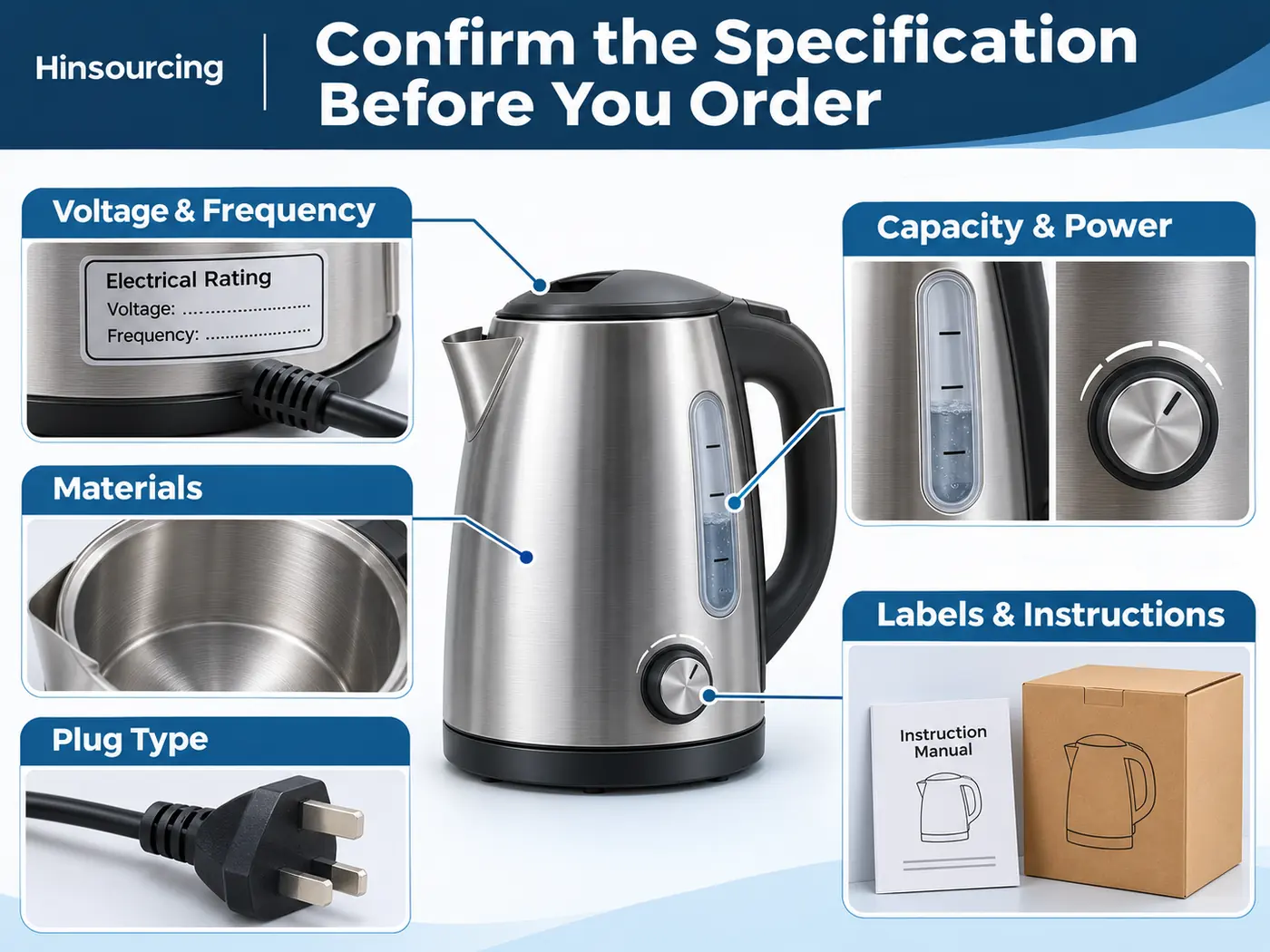
Ask suppliers to mark each requirement as included, excluded, or requiring development. A response such as “standard EU plug” is not enough: request a photo and precise identification of the actual plug, cord, and rating label. Keep a dated, version-controlled copy of the final brief.
Where Can You Find Small Home Appliance Manufacturers in China?
You can build a supplier shortlist through manufacturing clusters, B2B platforms, industry fairs, and direct manufacturer websites. What matters is identifying the business and production site behind each quotation—not simply collecting attractive product listings.
Manufacturing Clusters and Wholesale Channels
Shunde in Foshan is a major appliance manufacturing area, while Cixi in Ningbo is another useful location to investigate appliance suppliers. A Xinhua report published in January 2024 identified more than 2,000 small home appliance manufacturers in Cixi. Such a concentration can make it easier to find and compare potential suppliers, but it does not tell you which factory is best equipped for your product. Search for the specific process and model you need: a factory focused on electric kettles may not be a suitable producer of rechargeable vacuum cleaners.
Wholesale channels, including Yiwu, can help importers source mixed-product ranges. However, the wholesaler’s office or warehouse may not be the production site. Ask who manufactures each model and who controls its technical documents, product revisions, and spare parts.
B2B Platforms, Trade Shows, and Factory Websites
Alibaba.com, Made-in-China.com, Global Sources, and relevant 1688 listings are useful discovery channels. Compare business identities, product versions, and quoted terms before deciding which candidates deserve samples or a factory assessment.
At trade fairs, save each model number with its photographs and supplier quotation. A model displayed at a booth may differ from the version available for your market. Our Canton Fair buyer’s guide covers how to prepare for meetings and follow up with exhibitors.
If a supplier offers another company’s branded appliance, confirm the rights needed to resell it. Access to inventory does not automatically include authorization to use its trademarks or relabel its product.
How to Import Small Home Appliances from China: Step by Step
The following eight steps turn a supplier shortlist into an order you can evaluate. Keep the approved model identification, specification, quotation, evidence, and change records together. Do not release the next payment merely because the calendar says production should be finished.
Step 1: Define Your Appliance Specifications
A quotation for “a 1.7-liter stainless-steel kettle” still leaves important choices open: rated power, usable capacity, inner materials, lid construction, power base, cable, plug, and protective functions. For a blender, the equivalent questions include the jar, motor, blades, seals, operating cycle, and accessories.
Record each essential requirement in a simple approval sheet with four fields: requirement, agreed value, verification method, and approval status. A term such as “premium motor” is not a measurable specification.
Confirm the exact configuration in writing:
- Rated voltage, frequency, power, plug, and cord for the destination market; a plug adapter does not correct a voltage mismatch.
- Model suffix, rating plate, factory product label, and batch or revision identifier.
- Materials, components, capacity, controls, accessories, and permitted operating conditions.
- Retail packaging, instructions, warnings, and required language versions.
- For connected products, app region, wireless module, supported languages, and continued software support.
Ask for photos of the actual sample, not only catalog renders. Have a qualified person review electrical suitability before the product is offered for resale.
Step 2: Check Compliance and Import Requirements for Your Market
Check compliance before approving production. Give a competent testing or regulatory specialist the exact model, electrical version, intended use, and country of sale. Request a written list of applicable requirements, evidence needed, responsible parties, and items still unverified.
The following are starting points, not complete certification lists for every appliance:
| Destination | Main questions | Official guidance |
|---|---|---|
| European Union | Which electrical safety, EMC, RoHS, radio, energy, food-contact, traceability, and waste obligations apply? Are conformity assessment, technical documents, instructions, importer details, and CE marking handled correctly? | EU product compliance and importer obligations |
| United States | Does the product fall under a CPSC rule requiring a certificate, or under other agencies’ requirements? Are electrical, radio, food-contact, energy, and retailer requirements assessed for the actual model? | CPSC certificates and eFiling |
| Great Britain | Which electrical equipment rules and conformity route apply? What documentation, marking, importer details, and English instructions are needed? Northern Ireland follows a different framework. | UK electrical equipment safety guidance |
Important U.S. update for 2026: Since July 8, 2026, importers of products subject to CPSC certification requirements must electronically file the required certificate data for covered entries. This does not mean that every household appliance needs a General Certificate of Conformity (GCC), nor does it replace other product rules. A separate effective date of January 8, 2027 applies to relevant goods entered from Foreign Trade Zones. Ask your U.S. broker and compliance adviser whether your particular appliance and entry require eFiling.
For the EU, CE marking is not a universal third-party “CE certificate.” Applicable rules may include the Low Voltage Directive for equipment within its voltage scope, electromagnetic compatibility (EMC), restrictions on hazardous substances (RoHS), radio-equipment obligations for connected devices, and relevant waste-electrical-equipment responsibilities. Kettles, blenders, and coffee makers can also require a review of food-contact components. Requirements differ by configuration; for example, a low-voltage USB fan should not automatically be assigned the same electrical directive as a mains-powered kettle.
For Great Britain, official guidance issued in October 2026 confirms that CE and UKCA markings can be used for relevant electrical equipment when the corresponding requirements are met. Check the actual conformity route and documentation; do not assume the same rules apply in Northern Ireland.
Review test reports and declarations against the actual model, photographs, rating details, material or component versions, test scope, and date. A report for one motor, wireless module, or food-contact material may not cover a modified version. An ISO management-system certificate does not replace product-specific evidence.
Step 3: Find and Verify Suitable Appliance Suppliers
A manufacturer may be experienced at assembling kettles yet depend on outside suppliers for key heating components, PCB assemblies, or packaging. A trading company may coordinate several factories effectively, but you still need to know who makes the goods and who is accountable for the order.
When reviewing appliance suppliers, I would put more weight on their control of critical parts than on factory size or a polished catalog. For a kettle, that means understanding who selects and approves the heating element and thermostat; for a blender, it means knowing how the motor and seals are specified and checked. The answers tell you more about repeatable quality than a broad claim of “export-grade manufacturing.”
Ask candidates for evidence of:
- The legal business, contracting entity, actual factory, exporter, and payment beneficiary.
- Comparable products and the production processes performed in-house or subcontracted.
- Incoming-component controls, production records, batch traceability, and change approval.
- Test facilities and qualified personnel relevant to the agreed inspections.
- Production capacity for your order, realistic lead times, and spare-part support.
The same distinction is illustrated in our Kenyan retailer appliance sourcing scenario, which considers electric kettles, mini blenders, and USB fans from different factories. Each category needs its own electrical specifications, sample review, quotation, and production schedule. The scenario is a purchasing example, not a documented completed customer order; it shows why these items cannot be treated as one interchangeable purchase.
If the supplier’s factory identity, technical capability, or documents remain unclear, arrange supplier verification and a factory audit focused on the processes relevant to your model. A general factory profile is not proof of product quality or regulatory compliance.
Step 4: Compare Quotations and Calculate Your Landed Cost
Before comparing prices, make sure each offer covers the same model, electrical version, quantity, accessories, packaging, inspection scope, and delivery term. A quote that excludes testing, retail cartons, or spare parts is not directly comparable with one that includes them.
| Cost category | What to include |
|---|---|
| Product and development | Units, samples, branding, tooling, customization, and agreed testing |
| Quality and preparation | Inspection, possible reinspection, packaging, labels, and consolidation |
| Logistics | Transport within China, international freight, insurance, terminals, customs clearance, and delivery |
| Import charges | Duties, additional applicable tariffs, nonrecoverable taxes, and government or broker charges |
| Business allowance | Payment fees, currency changes, replacement units, spare parts, storage, and local after-sales service |
One cost I would examine early is after-sales support. A slightly cheaper blender may cost more to support if replacement seals are unavailable and a minor defect means replacing the whole unit. Asking about spare-part prices, lead times, and warranty remedies alongside the unit quote makes the margin comparison more realistic.
Example, not a market quotation: If 600 appliances cost $12 each and nonrecoverable costs to your warehouse total another $2,400, the resulting cost is $16 per unit, before selling and after-sales expenses. Recoverable import taxes can affect cash flow differently from permanent costs; confirm their treatment with your local adviser.
There is no single customs tariff code for “small home appliances.” Ask a customs broker to classify the exact product in your destination’s tariff schedule. A hair dryer, an electric kettle, and a rechargeable fan may have different classifications and trade requirements.
Compare the total cost and working-capital commitment, not only the quoted unit price. Stress-test your figures if freight rises, products need replacing, or the first shipment sells more slowly than expected.
Step 5: Approve Samples and Final Product Specifications
Request a sample of the intended market-specific production configuration, rather than accepting an unrelated showroom unit. Check its rating plate, plug, components, accessories, instructions, performance claims, and packaging against the proposed order.
Record the sample ID and revision, photos, accepted specifications, required corrections, and approval date. For a mini blender, for example, confirm which jar, blade, seal, and power configuration will be used in mass production—not just whether the sample blends a demonstration mixture.
Separate what the buyer can observe from what requires qualified testing. Ease of cleaning, control feel, lid fit, and carton contents can be assessed in a product review. Electrical safety, durability claims, and material suitability may require specialist methods and documented reports.
If a supplier changes a motor, material, battery, control module, or protective component after approval, require a written change request. Have the relevant specialist confirm whether the existing evidence still covers the changed product before production continues.
Step 6: Agree on Payment, Warranty, and Spare Parts
Your purchase agreement should identify the final specification, revision, quantity, artwork, delivery schedule, inspection arrangements, acceptance criteria, and remedies for nonconforming goods.
Payment and order release. Verify bank details through an independently confirmed contact. Agree on payment stages tied to evidence you can review—such as an approved sample, completed inspections, or accepted corrections—rather than treating any standard deposit percentage as automatically safe. For a protected platform transaction, read its actual coverage and claim deadlines.
Delivery responsibilities. State the Incoterms rule, edition, and named place. Terms such as EXW, FCA, FOB, CIF, DAP, and DDP allocate different responsibilities and risks. FOB and CIF are intended for sea and inland-waterway transport; DDP also involves import-clearance responsibilities that the seller must be able to perform legally. Delivery terms do not resolve quality claims or intellectual-property rights.
After-sales service. Before ordering, agree on warranty claims, evidence requirements, replacement parts, repair or replacement decisions, and who pays shipping and local service costs. An offer of “free spare parts” may still leave you responsible for technician labor and international freight. Confirm how customers in your sales market will actually receive help.
For private-label or newly developed appliances, clarify ownership and permitted use of molds, drawings, software, artwork, and packaging files, as well as how they can be transferred if you change suppliers.
Step 7: Inspect Production and Finished Appliances
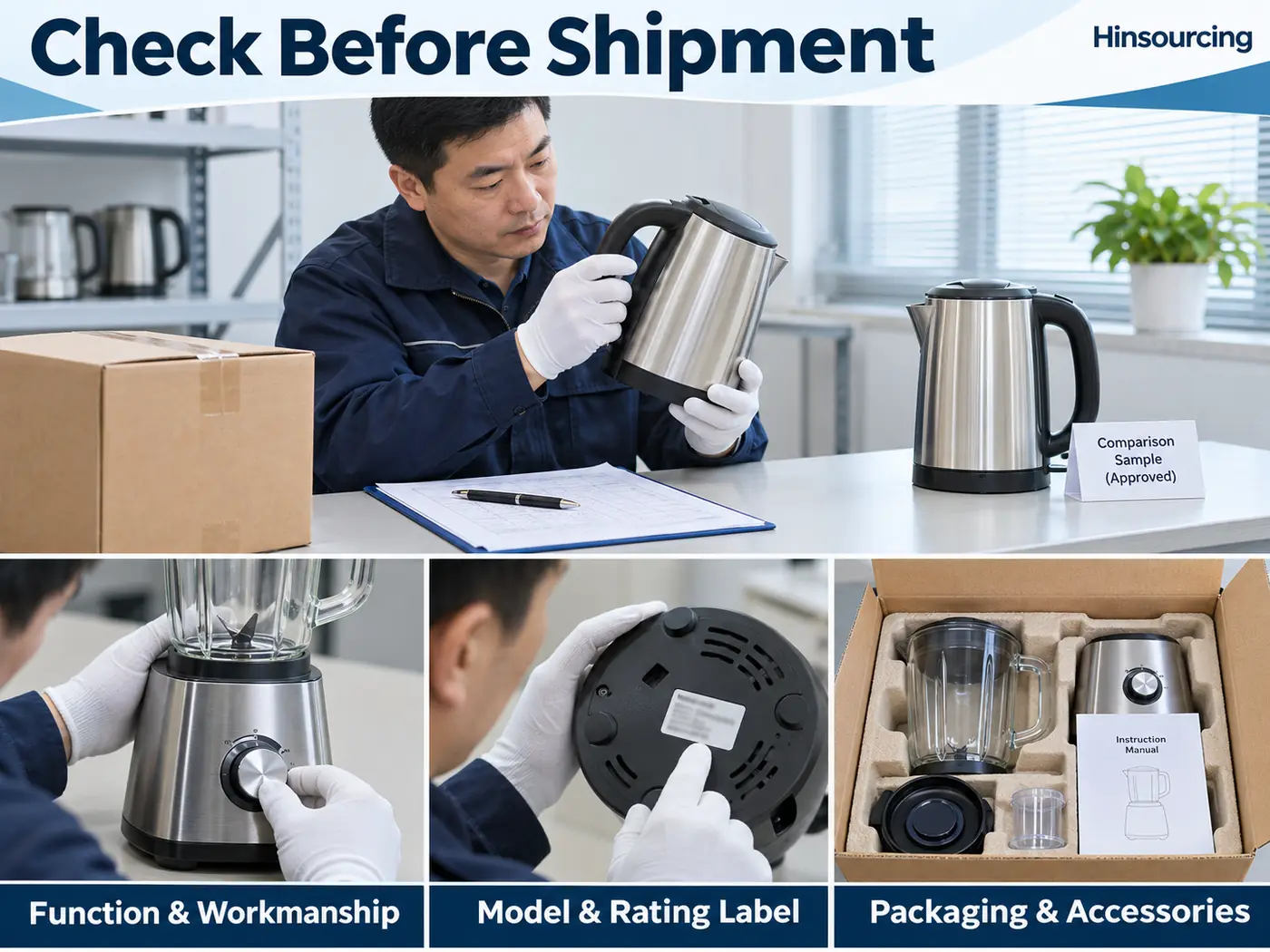
A good inspection plan is tied to the approved model, batch, and specification. It should also distinguish routine factory checks, order-specific inspection, and qualified safety testing; one cannot automatically replace another.
Four stages are particularly useful when planning quality control:
- Incoming component checks. Confirm the version and traceability of critical purchased materials, plugs, cords, motors, heating elements, seals, and other specified components.
- In-process checks. Check agreed assembly steps, workmanship, control of component substitutions, and recorded production tests while work is still underway.
- Pre-shipment inspection. Identify completed goods by model and plug version; check sampled quantities, functions within the agreed scope, labels, accessories, instructions, and packaging.
- Corrective action and recheck. Record defects, affected batches, supplier corrections, and which findings require buyer approval before release.
For example, if an order has two different plug versions, the inspection report should show which version and quantity were available and examined. A generic “passed” result without that breakdown is not enough to verify the agreed configuration.
Set a written sampling plan and defect criteria with the inspection provider. An AQL figure alone is not a complete inspection procedure, and a visual check does not prove compliance with electrical or food-contact requirements. If required specialist testing cannot be completed at the factory, arrange it separately instead of treating the missing result as a pass.
Our production follow-up and quality control service focuses on actionable findings: what was checked, what matched, what failed, and which corrections remain open.
Step 8: Arrange Shipping, Customs Clearance, and Receiving Checks
Send the forwarder the final carton count, packed dimensions, gross weight, product descriptions, model versions, pickup locations, destination, and battery details where relevant. Request quotes using the same cargo data and delivery scope.
- Courier may work for samples or small urgent shipments, subject to carrier rules and cost.
- Air freight may suit time-sensitive goods, but chargeable weight and destination handling can change the estimate.
- LCL sea freight can suit smaller commercial shipments; check consolidation and destination charges.
- FCL sea freight provides a dedicated container; compare the complete cost and practical loading capacity rather than using a universal volume threshold.
For battery-powered appliances, have the forwarder or dangerous-goods specialist confirm current transport classification, testing evidence such as applicable UN 38.3 information, packing, and carrier acceptance. A battery test summary by itself is not a complete shipping instruction.
Agree on packaging protection for glass parts, detachable accessories, stacking, moisture, and the intended distribution channel. On receipt, record carton counts, visible damage, model identities, and any discrepancy against the packing list. Preserve packaging and photographs for potential supplier, carrier, or insurance claims.
If collecting from several manufacturers, shipping and customs coordination also involves matching factory readiness with warehouse receipt, inspection release, and export documents.
What Documents Do You Need to Import Small Home Appliances from China?
Your customs broker and compliance adviser should confirm the final document list for the specific products and destination. Some records are used for customs entry; others demonstrate conformity or support traceability after the goods are sold.
| Document or record | Who usually prepares or supplies it | What to verify |
|---|---|---|
| Commercial invoice | Contracting supplier | Parties, goods, value, currency, and agreed delivery terms |
| Packing list | Supplier or consolidator | Model versions, carton contents, counts, net/gross weights, and dimensions |
| Bill of lading or air waybill | Carrier or freight forwarder | Consignee, routing, shipment, and release arrangements |
| Origin evidence, where required | Exporter or relevant issuer | Correct product origin and eligibility for any claimed treatment |
| Applicable test reports, declarations, or certificates | Manufacturer, laboratory, or other responsible party | Exact model, scope, validity, and the relevant target-market requirements |
| Importer and entry records | Importer and customs broker | Registration, tariff classification, valuation, and entry responsibilities |
| Battery transport records, if applicable | Battery supplier, appliance supplier, and forwarder | Battery model and documents required for the shipment |
Check that the documents match the actual cartons and products. Do not accept an incorrect invoice value or a borrowed test report to make a shipment appear cheaper or compliant.
Can You Import Private-Label Small Appliances in Small Quantities?
Yes, if a supplier offers an appropriate model and minimum order quantity (MOQ) for your project. But a small trial is only useful if you can still budget for product-specific requirements, samples, packaging, inspections, freight, and after-sales support.
Existing stock may reduce development time but still requires checks of the exact model, market version, batch, and documentation. Private labeling may involve a logo, instructions, packaging, or color changes. New OEM or ODM development can involve engineering, tooling, component changes, and additional validation.
Get minimum quantities by model, color, plug, and printed package. Some suppliers accept mixed-product orders but apply separate minimums for custom cartons, motors, or colors. Ask which configuration can be reordered reliably; a low-volume test of a discontinued stock item may tell you little about future supply.
How Should You Coordinate an Order from Multiple Appliance Factories?
Our Kenyan retailer sourcing scenario illustrates why a mixed-appliance purchase involves more than picking the lowest quotation. It describes a retailer considering electric kettles, mini blenders, and USB fans from different manufacturers, each with its own electrical specifications, plug requirements, samples, production schedule, and inspection arrangements. It is an illustrative planning scenario rather than a completed customer project.
For a mixed order like this, my priority would be to align specifications and delivery readiness before arranging consolidation. One factory may have finished producing its kettles while another still needs to correct a blender sample or confirm a fan’s electrical version. Even if the individual quotations look attractive, those differences can lead to unnecessary storage, reinspection, or split-shipment costs. Coordinating the stages is just as important as negotiating the prices.
Use one tracker containing each supplier, model revision, quantity, approved sample, production status, inspection result, warehouse receipt, and unresolved issue. Distinguish factory finished from inspected and approved for dispatch. If one supplier is late, decide whether to wait, ship separately, or adjust the order only after reviewing the costs and business impact.
Should You Use a China Sourcing Agent for Small Appliances?
A sourcing agent is useful when you need to compare several factories, coordinate technical questions from overseas, or manage sample and production follow-up. The value lies in the agreed tasks and evidence you receive, not simply in a promise to find a lower price.
Depending on the project’s scope, Hinsourcing can assist with supplier shortlisting, comparable RFQs, sample coordination, order tracking, inspection reporting, consolidation, and shipping communication. We agree on the deliverables, fees, and approval points before work begins.
A sourcing partner does not replace a qualified testing laboratory, local regulatory advice, or your legal responsibilities as an importer. If you’re evaluating a purchase, send Hinsourcing your product list, quantities, destination, and customization requirements so we can identify the sourcing work that needs to be done.
FAQs About Importing Small Home Appliances from China
Do I Need an Import License for Small Home Appliances?
That depends on the destination and the product. Business registration, customs importer registration, and a product-specific permit or approval are different matters. Ask your local broker and regulatory adviser what applies to the exact model, intended use, and shipment before you place the order.
Can I Sell Private-Label Small Appliances Imported from China?
Yes, if you have the right to use the branding and the product satisfies the applicable requirements. Agree on labels, instructions, model identification, warranty service, and any ownership of custom design work. A change of brand or configuration may require revised documentation or additional assessment.
Does a CE Mark or Supplier Test Report Guarantee My Appliance Is Compliant?
No. The applicability of CE marking depends on the EU legislation covering the actual product. A test report has a defined sample, method, scope, and date. Compare those details to your production version and have an appropriate specialist assess any missing or changed requirements.
How Long Does It Take to Import Small Appliances from China?
The schedule depends on supplier verification, samples, development, testing, manufacturing, inspection, corrections, transport, and customs clearance. Request dates for each milestone, and check whether quoted lead time starts after deposit, final sample approval, or completion of materials procurement. Factory completion is not the same as delivery to your warehouse.
Can I Import Chinese Domestic-Market Appliances for Resale?
Only after confirming that the specific configuration meets the requirements of the destination market and that you have any necessary branding rights. A Chinese domestic plug, rating label, report, or instruction manual may not be suitable for overseas retail. Availability on a marketplace or willingness to ship does not establish legal suitability for sale.
What Should I Do If the Appliances Arrive Defective?
Identify and segregate the affected models and batches, preserve photos and packaging, and compare the goods with the approved specification and inspection records. Notify the supplier, logistics provider, or insurer promptly as appropriate. If there may be a safety issue, stop distribution of potentially affected units while seeking qualified advice on corrective action, reporting, or recall obligations.