Choosing a toy manufacturer in China starts with the product you want to build—not simply the lowest price or the longest factory catalog. A custom plush character, wooden learning set, electronic baby toy, remote-control vehicle, and board game require different skills, equipment, and quality checks.
For overseas brands and importers, the more useful questions are: Can this company actually manufacture the product? What customization can it support? Will its order quantities and development process suit your business?
This guide compares 10 toy manufacturers in China across large-scale OEM production and specialist categories. All ten describe manufacturing operations in mainland China, although some have headquarters in Hong Kong. I’ll also explain how to compare MOQ, samples, tooling, toy safety requirements, and the support you may need before placing a first order.
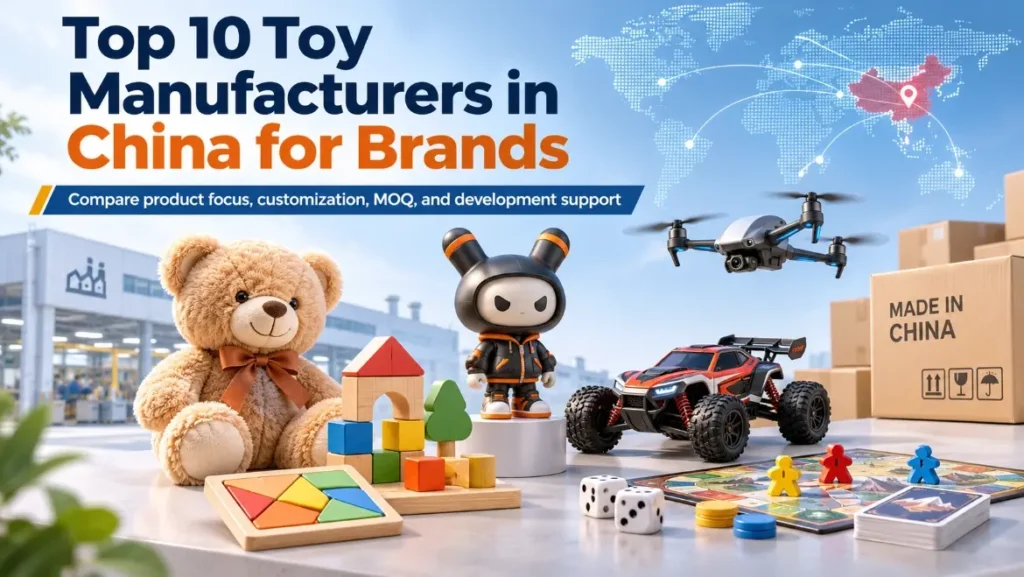
Toy Manufacturers in China: A Quick Comparison
These manufacturers serve different markets and order sizes. Start with the product category and production capability, then check whether a supplier offers OEM manufacturing, ODM development, catalog wholesale, or some combination. An MOQ for an existing toy should never be assumed to apply to a new mold, colorway, or custom retail package.
| Manufacturer | Mainland China Manufacturing | Product Focus | OEM/ODM or Customization | MOQ / Buying Conditions | Best Fit |
|---|---|---|---|---|---|
| Early Light Industrial | Shenzhen and Shaoguan, Guangdong | Molded, electronic and multi-process toys | Full OEM/ODM development, tooling, assembly | Project-specific; confirm volume and entry requirements | Established brands needing large-scale production |
| Jetta | Nansha and Conghua, Guangzhou | Mechanical, electronic and robotic toys | Engineering-led OEM, electronics, plastics, assembly | Project-specific; confirm technical and quantity requirements | Complex engineered toy programs |
| Wing Fat | Dongguan, Guangdong | Plastic toys, infant products, figures | Plastic OEM, molds, decoration and assembly | Project-specific; tooling may apply | Custom-molded plastic products |
| Winfat Holdings | Huizhou, Guangdong | Baby electronic and learning toys | OEM/ODM plus Winfun branded products | Confirm the model and permitted customization | Educational electronic toy ranges |
| Woodfield Toys | Dongguan, Guangdong | Plush, baby soft toys, cloth books | OEM samples, sewing, embroidery | Request design-specific MOQ | Soft toy and infant accessory brands |
| Tooky Toy | Ningbo, Zhejiang | Wooden puzzles and educational toys | OEM/ODM and selected ready-stock products | 1,000 pcs/design for new OEM/ODM; stock terms differ | Wooden educational toy collections |
| Double Eagle Industry | Chenghai, Shantou, Guangdong | RC vehicles, models and CaDA building blocks | Own-brand manufacturing, B2B supply; verify private-label scope | Confirm product availability, licensing and project MOQ | RC and construction-toy buyers |
| Shantou Xinyu Industry | Chaoyang, Shantou, Guangdong | Electronic and RC toys | OEM/ODM, 3D development and tooling | 3,000 pcs/colorway for ready-mold items; new tools quoted separately | Interactive and electronic toy projects |
| Demeng Toy | Shenzhen, Guangdong | Vinyl, PVC and resin figures | Character art, 3D modeling, molds and packaging | From 50 pcs advertised for selected projects; some items start at 100–200+ | Designer toys and collectible figures |
| LongPack Games | Manufacturing facilities in China; Shanghai office | Board games, cards and custom components | Printing, component manufacturing and assembly | Quote from full game specification | Tabletop game publishers |
A published MOQ is a starting point, not an all-inclusive offer. Tooky’s ready-stock quantities are separate from its new-production terms; Xinyu’s 3,000-unit rule is for ready-mold products; and Demeng lists different minimums across product types. Ask for a written quotation tied to your exact design, materials, packaging, and destination market.
How These Toy Manufacturers Were Selected
I built this shortlist around two things: verifiable mainland China manufacturing operations and a useful range of product-development capabilities. Large toy OEM companies can offer multi-process engineering and scale, while a specialist plush, wooden toy, figure, or tabletop manufacturer may be more relevant to a focused brand launch.
The selection considers:
- Product specialization: plush sewing, wood processing, plastic tooling, electronics, radio-control systems, printing, and game assembly.
- Manufacturing evidence: identifiable production locations, described processes, or factory facilities—not just a distributor’s product catalog.
- Custom development: OEM, ODM, prototyping, mold making, or adaptation of existing models where publicly described.
- Commercial fit: whether published buying conditions and development requirements help a brand ask useful first-order questions.
- Product-category balance: enough variety to compare manufacturers for different types of custom toys, instead of listing ten near-identical suppliers.
In this guide, OEM means production to agreed customer specifications, while ODM generally involves a manufacturer-developed design that can be adapted for a brand. A company with its own toy brand may also offer wholesale or licensed products without offering unrestricted private labeling. Clarify what is available before treating those routes as interchangeable.
10 Toy Manufacturers in China for Custom and Private Label Projects
1. Early Light Industrial — Large-Scale OEM and Multi-Process Toy Manufacturing

Official Website: Early Light Industrial
Headquarters: Hong Kong · Mainland Manufacturing: Shenzhen and Shaoguan, Guangdong · Founded: 1972
Early Light Industrial is an established original equipment manufacturer with a broad manufacturing base in southern China. Its website describes facilities in Shenzhen and Shaoguan capable of accommodating more than 350 assembly lines, with services ranging from prototyping and toolmaking to plastics, electronics, fabric processing and final assembly. These are company-reported capabilities, and they make Early Light a relevant candidate for brands with a technically involved or higher-volume toy program.
For large-scale custom toy manufacturing, I’d start with the product maturity and production forecast. Does your team already have validated drawings, component specifications and a realistic annual volume? Ask what Early Light would require to assess the project, which processes would be handled in-house, and how development, tooling and launch approvals would be scheduled.
- Main Products: Molded figures, plastic toys, electronic toys and other multi-process consumer products.
- MOQ: No universal public starting quantity; confirm project acceptance and production volumes directly.
- Customization: OEM/ODM development, prototyping, tooling, plastics, electronics and assembly.
- Best Fit: Established toy brands and importers planning technically developed, repeatable production.
Why shortlist it: Large-scale integrated facilities and multiple production processes. Check before ordering: Whether the project meets its commercial threshold, who owns new tools and design files, engineering milestones, and site-specific production and quality responsibilities.
2. Jetta — Complex Toy Engineering and OEM Manufacturing

Official Website: Jetta
Headquarters: Hong Kong · Mainland Manufacturing: Nansha and Conghua, Guangzhou · Founded: 1977
Jetta Company Limited is a long-established toy OEM manufacturer with mainland China campuses in Nansha and Conghua. Its publicly described capabilities span mechanical and electrical engineering, plastic processing, electronics, assembly and other supporting processes. That combination is particularly relevant to interactive toys or products requiring several engineering disciplines to work together.
Rather than sending a general idea, I’d prepare a functional brief: what the toy must do, how it is powered, which components move, how it will be used, and which design files or prototype results already exist. Ask how the engineering team would validate the concept and what must be approved before mass production.
- Main Products: Mechanical toys, electronic toys, robotic and related engineered products.
- MOQ: Discuss project suitability, volume, tooling and production terms directly.
- Customization: Engineering-led OEM, electronics development, plastics and manufacturing assembly.
- Best Fit: Brands with complex, engineered toy programs or established development budgets.
Why shortlist it: Extensive OEM engineering and multi-process manufacturing capabilities. Check before ordering: Technical scope, engineering and tooling fees, IP ownership, product validation, manufacturing site and minimum viable order scale.
3. Wing Fat — Plastic Toy OEM and Mold Development
Official Website: Wing Fat
Headquarters: Hong Kong · Mainland Manufacturing: Shipai, Dongguan · Founded: 1987
Wing Fat is a Hong Kong-owned plastic product OEM manufacturer with a factory in Dongguan. Its website describes a 40,000-square-meter production facility and processes covering plastic molding, decoration, assembly and packaging. Its products include plastic toys, infant-related plastic products, figures and molded components.
For a custom plastic toy manufacturer, the key decision is often made before the first production run: whether the design needs a new tool. I would request the mold-development schedule, sample and approval stages, expected tolerances, finishing method, maintenance plan and written agreement on mold ownership and future transfer.
- Main Products: Plastic toys, infant plastic products, figures and molded items.
- MOQ: Quote by design, tools, materials and order schedule.
- Customization: Prototypes, tool development, plastic molding, decoration and assembly.
- Best Fit: Brands developing molded plastic toys and components.
Why shortlist it: An established mainland China plastic manufacturing operation and in-house production processes. Check before ordering: Mold ownership, tool modifications, part consistency, decoration quality and the full cost of the first production batch.
4. Winfat Holdings — Electronic Educational and Baby Learning Toys

Official Website: Winfat Holdings
Headquarters: Hong Kong · Mainland Manufacturing: Huizhou, Guangdong · Founded: 1988
Winfat Holdings focuses on electronic educational toys, especially early-learning and baby products. It has a manufacturing operation in Huizhou and publicly describes OEM and ODM cooperation alongside its own Winfun toy brand. Its factory materials describe electronics development and manufacturing as part of a broader production system.
Winfat is worth comparing if your brand needs an interactive learning toy rather than a simple molded product. Ask whether you can adapt an existing model, what language or sound options can change, how the electronics and power configuration will be specified, and whether your proposed feature set requires new engineering.
- Main Products: Electronic baby toys, interactive learning products and educational electronic toys.
- MOQ: Confirm by model, function, customization and packaging; no universal public MOQ.
- Customization: OEM/ODM product development and manufacturing; exact private-label rights require agreement.
- Best Fit: Brands developing baby learning toys and electronic educational product ranges.
Why shortlist it: A dedicated educational-electronics focus and a mainland manufacturing base. Check before ordering: Electronics and audio versions, batteries, labeling, age suitability, intellectual property, and approval of functional testing.
5. Woodfield Toys — Plush Toys and Infant Soft Products

Official Website: Woodfield Toys
Mainland Manufacturing: Dongguan, Guangdong
Woodfield describes a manufacturing operation in Dongguan that specializes in plush toys, baby soft toys and fabric books. It supports OEM development from customer artwork, with sewing, embroidery and sample preparation relevant to a custom plush toy manufacturer in China. Its public company pages describe dedicated staff for samples and quality control.
For a plush character, send front, side and back references, color specifications, intended size, fabric preference and the target age group. Request a physical sample that documents the character proportions, embroidery placement, stitching, filling and any attachments. These details affect both appearance and product-specific safety assessment.
- Main Products: Plush characters, baby soft toys, cloth books and soft accessories.
- MOQ: Request a quote for your design, size, fabric and packaging.
- Customization: OEM samples, sewing, embroidery and fabric-based production.
- Best Fit: Plush toy brands and infant soft-product collections.
Why shortlist it: Clear specialization in sewing and other soft-goods processes. Check before ordering: Material and filling records, stitch and attachment specifications, intended age, sample-to-bulk consistency and relevant testing.
6. Tooky Toy — Wooden Toys and Educational Product Collections

Official Website: Tooky Toy
Location: Ningbo, Zhejiang · Founded: 2004
Tooky Toy focuses on wooden educational toys, including puzzles and pretend-play products. It offers its own product ranges alongside OEM/ODM manufacturing arrangements, making it a candidate for brands exploring wooden toys or private label educational toy collections.
Its published buying terms distinguish ready-stock items from new production. For new OEM/ODM production, MOQ is listed as 1,000 pieces per design. Selected ready-stock products have published conditions as low as 50–100 pieces per design, depending on the item and order terms. Ask for two quotations if applicable: one for an existing toy and one for a new or materially customized design.
- Main Products: Wooden puzzles, pretend-play sets and educational toys.
- MOQ: 1,000 pcs/design for new OEM/ODM production; different ready-stock conditions.
- Customization: Existing-product selection, private-label options and OEM/ODM development.
- Best Fit: Wooden toy retailers and brands with coordinated learning-toy ranges.
Why shortlist it: A focused product category with publicly differentiated order terms. Check before ordering: Which brand changes are allowed, coating and wood specifications, separate packaging minimums and supporting product documents.
7. Double Eagle Industry — RC Vehicles and Construction Toy Ranges

Official Website: Double Eagle Industry
Mainland Manufacturing: Chenghai, Shantou, Guangdong · Manufacturing Roots: 1988
Double Eagle Industry (China) Limited manufactures remote-control vehicles, toy construction equipment and building-block products, including its CaDA product lines. The company describes three manufacturing facilities covering approximately 50,000 square meters and its own mold-production capabilities. It also publishes information about overseas business partners and product licensing relationships.
For a buyer developing an RC or construction-toy range, this is a useful manufacturer to investigate—but first distinguish distribution of an existing Double Eagle or CaDA product from a custom OEM or private-label project. A company can own its manufacturing facilities while limiting how its branded designs, licensed vehicle models or components may be modified. Ask which commercial arrangements are available for your proposed product.
- Main Products: RC construction vehicles, remote-control cars, models and building-block sets.
- MOQ: Confirm for the particular product line, order type and any permitted customization.
- Customization: In-house product development and manufacturing; third-party private-label scope requires confirmation.
- Best Fit: Importers, retail brands and partners seeking RC or construction-toy products.
Why shortlist it: Substantial China-based RC production capability and specialized product lines. Check before ordering: Distribution versus OEM terms, trademark and license rights, controller and battery specifications, technical documentation, spare parts and after-sales support.
8. Shantou Xinyu Industry — RC and Electronic Toy OEM/ODM
Official Website: Shantou Xinyu Industry
Location: Chaoyang, Shantou, Guangdong · Founded: 1998
Shantou Xinyu is an electronic toy manufacturer offering OEM/ODM development, including remote-control vehicles and powered animal toys. Its website provides factory-specific details, including a 7,139-square-meter site and injection-molding equipment, as well as development from 3D drawings through functional prototypes and tooling.
For existing-mold products, Xinyu lists an MOQ of 3,000 units per colorway. New products require a separate development and tooling discussion. If your launch requires several colors or variants, calculate the combined opening quantity before comparing the quoted unit cost.
- Main Products: Electronic toys, RC toys and interactive powered products.
- MOQ: 3,000 units/colorway for ready-mold items; new projects quoted separately.
- Customization: OEM/ODM, 3D design, prototypes, molds, component and packaging development.
- Best Fit: Brands developing functional, electronic or interactive toys.
Why shortlist it: Specific public information about production equipment, development processes and order conditions. Check before ordering: Battery and charging specifications, functional acceptance tests, testing responsibilities, component substitutions and packaging approval.
9. Demeng Toy — Custom Designer Figures and Collectibles
Official Website: Demeng Toy
Location: Shenzhen, Guangdong
Demeng Toy specializes in designer toy manufacturing, including custom vinyl toys, PVC character figures, resin collectibles and related art-toy products. Its services cover artwork interpretation, 3D sculpting, prototype development, molds, finishing and packaging—important steps for creators building a physical product from a character concept.
The company’s general information advertises orders starting at 50 pieces, while specific figure and PVC product pages discuss 100- or 200-piece minimums or higher typical quantities for some manufacturing routes. I would not budget a custom figure on the lowest number alone. Request a written MOQ, per-unit quote, tooling fee and sample plan for your exact material, size, paint finish and design complexity.
- Main Products: Vinyl, PVC and resin figures, character merchandise and designer collectibles.
- MOQ: Supplier advertises from 50 pieces for selected projects; confirm product-specific thresholds.
- Customization: Artwork, 3D modeling, prototypes, molds, surface finishes and packaging.
- Best Fit: Artists, IP owners and brands developing collectible figures.
Why shortlist it: Specialization in character development and multiple figure-making processes. Check before ordering: Whether your product is marketed as a collectible or children’s toy, design rights, mold ownership, decoration consistency and relevant safety requirements.
10. LongPack Games — Board Games and Custom Components

Official Website: LongPack Games
Location: Shanghai, China; company describes in-house manufacturing facilities in China
LongPack Games is a specialist board game manufacturer in China working with game publishers on printed boards, cards, dice and other customized wooden, plastic and metal components. Its production scope extends from artwork preparation and manufacturing to assembly and retail packaging.
For a meaningful quote, prepare the full game’s bill of materials: card quantities and sizes, board material and folds, tokens, inserts, miniatures, dice, rulebook and retail box. If you revise the components after sign-off, ask how the change affects already purchased materials, printing schedules and assembly work.
- Main Products: Board games, cards, custom game pieces, components and retail game sets.
- MOQ: Quoted by complete game specification and component mix.
- Customization: Artwork preparation, printing, component production, assembly and packaging.
- Best Fit: Board-game publishers and brands producing multi-component games.
Why shortlist it: Complete-game manufacturing rather than a single generic toy category. Check before ordering: Final component count, print-file approval, packing accuracy, quality checks and charges for late specification changes.
How Hinsourcing Helps Evaluate Toy Suppliers
A supplier’s catalog tells you what it sells, not necessarily who makes your exact product, which specifications control production, or what you’ll receive before shipment. At Hinsourcing, our China toy sourcing support focuses on those questions. The scope depends on the project and the supplier verification or production checks a buyer needs.
1. Clarify the Production Route
We start with the product brief: artwork or reference product, target age, materials, functions, quantity, destination, and packaging. A plush character, a molded figure, and an RC vehicle each require a different manufacturing process. For brands asking how to find a toy manufacturer in China, matching this process to the product is more useful than collecting unrelated quotes.
2. Check the Business Behind the Quotation
For Chinese toy supplier verification, we can compare the registered entity, contact and operating address, and supporting documents. Where an on-site toy factory audit is part of the agreed scope, the review can cover facilities, equipment, production activities, and quality procedures. The key question is whether the supplier’s actual role—manufacturer, trader, or mixed operation—is clear. See our supplier verification and factory audit service.
3. Turn the Sample Into an Approval Record
A sample review is most useful when the findings can be checked again during production. We coordinate requirements such as dimensions, materials, colors, attachments, functions, packaging, and the changes accepted by the buyer. For a later production check, the approved sample and written specification should point to the same version.
4. Follow Production and Report Exceptions
During production, Hinsourcing’s follow-up and quality-control support can track agreed milestones, coordinate toy quality-control inspections before shipment, and record discrepancies with photos or inspection findings. Issues requiring changes, rework, or acceptance are brought back to the buyer for a decision before goods are released, where the agreed schedule permits.
What this means for a buyer: ask for clearly scoped deliverables—a supplier comparison, verification findings, sample record, or inspection report—rather than assuming the label “sourcing agent” covers every task. No generic supplier profile or factory visit replaces testing that is required for the specific toy and destination market.
How to Choose a Toy Manufacturer in China
Once you have two or three product-matched toy factories in China, compare them on the same requirements. A lower MOQ means little if the supplier cannot achieve the product’s function, compliance needs, or production consistency.
Match the Manufacturing Process to Your Product
For custom plush toys, ask about patterns, fabric sourcing, embroidery, sewing, filling, and attachments. For wooden educational toys, investigate cutting, sanding, coatings, and assembly. For plastic or electronic toys, look at tooling, parts sourcing, assembly, firmware or electronics (where relevant), and functional checks. Ask which processes are in-house and which are subcontracted.
Calculate MOQ Across Variants and Packaging
Request the minimum order quantity for custom toys per design, color, size, component, and packaging version, not simply “MOQ per order.” If your product needs several variants, calculate the combined opening quantity and the cost of unsold inventory. Printed retail boxes and custom components may have separate minimums even when the main toy is already available.
Define Samples, Molds, and Development Stages
For custom toy prototyping, confirm what files the supplier needs and what it will deliver: 2D artwork, 3D files, a visual model, a functional prototype, a production-intent sample, or final tooling. Agree on revision rounds, fees, approval points, and ownership of design files and molds. A visually attractive presentation sample may not fully represent mass-production materials or processes.
Plan Capacity and Lead Time by Milestone
Separate design approval, sampling, tooling, component buying, testing, mass production, packing, inspection, and shipment. Ask what starts the quoted lead time. A promise measured from deposit payment is not the same as one measured from final artwork and sample approval.
Control Quality on Reorders Too
For toy quality assurance across production runs, keep one approved specification with product version, materials, dimensions, colors, functions, accessories, packaging, and acceptance criteria. On repeat orders, require confirmation before a change in components, suppliers, tooling, or manufacturing site. Discuss which findings must stop shipment and who authorizes an exception.
Verify Toy Safety for the Destination Market
United States: For U.S. toy safety requirements, CPSC’s guidance explains that toys intended primarily for children age 12 and under generally need applicable third-party testing and a Children’s Product Certificate (CPC). The U.S. importer has responsibilities for toys manufactured overseas. Requirements depend on the toy’s actual features and intended age—not on a supplier’s broad claim that its factory is “certified.”
European Union: For EU toy safety compliance, the European Commission’s guidance covers conformity expectations and the transition to Toy Safety Regulation (EU) 2025/2509, generally applicable from 1 August 2030. Have a qualified provider assess the rules and documentation applicable when your specific toy will be placed on the market.
For reports supplied by a factory, match the test item, material, date, laboratory, and standard to your actual product. After changing a paint, battery, component, or intended age group, determine whether new review or testing is needed. A factory certificate is not the same as product-specific evidence.
Review Material Claims, Factory Audits, and Design Rights
If a supplier claims FSC-certified wood or paper, check the relevant organization and certificate scope using FSC Search. Audit reports should be evaluated for facility, date, scope, findings, and corrective actions—not their logo alone.
Protect your own brand assets too. Before sharing character files or commissioning a mold, agree on intellectual-property rights, confidentiality, permitted use, tool ownership, storage, maintenance, and transfer. Confirm that any existing licensed characters or components in the supplier’s proposal can lawfully be used for your intended product.
What Does It Cost to Manufacture Custom Toys in China?
Ask for the full cost to manufacture a custom toy in China, not just the unit price. A quoted factory price may exclude samples, engineering, mold development, testing, printed packaging, and delivery. Request a cost breakdown with assumptions and exclusions.
| Cost Area | Ask the Manufacturer to Confirm |
|---|---|
| Design and engineering | Deliverables, file ownership, revisions and fees |
| Samples and prototypes | Sample type, materials, courier charges and included revisions |
| Molds and tooling | Initial charge, ownership, maintenance, storage, changes and transfer |
| Unit manufacturing | Materials, components, finish, labor and quantity basis |
| Retail packaging | Labels, inserts, print setup, packaging MOQ and assembly |
| Testing and inspection | Applicable scope, laboratory or inspection fees, retesting responsibilities |
| Freight and import | Carton size, weight, trade terms, transport and destination charges |
Compare Catalog Adaptation With Fully Custom Development
| Decision | Existing Product + Private Label | New Custom Toy |
|---|---|---|
| Starting point | Supplier’s established model | Your specifications, artwork or concept |
| Key work | Branding, color, packaging and permitted changes | Design, prototypes, engineering and possibly new molds |
| Main quote risk | Assuming a catalog MOQ applies to custom options | Leaving tooling, revisions or testing out of the budget |
| What to approve | Exact product version and packaging | Final production specification, tools, parts and packaging |
Neither route is always cheaper overall. Compare total cash required, how many units you must carry, the development work your brand needs, and whether the design can be reordered consistently.
Ask for Like-for-Like Quotes
Give each shortlisted company the same dimensions, materials, functions, quantity, packaging, destination, and delivery terms. If a supplier proposes a cheaper material or simpler construction, ask it to quote that as a separate option. You then know whether a price difference reflects efficiency or a materially different toy.
How to Compare Toy Samples Before Mass Production
When comparing samples from custom toy manufacturers, remember that each stage answers different questions: a concept model shows appearance; a functional prototype tests mechanisms; a production-intent sample helps verify the manufacturing specification. Label each version and document revisions before giving final approval.
| Toy Category | Sample Checks | What to Record |
|---|---|---|
| Plush | Shape, fabric feel, embroidery placement, seams, attachments | Pattern changes, material codes, attachment specifications |
| Wooden | Dimensions, finish, fit, joints, printing | Measurements, coating specification, fit and finish changes |
| Plastic / electronic | Part fit, surface, controls, movement, power and accessories | Functional acceptance checks, part versions, power configuration |
| Board games | Print color, card stock, board construction, component count, insert | Final bill of materials, print files, packing configuration |
Check the complete retail product: instruction sheet, warnings, retail packaging, included accessories, barcode and outer cartons where required. A sample approval is not a substitute for safety testing, and a pre-shipment photograph is not a comprehensive inspection.
Keep the final sample reference, revision list, buyer approval, and matching packaging files together. Decide before production which discrepancies trigger a hold, a recheck, or a commercial decision.
Where to Find More Toy Manufacturers in China
If none of these companies matches your design, use the routes below to find more wholesale toy manufacturers in China. Search by manufacturing process rather than the broad word “toy”:
- Process-specific searches: Try terms such as “custom plush toy OEM China,” “wooden toy private label manufacturer,” or “plastic toy mold manufacturer.” Look for production examples and legal company details.
- B2B sourcing platforms: Build a shortlist, then confirm who will actually manufacture the item, the quotation’s unit basis, and whether the listed MOQ covers customization.
- Trade shows: Bring product references, a target quantity, and questions about tools, production sites, and samples. Follow up with a written specification after the event.
- China sourcing support: A local sourcing partner can help compare quotes, verify supplier information, coordinate samples, and follow production. Agree on deliverables and fees before work starts.
How to Start Working With a Toy Manufacturer in China
When contacting private label toy manufacturers or custom OEM factories, send the same short request for quotation (RFQ) to the most relevant two or three suppliers. A clear first message produces more comparable answers than simply asking for “your best price.”
| RFQ Field | What to Include |
|---|---|
| Product | Toy type, references, intended user and age group |
| Design | Artwork, dimensions, drawings, 3D files or clearly stated gaps |
| Materials and functions | Material requirements, electronic or moving parts, accessories |
| Quantity | Opening units by design, size, color and packaging version |
| Target market | Destination country, sales channel, testing and label needs |
| Packaging | Retail box, inserts, warnings, instructions, carton requirements |
| Budget | Target unit cost and known development-cost limit |
| Schedule | Launch target, sample approval timing and required delivery terms |
Use five approval stages: (1) validate the brief and production route; (2) compare itemized quotations; (3) approve the correct sample and design files; (4) agree ownership, payment milestones, specifications, testing and inspection; (5) review production and shipment readiness. Our shipping and customs coordination service can help organize the delivery stage once packaging and cargo information are confirmed.
FAQs About Toy Manufacturers in China
Which Toy Manufacturers in China Have Lower MOQs?
There is no single low-MOQ supplier for every toy type. Demeng advertises selected projects starting at 50 pieces, although some figures require 100, 200 or more. Tooky lists selected ready-stock conditions of 50–100 pieces per design, but its new OEM/ODM production is 1,000 pieces per design. For Early Light, Jetta, Wing Fat, Winfat, Woodfield, Double Eagle, Xinyu and LongPack, discuss the exact project rather than assuming an entry quantity. Compare sample, mold and testing costs alongside the minimum order.
What Is the Standard MOQ for Custom Toys in China?
There is no universal standard MOQ. A sewn plush toy, an existing wooden puzzle, a new molded PVC figure and an electronic toy have different setup requirements. Ask for the minimum per design, size, color and packaging version, including any separate minimums for components or printing.
Are These Toy Manufacturers Actually Located in China?
All ten companies describe manufacturing operations in mainland China. Early Light, Jetta, Wing Fat and Winfat have Hong Kong headquarters or ownership connections as well as factories in Guangdong. For any quotation, confirm the legal seller, the factory handling your specific order and whether any production steps are subcontracted.
How Much Does It Cost to Manufacture a Custom Toy in China?
Cost depends on the toy’s size, materials, functions, tooling, order quantity, packaging, testing and delivery. Request a breakdown of one-time design or mold fees and recurring unit costs. A low factory price is not a complete launch budget if it excludes prototypes, certification work or freight.
Can I Start a Private Label Toy Brand With a Small Order?
Sometimes. Existing models, fewer variants and straightforward packaging may make a smaller first order more practical. However, a smaller batch does not remove safety requirements or necessarily reduce the total development cost. Confirm that the product can legally be relabeled and that the supplier permits the intended changes.
Can a Chinese Toy Manufacturer Turn My Drawing Into a Toy?
Yes, several manufacturers in this list offer design development, but the route varies. Plush toys require patterns and sewn samples; figures may require 3D sculpting and molds; electronic toys need engineering and functional validation. Ask what is included in the development fee, who owns the files and tools, and which stage requires your approval.
Are All Manufacturers on This List Open to Private Label OEM Orders?
Not necessarily for every product. Some companies specialize in large custom OEM projects, while others also sell proprietary or licensed product lines. Double Eagle, for example, has established Double Eagle and CaDA ranges; private-label rights for a particular model must be confirmed. Request the specific customization scope instead of assuming every catalog item can carry your branding.
How Long Does Custom Toy Manufacturing Take?
It depends on design readiness, sampling rounds, tooling, component availability, testing, packaging and the production schedule. Ask for a milestone plan separating sample approval, mass-production completion, final checks, dispatch and delivery.
What Toy Safety Documents Should Importers Request?
Start with documents matching the actual toy, intended age and destination market. Depending on the product, these may include applicable test reports, material and component records, labels, declarations or certificates. For children’s toys imported into the United States, the importer has responsibility for the required Children’s Product Certificate. Consult a qualified testing or compliance provider for the product-specific requirements.
Who Owns the Toy Design, Artwork and Molds?
Your written agreement must define ownership and permitted use of artwork, source files, molds, designs and licensed components. Also clarify maintenance, storage, changes, access and transfer. A paid sample or tooling invoice does not, by itself, settle every intellectual-property question.
Should I Choose a Toy Factory or a Trading Company?
Choose according to product fit, technical requirements and accountability. A direct factory may be better for specialized production, while a trading company can coordinate multiple categories. In both cases, identify the actual manufacturer, contracting entity, quality-control arrangements and the person authorized to approve changes.
Find the Right Toy Manufacturer in China for Your Brand
Start with the toy manufacturers in China whose actual processes and commercial terms match your design. Send them one consistent brief, compare itemized quotations, and use samples and written specifications to settle differences before authorizing production. A reliable custom toy manufacturing partner can explain how your product will be developed, manufactured, checked, and delivered—not simply show an attractive catalog.
If you’d like help comparing suppliers, contact Hinsourcing with your product type, artwork or references, expected quantity by variant, intended age group, destination market, packaging, budget, and target timeline. We can discuss the appropriate supplier review, sample coordination, quality follow-up, and shipping support for your project.