
You’ve found a product at a promising price, agreed on the quantity, and reached the delivery details. Then the supplier asks for a Chinese address. For a U.S. buyer, that leaves a lot unresolved: who receives the goods, who checks them, and who gets them to your warehouse?
At Hinsourcing, the problems we help buyers address go beyond booking freight. Missing items, wrong colors, oversized cartons, and suppliers finishing at different times can all affect the order. Planning those checks before you pay gives you more room to correct mistakes while the goods are still in China.
Can 1688 Ship Directly to the USA?
You can receive a 1688 order in the USA when the goods have a suitable international shipping arrangement. Check whether the seller or checkout provides one for your purchase. Otherwise, arrange a China receiving point and onward freight yourself or through a partner. Payment confirmation alone doesn’t confirm U.S. delivery.
Alibaba Group describes 1688 as a domestic wholesale marketplace. That explains why a Chinese delivery address may be part of the purchasing process, but it doesn’t establish the shipping options for every seller or product.
Before ordering, confirm the destination shown at checkout, who arranges international freight, and where the quoted service ends. A seller saying “we can ship overseas” still needs to explain the method, charges, and delivery terms. If the order only covers delivery within China, settle the onward arrangement first.
What Are Your Options for Shipping 1688 Orders to the USA?
You can ask the supplier to arrange shipping, use a forwarder, or hire a sourcing agent for a wider purchasing service. Choose according to the work you need done before export, as well as the transport itself.
Ask the Supplier to Arrange International Delivery
For a straightforward order from one supplier, ask whether they can quote delivery to your U.S. address. Request the carrier or service, destination, estimated timing, and treatment of import charges in writing.
Also ask who handles a missing carton or a customs document request. A supplier-arranged shipment is easier to manage when the seller has a clear contact and agreed responsibilities after dispatch.
Use a China Warehouse and Freight Forwarder
You place the orders, and sellers send them to a designated receiving address. The forwarder then arranges the international movement, with warehouse services agreed separately.
Receiving a sealed carton is different from checking the products inside it. Ask whether the service includes opening boxes, counting units, photographing variations, repacking, or only recording weight and external condition.
Work with a Sourcing Agent for Purchasing and Shipping Coordination
A sourcing agent can help with supplier communication, order details, samples, production follow-up, and checks before the freight stage. This is useful when several suppliers or product variations need attention.
| Arrangement | Main responsibility to clarify | Best fit |
|---|---|---|
| Supplier-arranged delivery | Seller’s delivery scope and after-sales contact | One supplier with a workable export arrangement |
| Warehouse and forwarder | Receiving, handling, freight, and import coordination | Buyers who manage purchasing themselves |
| Sourcing agent with logistics partners | Purchasing tasks, checks, approvals, and shipping coordination | Buyers needing support across the order |
Our guide to what a purchasing agent does in China explains the wider role. An agent, warehouse, carrier, and customs broker may be separate businesses; your service agreement should identify their responsibilities.
Which 1688 Products Need Extra Checks Before Shipping to the USA?
Check both the transport route and the destination requirements before buying. A carrier accepting your shipment doesn’t establish that the product meets U.S. import or sales requirements. Likewise, a product that can legally be imported may need a particular transport service.
Batteries, Liquids, Powders, and Other Special Cargo
Tell the transport provider what the product contains. For a battery-powered item, provide the battery type, capacity, and whether it is installed, packed separately, or shipped alone. For liquids or powders, obtain the composition and relevant handling information.
DHL’s shipping guidance distinguishes restricted goods from prohibited goods and explains that some shipments need prior approval. Ask for acceptance of your actual cargo and route, including packaging and documents, before the supplier dispatches.
Products with U.S. Safety, Labeling, or Import Requirements
Children’s products, food-contact products, and wireless electronics deserve a product-specific review. “We sell this in China” doesn’t answer which requirements apply in your market.
For example, CPSC explains that children’s products subject to applicable safety rules require testing and certification. Check current testing, certificate, labeling, and filing obligations with an appropriate specialist. Match supporting documents to the actual model and materials you plan to buy.
Branded Goods and Intellectual Property Concerns
Check the branding on both the product and its packaging. Ask for evidence of authenticity and relevant authorization rather than relying on a seller’s assurance that customs won’t notice. CBP targets and seizes counterfeit and pirated imports.
If a proposed shipping solution depends on hiding the brand or misdescribing the goods, don’t use it.
How Do You Choose a Reliable 1688 Shipping Agent for the USA?
Ask a prospective partner to explain how they would handle your actual shipment. Their answers about receiving, charges, and problem resolution tell you more than a low headline rate.
Verify the Business, Receiving Address, and Service Scope
Check the contracting company, payment beneficiary, and receiving address. Ask whether the warehouse is operated directly or by a partner, and who answers for goods held there. A partner warehouse can work well; an unexplained handoff is the concern.
Request a redacted receiving record or inspection report. Look for identifiable orders, carton references, findings, and next actions rather than a few general warehouse photographs.
Compare Written Quotes for the Same Shipment
Send each provider the same product information, packed dimensions, weight, U.S. ZIP code, and delivery deadline. Ask them to identify:
- Minimum charges and the method used to calculate billable weight.
- Storage, inspection, packing, and handling fees.
- Customs and destination services included in the price.
- Residential, appointment, or unloading charges where applicable.
- Quote validity and what could change the final amount.
A cheaper quote may leave you paying the destination charges separately. Put both quotes on the same basis before choosing.
Agree on Release Approval, Liability, and Claims
Decide who can authorize international dispatch and whether changes to packing or routing need your approval. Get the claims procedure, liability limits, and any insurance proposal before payment.
I would question a provider promising that every product can ship without checks. A useful partner asks enough about the goods to identify restrictions and gives you a clear escalation contact.
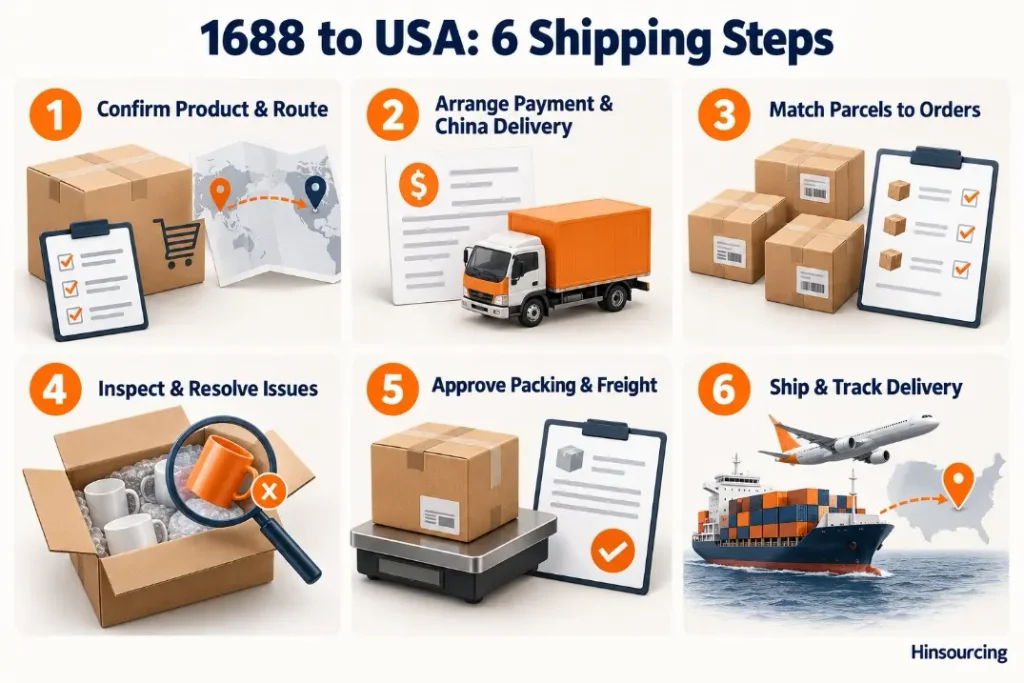
How to Ship from 1688 to the USA in 6 Steps
Arrange the receiving and international shipping plan before placing orders. Then keep one order record through the six steps below, so quantities, packaging, and approvals don’t get lost between supplier chats and freight messages.
Step 1: Confirm Product and Route Eligibility
Send the proposed logistics partner your product links, quantities, specifications, supplier locations, and destination ZIP code. Disclose batteries, liquids, powders, branding, and other relevant characteristics. Include your required delivery date, not just “as soon as possible.”
Obtain a preliminary route assessment and list of required documents. Ask the supplier whether the goods are in stock, how they will be packed, and when they can reach the China receiving point.
Before committing, review whether the supplier can consistently provide the agreed product. A supplier verification or factory assessment addresses that question; a warehouse receiving check later serves a different purpose.
Step 2: Arrange Payment and China Delivery
Check the payment methods available for your account and order. WorldFirst’s 1688 World Pay is one payment option for eligible users, but confirm your business’s eligibility rather than assuming a global product page guarantees U.S. access. Payment and international delivery remain separate arrangements.
If an agent places the order, agree on who holds the purchase record and submits any supplier dispute. Confirm currency conversion, service fees, and the refund process.
Use the receiving address exactly as supplied, including the warehouse phone number and customer reference. Save the selected SKU, color, size, quantity, domestic freight charge, and expected dispatch date. An omitted customer code can leave a parcel difficult to identify even when it reaches the correct building.
Step 3: Match Incoming Parcels to Your Orders
Maintain a simple arrival sheet with these fields:
- Supplier and 1688 order number.
- Domestic tracking number.
- Expected products and quantities.
- Cartons received and receiving date.
- Checks completed, discrepancies, and pending decisions.
Don’t mark an order complete just because its tracking says “delivered.” That may confirm only arrival at the China warehouse. The carton count can be correct while the contents are short or include the wrong variations.
Ask for missing tracking details as each supplier dispatches. Confirm storage deadlines while waiting for the remaining goods, rather than discovering a storage bill at the end.
Step 4: Inspect and Resolve Problems Before Export
Specify what to inspect. “Check the goods” is too vague for an order containing several sizes and colors. A useful instruction might read: “Count each size separately, compare the color with the approved sample, check the printed logo, and photograph damaged units.” This is an example of an instruction, not a report of a particular customer order.
Choose the inspection depth deliberately. Carton photographs, a sample inspection, a full unit count, functional testing, and laboratory testing answer different questions. Photos can’t establish every material property or hidden defect.
Record shortages or mismatches and contact the supplier while the goods remain in China. Decide whether to replace, rework, return, or accept the affected items before releasing them for export.
Step 5: Approve Packing and the Final Freight Quote
Tell the warehouse which retail boxes, inserts, labels, and accessories must stay. Authorize removal of unnecessary outer packaging only where product protection allows it.
After packing, obtain the final carton count, gross weight, dimensions, and packing list. Those figures should support the final freight quote. If the charge increases, ask whether the cause is larger dimensions, extra protection, a different route, or an added service.
Confirm whether all suppliers’ goods should travel together. Waiting for one delayed order may be more expensive than sending ready stock first. Approve the actual shipment and its costs, not just an early estimate based on a product photo.
Step 6: Authorize Dispatch and Track U.S. Delivery
Review the packing information, invoice details, destination, recipient contact, and agreed import responsibilities. For delivery to a warehouse or 3PL, confirm receiving hours and appointment requirements. For a residential delivery, ask about access and unloading arrangements.
Keep the domestic tracking numbers, international transport document, and U.S. last-mile reference together. If tracking stops, ask which party currently holds the goods and what event is expected next.
On arrival, record carton quantities and visible damage promptly. Save photographs and packaging when reporting a problem, and follow the applicable claims deadlines. Delivery tracking alone won’t explain whether a shortage began with the supplier or during transport.
Can You Combine Multiple 1688 Orders into One U.S. Shipment?
Yes, suitable orders from different suppliers can be collected at one China receiving point and shipped together. Consolidation is useful when it reduces repeated charges or improves packing, but the decision also depends on product compatibility, storage time, and how urgently you need each order.
When Consolidation Can Reduce Shipping Costs
Ask for a comparison using the final packing plan. Combining eligible parcels may reduce repeated minimum charges or remove wasted space, while retaining enough protection for the goods.
Keep supplier and SKU references traceable through repacking. If several products share a carton, the packing list should show its contents. Also confirm that the selected service accepts the combined cargo; adding one restricted product can affect the route for everything packed with it.
When Separate Shipments Make More Sense
Suppose, as a planning example, your main products are ready but their display stands need another week. Compare the additional freight for a split shipment with the cost of delaying the products. If you cannot sell the products without the stands, waiting may still be sensible.
Separate dispatch can also suit goods needing different transport conditions. The cheapest combined shipment isn’t necessarily the best replenishment plan.
How Much Does It Cost to Ship from 1688 to the USA?
The cost depends on what you buy, its final packed size and weight, the route, and the U.S. destination. A product link can support an initial estimate, but a dependable final quote needs cargo data and a clear list of included services.
Separate Product Costs from Shipping and Service Fees
Check the total in stages so bundled quotations don’t hide omissions or cause double counting.
| Cost stage | What to confirm |
|---|---|
| Purchasing | Goods, customization, payment conversion, and purchasing service fees |
| China delivery and preparation | Domestic freight, receiving, storage, inspection, packing, and labels |
| International movement | Freight, export handling, applicable surcharges, and insurance if purchased |
| U.S. arrival and delivery | Import charges, brokerage, destination handling, and final delivery |
Ask whether the price ends at a port, airport, warehouse, or your exact address. Those quotes are not interchangeable.
Understand Actual Weight and Dimensional Weight
A large box of lightweight products can cost more to transport than its scale weight suggests. For its stated express calculation, DHL uses length × width × height in centimeters, divided by 5,000.
An illustrative 60 × 40 × 40 cm carton has a dimensional weight of 19.2 kg under that formula. If it weighs 8 kg on the scale, the dimensional weight is higher. The final bill can also reflect rounding and surcharges.
Confirm the formula for your service. Don’t apply this divisor to every airline, parcel service, or sea freight quote.
Get a Quote for the Final Packed Shipment
Send the product description, quantity, purchase value, carton dimensions and weights, origin, destination ZIP code, address type, and deadline. Include special cargo information and packing instructions.
Ask for an itemized estimate before ordering, then an updated quote once packing is complete. If a provider quotes without knowing your goods or destination, treat that figure as indicative rather than a confirmed total.
Is Buying from 1688 Still Worth It After Shipping Costs?
Compare the cost of usable inventory at your destination. In a hypothetical budget, 200 units cost $600, China preparation and service fees total $120, international freight is $280, and import handling and final delivery have a $200 allowance. That is $1,200, or $6 per unit, before your selling expenses.
If only 190 units are usable, the same spending becomes about $6.32 per usable unit. These numbers demonstrate the calculation; they are not a freight quote, tax estimate, or Hinsourcing result.
Use comparable specifications and delivery scope when checking alternatives. Low product prices can lose their advantage on small, bulky, or urgent orders.
How Long Does 1688 Shipping to the USA Take?
Express and air services are options when speed matters; sea freight requires a longer planning window. For your delivery date, add supplier preparation, China transit, warehouse work, customs processing, and U.S. delivery. The seller’s dispatch promise covers only part of that timeline.
Express, Air Freight, or Sea Freight?
| Option | Orders to consider | Timing question to ask |
|---|---|---|
| Express courier | Eligible samples, compact urgent orders, replacement items | Does the estimate run from pickup to the final address? |
| Air freight | Larger urgent shipments where air costs are justified | Are airport handling, clearance, and delivery included? |
| Sea freight, LCL | Orders sharing container space | How much time is needed for consolidation and destination release? |
| Sea freight, FCL | Orders suited to a dedicated container | Is the estimate port-to-port or to your receiving location? |
Sea freight times vary by route, ports, carrier, and sailing schedule. Ask your forwarder for a current port-to-port estimate, then allow for destination handling and inland delivery before setting a launch date.
Add Supplier, Warehouse, and Final-Delivery Time
Build your schedule in this order: goods ready → China delivery → receipt and checks → corrective work if needed → packing and booking → international transit → clearance and final delivery.
Ask for the cargo-ready date separately from the estimated departure date. If the supplier is still producing, or you haven’t approved a replacement for incorrect goods, a fast international service won’t remove that delay. Allow additional room around the confirmed schedule when missing a delivery date would disrupt sales.
What Customs Requirements Apply to 1688 Shipments to the USA?
Buying through 1688 doesn’t create a separate set of U.S. import rules. Your requirements depend on the actual goods and shipment. Before dispatch, agree with the logistics provider and, where needed, your customs broker on the documents, importer details, and charges involved.
Confirm Documents and Import Responsibilities
Prepare accurate commercial invoice information, packing details, and the relevant transport documents. CBP’s commercial invoice guidance calls for information including an adequate description, quantities, values, and seller details.
Check that the documents describe the shipped goods, not an earlier order version. Agree who supplies classification and product documents, who files the entry, and who responds to questions. Send sensitive importer information only through verified channels. Ask your broker about any additional filings and deadlines for the chosen transport mode.
What Does DDP Shipping from 1688 to the USA Include?
Under Incoterms® 2020, DDP places import clearance and associated duty obligations with the seller. Under DAP, the buyer handles import clearance. Both require an agreed destination. ICC explains these differences and practical limitations.
DDP describes delivery responsibilities, not a transport mode. It can apply to an air or sea arrangement. A forwarder’s “DDP service” label also needs a written scope: identify who is importing, what charges are covered, and which delivery or exceptional services cost extra.
Door-to-door delivery alone doesn’t establish that duties are included. Nor does paying a logistics provider remove the need for accurate product information and an appropriate import arrangement.
Check Duties and Product Requirements Before Paying
Don’t budget on the old assumption that orders below $800 automatically enter duty-free. CBP’s 2026 guidance continues the suspension of broad de minimis treatment. Confirm current treatment for your goods and entry method rather than copying a rate from a shipping blog.
Ask a qualified customs professional to assess classification, applicable duties, and other charges before committing to a large order. Disclose the true transaction details; don’t use understated values, false gift descriptions, or artificial splitting to evade charges. Product safety and labeling requirements still need their own review.
What Can Go Wrong When Shipping 1688 Orders to the USA?
The recurring problems Hinsourcing helps U.S. buyers address often start before international dispatch. The table below reflects those purchasing and preparation issues; it isn’t a claim that every 1688 supplier has them.
| Problem | What it looks like | Why it matters |
|---|---|---|
| Missing items or short shipments | Fewer units arrive, or some SKUs are absent | Stock is incomplete and replacements need another arrangement |
| Incorrect products or variations | Wrong style, color, size, or model | The goods may not serve the intended order |
| Oversized packaging | Large cartons with unnecessary empty space | Billable volume or weight can increase |
| Inadequate protective packaging | Weak cartons or insufficient cushioning | Damage becomes more likely during handling |
| Inconsistent supplier packaging | Mixed bags, cartons, and unclear labels | Receiving and export preparation take more work |
| Different completion dates | Most orders are ready but one supplier is late | You must choose between waiting and splitting the shipment |
| Packing records that don’t match | Quantities, weights, or carton contents differ | Freight and document details need correction |
| Inconsistent quality between batches | Color, size, workmanship, or material varies | Replenishment stock may not match existing inventory |
| Bulk goods that differ from the sample | Production differs from the approved reference | A good sample hasn’t translated into an acceptable order |
Batch variation and sample-to-bulk mismatch need different comparisons. For the first, compare production lots with each other and the specification. For the second, compare actual production against the approved sample. Keep both the physical reference and written requirements available for the agreed inspection.

What If Your 1688 Shipment Arrives Damaged, Incomplete, or Not at All?
Start by tracing where the problem occurred. If a carton never reached the China warehouse, investigate the domestic delivery; if it was recorded there but is missing from the U.S. delivery, check the packing and transport records. Report the discrepancy promptly under the applicable order, service, and insurance terms.
Resolve Supplier Problems While the Goods Are Still in China
Pause dispatch of the affected items and compare the order with receiving and inspection records. Ask the supplier to explain the discrepancy and propose a remedy. Confirm the replacement specification, timing, and responsibility for return or additional shipping costs.
If an agent ordered through its account, agree who will submit and follow the dispute. Check deadlines immediately; don’t assume waiting for international delivery extends the original order’s after-sales period.
Keep Evidence for Loss or Damage During Transit
Preserve the order, invoice, packing list, carton references, before-dispatch photographs, transport records, and delivery evidence. Photograph damage and keep the packaging while the claim is assessed.
For a missing shipment, first reconcile the domestic, international, and last-mile tracking. A gap in updates needs investigation, but isn’t by itself proof of loss. Ask the party managing that leg to open a trace and give you a case reference.
Check Insurance Coverage and Return Costs
Before shipping, establish whether cargo insurance is included or separately purchased, which risks it covers, and how to claim. Check exclusions, deductibles, evidence requirements, and deadlines. Don’t assume a carrier’s liability limit equals your full purchase value.
For incorrect goods already in the USA, compare the agreed remedy with the cost and requirements of returning them. Obtain written instructions before paying for an international return; a refund or free return isn’t automatic.
How Does Hinsourcing Help U.S. Buyers Source and Ship from 1688?
Hinsourcing helps connect the purchasing decisions with what is actually received and prepared for shipment. Our role is to reduce preventable errors and help address discrepancies before you spend money exporting them. We agree on the checks, coordination work, and approvals needed for your order.
Check the Order Against the Goods Received
We coordinate checks against the purchasing list, including quantities and agreed product variations. A discrepancy needs a record that identifies the order, item, and problem clearly enough for the supplier to respond.
Where a shortage or wrong item is found, we follow up with the supplier and clarify the proposed correction. You can review the issue before deciding whether the affected goods should ship.
Coordinate Packaging and Consolidation
Packaging needs to suit both the product and the route. We help coordinate packing instructions, required retail packaging, identification, and suitable consolidation with the parties handling the goods.
Reducing carton size can help, but we wouldn’t recommend removing protection simply to produce a lower weight figure. The packing decision should balance freight cost and the condition in which you need the goods to arrive.
Follow Supplier Readiness and Reconcile Packing Details
We follow supplier readiness and coordinate the final carton information used for freight planning. When a supplier is delayed, we help clarify the effect on the rest of the shipment and the available choices.
Our shipping and customs coordination service also covers aligning shipment information with logistics partners. Customs classification, duties, and clearance decisions remain matters for the appropriate professionals and authorities.
Compare Bulk Goods with the Approved Requirements
Approved samples and written specifications give inspections a reference. We help coordinate the agreed checks, record differences, and follow supplier responses. Material or performance questions may need suitable testing beyond a visual inspection.
If you’re planning a U.S. order, send Hinsourcing your sourcing and delivery requirements: product links, quantities, supplier details, available packing information, destination ZIP code, and deadline. We can discuss the purchasing support and shipping coordination needed, with product costs, service fees, and transport costs identified separately.
FAQs About Buying from 1688 and Shipping to the USA
Account access, “free shipping,” and tracking statuses can mean something different from what a U.S. buyer expects. Clarify these details before treating an order as ready for international delivery.
Can I Buy from 1688 While Living in the USA?
Yes, provided you have a workable account, payment method, and delivery arrangement. Check the requirements for your specific account and purchase. Living in the USA doesn’t mean the seller’s price includes delivery there. If you use an agent, agree who places the order and retains the purchasing records.
Do I Need a Sourcing Agent or Just a Freight Forwarder?
A forwarder may be sufficient when purchasing is settled and you need receiving and transport. A sourcing agent is useful when you also need supplier communication, specification checks, order follow-up, or help resolving discrepancies. Compare written service scopes: neither job title guarantees that an internal product inspection is included.
Can 1688 Orders Be Sent to Amazon FBA in the USA?
Yes, with suitable products and the required preparation and delivery arrangements. Follow the current Send to Amazon workflow for shipment information and labels. Give your logistics partner the correct files and box details; an Amazon warehouse address alone isn’t enough to prepare an inbound shipment.
Why Does My 1688 Order Say Delivered When I Haven’t Received It?
The status may refer to delivery to your China warehouse. Check the address and domestic tracking number, then match them with the warehouse receiving record. International dispatch needs its own confirmation and tracking information. If the warehouse has no record, ask it and the supplier to investigate the domestic delivery.
Does Free Shipping on 1688 Include Delivery to the USA?
Don’t assume it does. Read the offer’s delivery area and conditions. If the order is addressed to a China warehouse, free shipping may cover only that domestic leg. International freight, warehouse services, import charges, and U.S. delivery need their own confirmed arrangement unless explicitly included.
Can I Ship a Small 1688 Order to the USA?
Yes, if the supplier accepts the quantity and a suitable service accepts the shipment. Check the supplier’s minimum order separately from the transport provider’s minimum charge. Samples or a small trial can be useful, but compare the full delivered cost before deciding whether the purchase makes sense.