China Sourcing for Amazon Sellers can start with an attractive factory quote, but packaging, freight, fulfillment fees, and returns can change how promising that product looks. Work through those costs while you can still adjust the product or choose a different supplier.
When I assess a sourcing request, I want enough detail to compare the options fairly. That means looking beyond product photos to materials, samples, production arrangements, and delivery requirements. This guide explains how to make those decisions, with FBA examples where warehouse preparation needs particular attention.
Why Amazon Sellers Source Products from China
China gives Amazon sellers access to manufacturers, component suppliers, and packaging businesses across many product categories. For a private-label seller, that can make it practical to develop a product and its retail packaging within the same sourcing project.
The advantages are especially useful when you need:
- A choice of suppliers: Compare different materials, production methods, quantities, and price levels instead of accepting one available option.
- Private-label customization: Discuss changes to colors, accessories, instructions, branding, or packaging around the product you want to sell.
- Related suppliers: Coordinate the main product with boxes, printed materials, and other components from specialist businesses.
- Repeat production: Develop an approved specification that a suitable supplier can reproduce as demand grows.
Manufacturing prices can also be competitive, particularly at quantities that suit the production process. But the saving has to survive freight, import charges, inspections, and selling expenses. I’d compare the cost of getting saleable inventory to your destination, not just the price on the quotation.
What Should You Confirm Before Sourcing from China?
Before asking factories for prices, decide where you’ll sell, how you’ll fulfill orders, and what kind of product business you’re building. These choices affect the suppliers you approach and the instructions you give them.
Choose Your Amazon Marketplace and Fulfillment Method
Name the destination country and choose between Fulfillment by Amazon (FBA), fulfillment you arrange yourself (FBM), or a setup involving a third-party logistics warehouse (3PL). This guide uses FBA examples, but much of the supplier work applies to FBM too.
Also define what your delivery date means. Goods reaching a port, arriving at a warehouse, and becoming available for sale are different events. A launch plan needs to account for the last one.
Define Your Selling Model and Buying Responsibilities
A private-label order, an unbranded product purchase, and a purchase of another company’s branded goods require different checks. Tell the supplier which model applies rather than simply saying, “I sell on Amazon.”
Assign responsibility for purchasing approvals, product documents, import arrangements, and your Seller Central shipment setup. A supplier or agent can help with execution, but your instructions should identify which decisions require your approval.
Which Products Are Practical to Source from China for Amazon?
A product is worth investigating when customers have a reason to buy it and you can supply it at a workable cost and quality level. I would assess that combination before spending money on custom molds, printed boxes, or a large sample order.
Check Demand and Identify a Useful Product Improvement
Look at demand over time, competing offers, seasonality, and recurring customer complaints. One successful listing doesn’t prove that an identical product from another seller will attract buyers.
Use reviews to form a specific product requirement. For example, complaints about missing assembly parts could lead you to specify a sealed hardware pack and a packing check. Complaints about unclear instructions suggest testing the instructions with someone unfamiliar with the product. These are possible improvements, not evidence that a new version will sell. Don’t copy another brand’s protected design or content.
Screen for Size, Fragility, Complexity, and Return Risk
Think about the product after it has been packed and shipped, not only while it sits on a supplier’s sample table.
| Product characteristic | Question to resolve before sourcing |
|---|---|
| Bulky or heavy packaging | Can the selling price support freight, storage, and fulfillment costs? |
| Fragile parts or finishes | What packaging and checks will address likely damage? |
| Multiple sizes or compatibility claims | Can customers choose the correct version without confusion? |
| Assembly or technical functions | Can you specify, test, and explain how it should work? |
| Batteries, children’s uses, or food contact | Which product, transport, and destination requirements need specialist review? |
Small, simple products may be easier to manage, but they aren’t automatically profitable. A complicated product can still be viable when you understand its requirements and have the resources to meet them.
What Compliance and Supplier Documents Should You Check Before Ordering?
Check whether you can sell the product before committing to bulk production. Supplier verification, product compliance, and Amazon approval answer different questions. A real factory can still offer a product that doesn’t meet the requirements for your intended market.
Confirm Product Eligibility in Your Target Amazon Store
Review the product and category requirements in your own selling account. Amazon explains that some categories require approval or a particular selling plan, while restrictions and brand relationships can affect what you may list. A supplier’s history of selling to other Amazon merchants doesn’t establish your eligibility. See Amazon’s guidance on what you can sell.
Check the destination separately. Amazon’s Global Selling guidance directs sellers to country-specific product, safety, and listing requirements. Approval in one market should not be treated as approval everywhere.
Match Test Reports to the Product You Will Actually Sell
Ask for the underlying documents, not just a certificate image on a product page. Review them against the product and manufacturing details you plan to order.
| Document or information | What to compare |
|---|---|
| Test report | Product description, model, tested materials, relevant standard, and laboratory details |
| Applicable declaration or certificate | Responsible entity, product scope, destination, and any validity conditions |
| Product and packaging information | Materials, intended use, warnings, instructions, and claims |
| Supplier explanation of changes | Whether the proposed version differs from the version covered by the documents |
If a material, component, or design changes, ask a qualified laboratory or compliance adviser whether the existing evidence still applies. A visual inspection cannot establish chemical composition or replace required testing.
Keep Authentic Purchase and Brand-Authorization Records
Retain original quotations, purchase orders, invoices, payment records, and supplier contact information. A pro forma invoice used to request payment is not interchangeable with every document Amazon may request later. Follow the requirements of the actual review rather than buying a supplier’s promise of an “Amazon-approved invoice.”
For branded resale, check the source of the goods and your relationship with the brand. For private-label products, establish your rights to use the design, artwork, and tooling involved. Adding your logo doesn’t resolve someone else’s intellectual property rights.
China Sourcing for Amazon Sellers: The Step-by-Step Process
Move from a written product brief to comparable quotes, supplier checks, samples, an agreed order, inspection, and shipment. At each stage, keep the information needed for the next decision. Start shipping and compliance planning early, even though the physical shipment happens after production.

Step 1: Turn Your Product Idea into a Clear Sourcing Brief
Send each supplier the same request for quotation, or RFQ. A product link explains the general idea, but a factory needs more detail to price your version. Specify what is included, what can change, and how you will assess the result. Your brief should cover:
- Product type, intended use, and target Amazon marketplace.
- Materials, dimensions, functions, colors, and relevant tolerances.
- Quantity for each size, color, or bundle, not just the total order.
- Accessories, instructions, branding, and retail packaging.
- Required documents, checks, and any unresolved testing questions.
- Target timing and the intended delivery destination.
For an illustrative storage-bag order, “strong fabric” leaves too much open. Fabric composition, dimensions, seam construction, zipper requirements, and an agreed load test give suppliers something they can discuss and quote. Ask them to identify requirements they cannot meet rather than silently substituting their standard version.
Separate essential features from preferences. If an exact custom color is optional, say so; it may affect material availability and minimum quantities. Give the brief a version number so later quotations and samples can refer to the same requirements.
Step 2: Build a Shortlist of Suitable Suppliers
You can find Chinese suppliers for Amazon sellers through Alibaba, 1688, trade fairs, industry contacts, and sourcing companies. Treat each channel as a way to discover candidates. To find out whether a business can handle your order, ask:
- What comparable products do you currently make or supply?
- Which processes happen at your premises, and which are outsourced?
- What are the minimum quantities for the product, each color, and printed packaging?
- Can you quote the specified version and identify any alternatives separately?
- How will samples, production, and packaging fit into the proposed schedule?
- What information do you need from me to prepare this order for its destination?
A trading company may be useful for a mixed assortment, while direct factory contact may suit a focused production order. Establish who you are dealing with and how problems will reach the actual manufacturer. Neither business model proves quality on its own.
A manageable shortlist can help you compare actual options; two or three suitable candidates may be a useful starting point, depending on the order. Ask Hinsourcing how its sourcing and procurement support could be organized around your brief.
Step 3: Verify the Supplier Before Committing Money
Check the registered business identity and the production arrangements behind the quote. The company communicating with you, the company invoicing you, and the business making the goods may have different roles. Ask for an explanation and supporting information when they differ. Depending on the order, you can:
- Review business information against the supplier’s stated name and activities.
- Ask for current evidence of relevant products, equipment, and production processes.
- Use a live video walkthrough or a site visit where the order warrants it.
- Confirm whether subcontractors will handle important operations.
- Check who can resolve a specification or quality problem during production.
A factory visit can help assess capability, but it doesn’t guarantee your future batch. Keep capability checks separate from the product inspection you will arrange for the actual order. Likewise, a business license helps identify an entity; it doesn’t establish that every product in its catalog is made there.
If a supplier avoids basic questions, changes its account details without a credible explanation, or cannot connect its documents to your product, pause the order while you investigate. Don’t let an attractive launch date become the reason to ignore an unresolved issue.
Step 4: Calculate Landed Cost and Your Selling Margin
Compare quotations on the same product specification and delivery basis. One quote may include printed packaging and domestic delivery, while another covers only unpacked goods at the factory. Build the cost estimate in separate layers so you can see what each supplier has included:
| Cost layer | What to include |
|---|---|
| Product and development | Goods, customization, packaging, samples, and an appropriate allocation of tooling or setup costs |
| Order management and checks | Agreed agent fees, inspections, testing, and handling |
| Delivery to your chosen destination | China transport, international freight, insurance where arranged, import charges, clearance, and local delivery |
| Amazon and selling operations | Applicable selling and fulfillment fees, inbound services, storage, advertising, returns, and other operating costs |
Define where your landed-cost calculation ends, then add selling expenses separately. If your freight quote already includes a charge, don’t add it again. Record whether a number is confirmed, estimated, or still missing.
Use Amazon’s Revenue Calculator and fee-estimation guidance to compare fulfillment options with the product’s dimensions, weight, category, and price. Update the estimate after approving the packed sample. Add expenses that aren’t already included in the calculation.
Test the Margin Before Increasing the Quantity
For illustration, suppose a product sells for $25. Your estimated landed cost is $8, Amazon selling and fulfillment costs are $8, and advertising and returns allowances total $4. That leaves $5 before overhead, tax, and other uncounted expenses. These are hypothetical figures, not current fee quotes or a Hinsourcing case.
Now reduce the selling price or increase the delivery estimate. If a small change removes the remaining contribution, investigate the assumptions before placing a larger order. A lower unit price on a bigger purchase won’t help if the stock is difficult to sell.
Step 5: Approve the Product and Packaging Samples
Ask whether the sample is an existing stock item or a version made to your requirements. Use it as a customer would: unpack it, follow the instructions, assemble it if needed, and check the functions you intend to describe in the listing.
For private-label sourcing, review the product and packaging together. A suitable item can still have a box that crushes easily, an accessory that moves around inside it, or instructions that don’t match the supplied version. Have any required performance or material testing handled separately; appearance alone cannot answer those questions.
Record the Approved Version
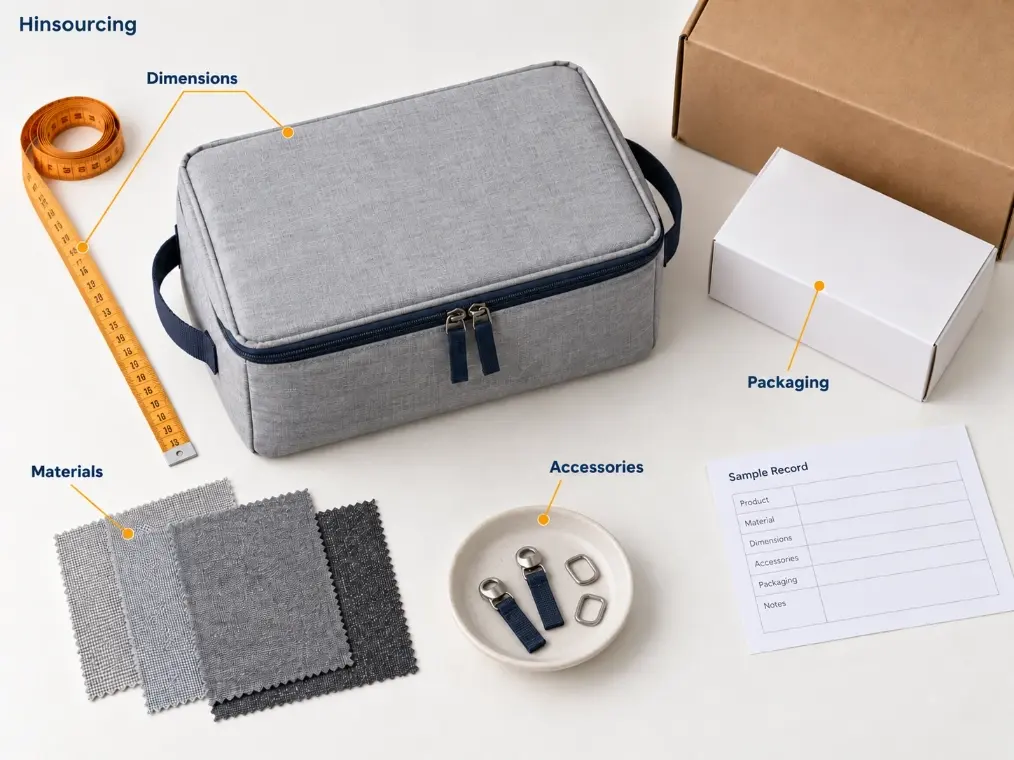
Keep the following with your sample approval:
- A product reference and sample version.
- Photos, measurements, and agreed performance checks.
- The packaging and artwork files to be used.
- Remaining changes, each with a clear acceptance requirement.
- Confirmation of whether another sample is needed before production.
If you request a different zipper after receiving a bag sample, don’t leave the instruction as “use a better zipper.” Identify the replacement and how it will be approved. Keep a reference sample available to the people checking production. The approved sample defines the target; it doesn’t prove the whole batch meets it.
Step 6: Confirm the Order Terms and Production Milestones
Put the approved specifications, quantities, packaging, commercial terms, and acceptance process into the order documents. Agree on who may approve changes and how problems will be reported, so you don’t discover a material substitution during final inspection. Before production starts, ask:
- What starts the lead-time clock: deposit receipt, artwork approval, material arrival, or another event?
- Which milestones will you receive updates on?
- What evidence or conditions are required before each payment?
- Who pays for agreed rework or reinspection if goods fail the agreed checks?
- Who authorizes shipment, and what happens if an issue remains unresolved?
Confirm the recipient’s relationship to the contracting supplier before transferring funds. If bank details change, verify the change using an established contact channel rather than relying on the new message alone. Where platform payment protection is available, read the terms for that order and keep the agreed specifications in the relevant transaction record.
Don’t use a universal deposit percentage as a substitute for negotiating suitable terms. Stock purchases, custom tooling, and made-to-order goods involve different commitments. Our guide to production follow-up and quality control explains the distinction between tracking progress and inspecting the finished goods.
Step 7: Inspect the Goods and Verify FBA Preparation
Book inspection early enough to allow correction before dispatch. Give the inspector the current specification, approved sample information, and a product-specific checklist. Agree on the inspection method and acceptance criteria; a sample-based inspection does not check every unit or guarantee a defect-free shipment.
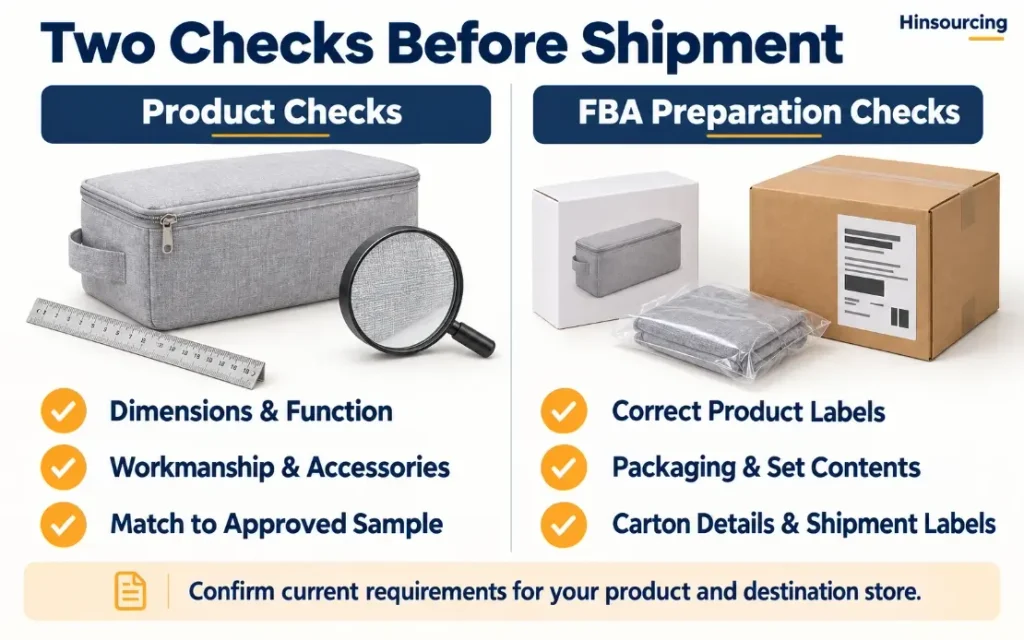
Product Checks
- Appearance, workmanship, dimensions, and agreed functional checks.
- Correct versions, accessories, and quantities.
- Packaging protection and the condition of finished goods.
- Differences from the approved sample or written specification.
FBA Preparation Checks
- The applicable product barcode is correct and scannable.
- Labels match the product and variant inside the packaging.
- Bundles or sets contain the correct components and are prepared as required.
- Packaging, warnings, cartons, and shipment labels follow the relevant current requirements.
- Carton contents agree with the shipment information supplied by the seller.
Don’t treat SKU, ASIN, GTIN, and FNSKU as interchangeable instructions. Obtain the applicable barcode and label requirements from your account, then give the packing team approved files and placement instructions. Check a packed unit before the whole run is labeled.
For US FBA shipments created from January 1, 2026, Amazon ended its prep and item-labeling services. Arrange that work before sending inventory to FBA rather than assuming Amazon will finish it for you. The scope and transition are explained in Amazon’s official clarification. Check other stores separately.
Step 8: Ship Inventory Using Your Confirmed Fulfillment Plan
Plan the route while production is underway. The right arrangement depends on shipment size, how much preparation remains, your destination, and when inventory is needed.
| Route | When to consider it | What to settle first |
|---|---|---|
| Supplier directly to FBA through an arranged carrier or forwarder | One prepared shipment with completed checks | Shipment plan, labels, import arrangements, and delivery requirements |
| Suppliers to a China consolidation warehouse, then onward | Products, packaging, or accessories come from several sources | Receiving records, assembly or packing tasks, quantities, and dispatch approval |
| China to an overseas 3PL before FBA or customer fulfillment | You need local storage, staged replenishment, or further handling | Receiving charges, prep scope, storage, and onward-delivery costs |
For a multi-supplier bundle, assign someone to reconcile all components. If the main product is ready but its accessory is missing, the set isn’t ready to ship. Consolidation can simplify transport, but it doesn’t automatically reduce each factory’s production MOQ.
Confirm the Shipping Handover
Compare air, sea, or courier options using the packed dimensions and weight, the delivery window, and a written quote. Confirm what trade terms and charges cover, who handles customs and import arrangements, and which destination appears in the shipment plan. A DDP quote still needs an understandable scope and named responsible parties.
Keep the packing list, carton quantities, shipment identifiers, and transport records together. Delivery to an Amazon facility and inventory becoming available for sale are separate milestones. Leave room for receiving in your replenishment plan.
What Should You Do When a Sourcing Order Goes Wrong?
When an order has a problem, first establish what happened and which goods are affected. Photos, measurements, batch references, and written requirements give you a better basis for action than a general complaint that the quality is poor.
Handle Inspection Failures Before Releasing the Shipment
Ask the inspector to identify the issue, the checks performed, and the affected sample or lot. Compare the findings with the agreed acceptance criteria, then request a corrective proposal from the supplier. Don’t treat a failed sample inspection as proof that every unit is defective, or a supplier’s reassurance as proof that the problem is fixed.
| Finding | Next decision |
|---|---|
| Goods differ from the approved specification | Determine the extent, correction options, and revised schedule |
| Packaging or labeling is wrong | Agree on correction and verification before dispatch |
| Supplier proposes sorting or rework | Confirm the method and how the corrected goods will be checked |
| Compliance or safety concern remains unresolved | Obtain the necessary specialist assessment before release |
A discount doesn’t make an unsuitable product suitable. Document the agreed remedy and any reinspection, payment, or shipment conditions. Available remedies depend on the order terms and circumstances; an agent cannot guarantee a refund simply by requesting one.
Respond to Delays, Missing Units, and Customer Complaints
For a delay, establish the unfinished task and revised completion date before considering faster freight. Air shipping won’t solve a material shortage. If partial shipment is proposed, confirm which complete, checked units can leave and what the split will cost.
For missing goods, reconcile factory packing records, warehouse receipts, transport handovers, and destination counts. Follow the current Amazon process for a receiving discrepancy when applicable. If customer complaints emerge after sale, connect them to batches and specific defects, then agree on a change that can be checked in the next production run.
How Do You Plan Your First Order and Reorders?
Your first order should give you useful evidence about both demand and the supplier without committing more cash than the business can support. Repeat orders should use what you’ve learned, including actual production times and customer feedback.
Set an Order Quantity You Can Support
Compare the MOQ with your demand assumptions, cash budget, storage costs, and the consequences of slow sales. If the minimum is too high, discuss standard materials, fewer variants, or simpler packaging before buying extra units just to reach a price tier.
Leave money available for inspection, shipping, selling expenses, and a possible reorder. A first batch that consumes the entire budget can leave you unable to replenish even if it sells well.
Plan Reorders Around the Full Lead Time
A useful starting point is expected demand during replenishment lead time plus safety stock, compared with your inventory position. Include stock already on order, and update the assumptions using actual sales rather than only the launch forecast.
Your planning checks should include:
- Material availability and the factory’s confirmed production slot.
- Inspection, possible correction, and packing time.
- Transport, import processing, and destination receiving.
- Peak-season capacity and holiday arrangements.
- Any changes to the product, packaging, or required documents.
Some tasks overlap. Ask for a dated schedule instead of adding every quoted duration together or assuming a repeat order will follow the first order’s calendar.
Qualify a Backup Supplier Before You Need One
A second contact isn’t a qualified backup. If supply continuity justifies the expense, compare a candidate against your current specification and reference sample, then assess a trial order before depending on it.
Confirm design and tooling rights before planning a transfer. Keep product changes visible, especially when the replacement will supply an existing listing. Developing a backup during normal trading gives you more time to assess it than searching after your current factory misses a deadline.
Practical Tips for Amazon Sellers Sourcing from China
Small coordination habits can save repeated explanations and prevent avoidable packing errors. These are the working practices I’d build into a sourcing project alongside the formal order process.
- Keep the first assortment manageable. Every extra color, size, and bundle adds another specification, stock count, and label combination to control.
- Ask for separate minimums for the finished product, materials, colors, and printed packaging. You may be able to simplify the requirement causing the highest minimum.
- Maintain one current change log. Record the request, supplier response, approved version, and approval date instead of expecting people to reconstruct decisions from messages.
- Photograph a correctly packed reference unit, including accessories and label placement. Written specifications still matter, but the reference helps the packing team understand the intended result.
- Recalculate costs after packaging changes. A nicer box may alter both shipment volume and fulfillment costs.
- Turn recurring return reasons into specific checks. If buyers report missing screws, add a hardware-pack count rather than telling the factory to “improve quality.”
Do Amazon Sellers Need a China Sourcing Agent?
An Amazon sourcing agent is worth considering when supplier selection, product development, or daily follow-up exceeds your team’s capacity. Local support is particularly useful when several factories must coordinate products, packaging, and accessories for the same order.
Ask what you will receive for the fee:
- A supplier comparison showing differences and unresolved questions.
- Samples and recorded feedback before a production decision.
- Production updates tied to agreed milestones.
- Inspection findings and follow-up on identified problems.
- Packing or shipping coordination within the agreed scope.
Our guide to what a purchasing agent does in China explains these responsibilities in more detail. When choosing a purchasing agent, compare fees, relevant experience, and actual deliverables. You can agree on selected tasks or broader support while keeping control of product strategy, account decisions, and purchasing approvals.
How Hinsourcing Can Support Your Amazon Sourcing Project
At Hinsourcing, we help buyers evaluate products and suppliers before committing to a bulk purchase. We work from your requirements, narrow the supplier options, and use actual product photos or video to explain what is available. When you need physical samples, we can coordinate them before you approve the goods for bulk purchasing.
We list product prices, sourcing service fees, and shipping costs separately. Production follow-up, inspections, packaging, consolidation, and shipping coordination are agreed around the project. You make the key purchasing decisions while we handle the day-to-day work assigned to us.
To discuss your Amazon sourcing project, send:
- A product link, photo, or specification.
- Your estimated quantity and customization needs.
- The Amazon marketplace and fulfillment method.
- Your target timing and the main issue you need help resolving.
FAQs About China Sourcing for Amazon Sellers
These questions address practical details that can affect a first order. Confirm the answers for your own product and destination before approving production or booking freight.
Can Chinese Suppliers Ship Directly to Amazon FBA?
Yes, a supplier can arrange a shipment through a suitable carrier or forwarder when the goods, documents, and shipment setup meet the relevant requirements. Confirm who handles inspection, prep, import arrangements, labels, and delivery. Direct shipping should not mean skipping those tasks.
What Is the Minimum Order Quantity for Amazon Sourcing?
The supplier sets its production minimums, not Amazon. MOQ depends on the product, materials, colors, and customization. Ask whether the quoted minimum applies to the whole order or each variant, and whether standard materials or packaging would change it.
Can I Buy from 1688 and Sell on Amazon?
You can source suitable products through 1688, but purchasing there doesn’t establish that the goods are eligible for Amazon. Check the supplier, product authenticity, required documents, packaging, and delivery arrangements. Confirm a workable payment and export plan before placing the order.
How Much Money Do I Need to Start Sourcing from China?
Build the budget from your product and quantity rather than a universal startup figure. Include samples, development, inventory, checks, preparation, freight, import costs, and selling expenses. Keep a reserve for corrections or delays and consider when you’ll need cash for replenishment.
Who Is Responsible for FBA Prep and Labeling?
You need to arrange appropriate preparation for your inventory. The supplier, sourcing agent, or a prep provider can perform agreed tasks, but responsibilities, files, checks, and charges should be clear before packing starts. Verify current requirements for the product, account, and destination store.