Finding a product on a B2B sourcing platform can take minutes. Deciding whether to order it takes more work. You need to know which version the supplier has quoted, who will make it, and what happens after you pay.
Platform listings are a useful starting point for supplier conversations. Before recommending a purchase, I want answers about the product itself and the work needed to deliver it. Understanding the platform’s role helps you know which questions to ask the seller and which tasks still need someone to handle them.
What Is a B2B Sourcing Platform?
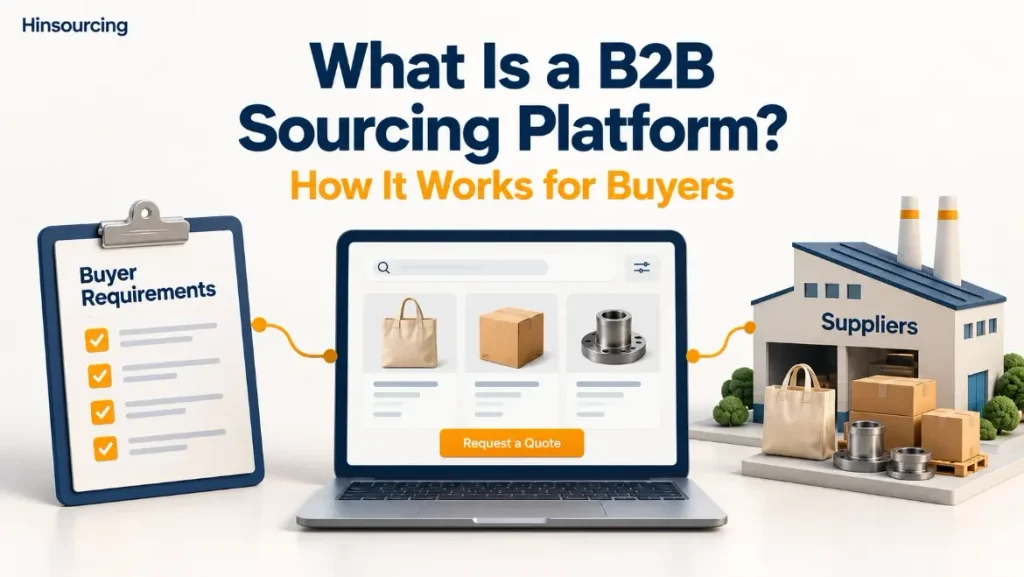
“B2B” means business-to-business. In sourcing, the buyer is purchasing goods or services for a business, such as products for resale, packaging for a brand, or components for manufacturing. The platform brings buyers and potential suppliers together and provides tools for some or all of that process.
Unlike a typical retail purchase, the product and price may need discussion before checkout. A buyer ordering fabric bags might request a different lining, a printed logo, or individual packaging. The supplier then needs to quote that version. An RFQ, or request for quotation, sets out what the buyer wants suppliers to price.
Ready-made goods can be simpler: a listing may already specify the version, quantity, and delivery options. The distinction is how much still needs agreeing before purchase. A custom order requires more information than a product photo and a unit price.
How Is a Sourcing Platform Different from a Supplier?
The platform and the company selling the goods are not necessarily the same business. On a marketplace hosting independent sellers, the platform provides the online environment, while individual suppliers present products and respond to inquiries. Those suppliers may be manufacturers, trading companies, or distributors.
A platform’s familiar name doesn’t identify who will manufacture your order. Check the company behind the listing and the seller named in the proposed transaction. Some platforms also sell goods or provide managed sourcing services, so establish which arrangement applies. The responsibility section below explains what to confirm once you are ready to order.
What Are Some Common B2B Sourcing Platforms?
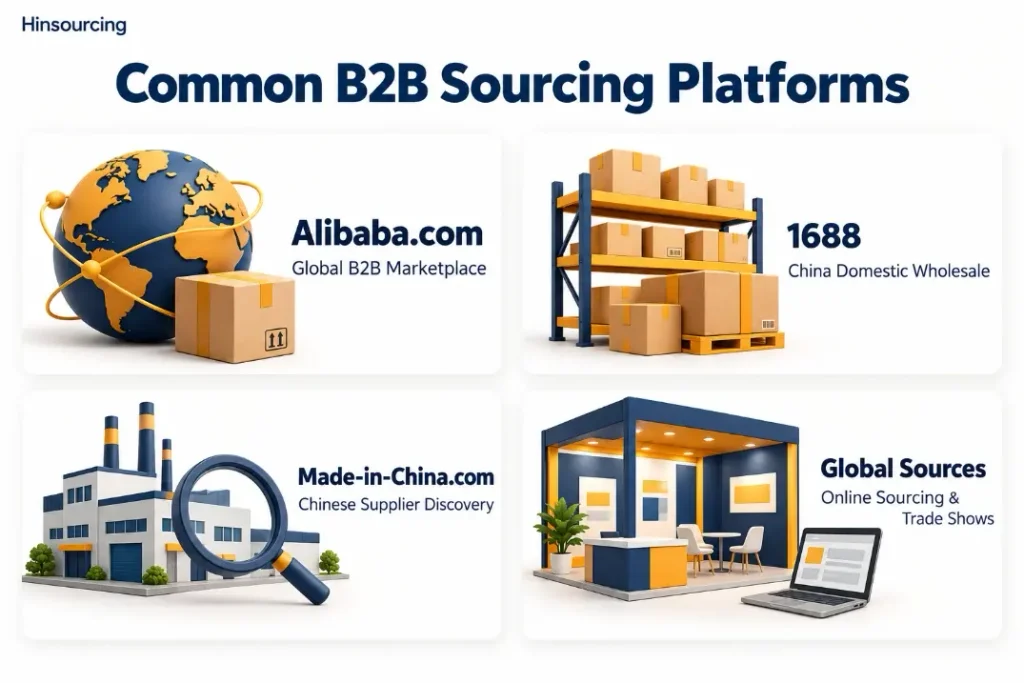
For buyers exploring suppliers in China, examples include Alibaba.com, 1688, Made-in-China.com, and Global Sources. They connect businesses with potential suppliers, but their market focus and purchasing arrangements differ.
- Alibaba.com: A global B2B marketplace where buyers can search across product categories, contact suppliers, and discuss wholesale or customized orders. Its international focus makes it a familiar example of online cross-border sourcing.
- 1688: Alibaba Group’s domestic wholesale marketplace in China. Overseas buyers can explore its listings, but should confirm how communication, payment, and delivery will work for their order.
- Made-in-China.com: A B2B platform connecting global buyers with Chinese suppliers. Its product listings and supplier information give buyers another channel for identifying companies and discussing purchasing requirements.
- Global Sources: A sourcing business combining online supplier discovery with trade shows. Buyers can research suppliers online and explore opportunities to meet exhibitors and examine products in person.
These are examples, not a ranking. Finding a supplier on a familiar platform is the beginning of the assessment. You still need to establish whether that company can supply the product, quantity, and service your business needs.
What Types of B2B Sourcing Platforms Can Buyers Use?
Two distinctions help explain the options: the industries a platform covers and the purchasing tasks it supports. These overlap. A specialized industry network can also offer online transactions and hands-on sourcing assistance.
Broad Marketplaces and Industry-Specific Networks
Broad marketplaces cover many product categories. Alibaba.com, for example, is described by Alibaba Group as a global B2B e-commerce platform. This type of marketplace can be useful when your search involves several kinds of products or suppliers.
Industry networks concentrate on a narrower field. FOURSOURCE’s buyer services focus on apparel and textiles, including fabrics, trims, and yarns. Its tools include supplier discovery, quotation requests, and access to certificate information. A focused network may help you ask more relevant questions, but you still need to check whether a supplier fits your order.
For a comparison of individual options, see our guide to websites for sourcing from China. Here, the more useful distinction is what happens after you find a company.
Supplier Directories, Transaction Platforms, and Managed Services
Some services help you discover suppliers and make contact. Others support orders and payments. Some also offer people who can help with the purchasing work. Access to a platform doesn’t automatically include every service advertised on its website.
| Function | What It Helps You Do | What to Confirm |
|---|---|---|
| Supplier discovery | Find companies, review profiles, and send inquiries | What information has been checked and how recently |
| Online transactions | Record orders and use supported payment options | Which terms and protections apply to your order |
| Managed sourcing | Get help with agreed purchasing tasks | Who performs the work, what it costs, and what they report |
FOURSOURCE, for instance, also describes support for sampling, production, and inspections on its buyer page. That is why I wouldn’t assume a platform is only a directory. Read the service scope before deciding which tasks you need to handle elsewhere.
How Does a B2B Sourcing Platform Work for Buyers?
Buyers generally move through five stages, although some tasks may happen outside the platform. At each stage, aim to obtain information that lets you make the next decision. A supplier reply is useful when it resolves a question about your order, not simply because it arrives quickly.
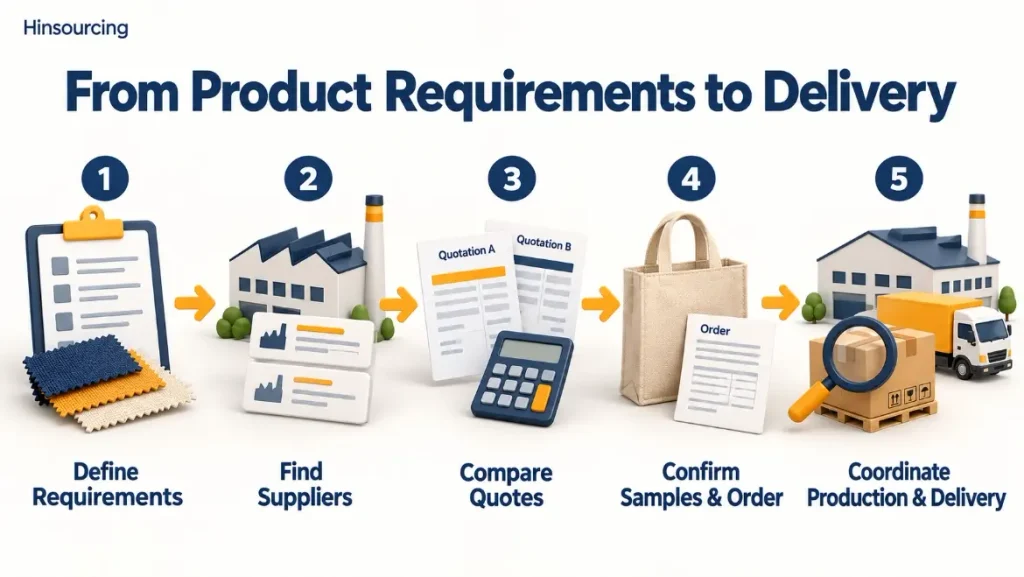
- Turn your product idea into a clear sourcing request.
- Find relevant suppliers and identify the companies behind the listings.
- Request quotations you can compare on the same basis.
- Confirm samples and record the agreed order.
- Coordinate production, inspection, and delivery.
1. Turn Your Product Idea into a Clear Sourcing Request
Start with what you want the product to do and which details are fixed. If you don’t yet know the right material or construction, say so. You can ask suppliers to propose alternatives, provided they explain what each quotation covers.
For an illustrative fabric storage-bag order, your request could include:
- Intended use and the weight the bag needs to hold.
- Dimensions, fabric requirements, lining, and closure.
- Quantity by size and color, including any trial quantity.
- Logo artwork and individual packaging requirements.
- Destination country, receiving location, and required arrival date.
- Questions that need resolving before a sample can be approved.
A reference image helps communicate appearance, but it leaves many of these details unanswered. For example, two bags can look similar while using different fabric weights or zipper constructions.
Separate your non-negotiable requirements from preferences. A supplier who proposes a different available fabric may still be worth considering if it meets the intended use. Ask for that alternative as a separate option rather than allowing it to replace your specification without explanation.
2. Find Relevant Suppliers and Understand Who You Are Contacting
Use product categories and available filters to narrow the search. Then read the company information behind the listings. Establish who is offering the goods and whether that business manufactures them, sources them from another company, or uses subcontractors for some processes.
A factory can suit an order built around a particular production process. A trading company may help with a mixed-product purchase. The label alone doesn’t tell you who will control quality or resolve a problem.
Keep a short record for each candidate:
- Company name and product or profile link.
- Evidence of experience with the relevant product.
- Confirmed information, such as an available material or accepted quantity.
- Open questions, such as the production location or packaging minimum.
A useful shortlist explains why each supplier belongs on it. “They replied first” is a weaker reason than “They can explain the construction, quote the requested version, and provide a relevant sample.” Our guide to finding manufacturers and suppliers in China covers the wider search process.
3. Request Quotes You Can Actually Compare
Send the same brief to your shortlisted suppliers. Ask them to identify anything they cannot meet and to separate alternatives from the requested version. Otherwise, several attractive prices may refer to different products.
Use a comparison sheet with these fields:
| Item | What to Record |
|---|---|
| Product version | Material, dimensions, components, and approved changes |
| Quantity and unit | Pieces, sets, meters, or another specified unit; minimums by variant |
| Packaging | What is included and what requires a separate charge |
| Samples and setup | Sample, artwork, tooling, or other development costs |
| Delivery | Named delivery point, included transport, and exclusions |
| Timing | Sample schedule, production lead time, and what starts the clock |
For the storage-bag example, a plain bag delivered to a warehouse in China is a different offer from a branded bag delivered to your address. Bring both quotations to the same product specification and delivery point before comparing totals.
Mark missing information as unconfirmed, not zero. If a supplier cannot quote freight until packing details are available, keep that cost open and obtain an estimate on stated assumptions. Don’t treat the product subtotal as your final purchasing cost.
4. Confirm Samples and Record the Agreed Order
Samples let you check details that a listing cannot communicate well. With textiles, that includes feel, thickness, and how a color looks away from the screen. Establish whether you are reviewing a stock sample, a custom development sample, or the final version intended for production.
Before approving the bulk order, check that the record includes:
- The agreed specification and identifiable sample reference.
- Quantity by variant, packaging, and labeling instructions.
- The seller’s company details and agreed payment arrangements.
- Production timing and any approvals needed before work begins.
- Inspection arrangements and the process for reporting problems.
If you approve a change after receiving the sample, record it against the order. “Same as the sample” becomes ambiguous when the fabric, logo, or packaging has since changed. Save the final agreed version together with the relevant messages and attachments.
Where you use platform protection, follow its order and payment requirements. Alibaba.com’s Trade Assurance overview describes protection tied to the trade contract and its refund and dispute policy. Confirm eligibility and current terms for your purchase; a conversation with a supplier alone doesn’t establish coverage.
5. Coordinate Production, Inspection, and Delivery
Once the order is placed, agree on updates that help you track it. A calendar date without an explanation of what should be finished is hard to use. Ask whether an update concerns material purchasing, production, packing, or readiness for inspection.
For a custom bag order, for example, you might arrange an update when the agreed materials are ready and another when finished goods can be checked. The appropriate checkpoints depend on the production process. Decide early who will review the information and approve any proposed substitution.
Before shipment, establish:
- Who checks the finished goods and which requirements they check against.
- Who reviews the findings and authorizes release.
- Who arranges collection, transport, and the required documents.
- Where the seller’s delivery responsibility ends.
- Who checks the delivery on arrival and reports discrepancies.
Receiving goods at a warehouse doesn’t mean their quality has been checked. If you need inspection, sorting, or repacking, include those tasks explicitly. Keep an order record with the latest status, supporting information, next action, responsible person, and due date. This remains useful whether updates arrive through a platform, email, or a sourcing agent.
Who Is Responsible for the Order: The Platform, Supplier, or Buyer?
Check the order and service agreements rather than assuming one company handles everything. The platform operator, contractual seller, manufacturer, and logistics provider may be different businesses. The table below is a planning aid, not a substitute for the terms of your purchase.
| Party | Role to Clarify | Question to Ask |
|---|---|---|
| Platform | Tools, payment arrangements, and any applicable dispute or support services | Which services and protections apply to this order? |
| Seller and manufacturer | Supply commitments, production, and correction of agreed problems | Who is the contractual seller, and who makes the goods? |
| Buyer | Requirements, purchasing approvals, and arrangements for the destination | Who approves samples, changes, and shipment release? |
| Sourcing or inspection provider | Specifically commissioned checks and follow-up | What work will be performed, and what evidence will I receive? |
| Logistics provider | The agreed transport and handling stages | Where does the service begin and end, and what is excluded? |
One business may perform several roles. Ask it to explain those roles separately. A company arranging freight might also offer inspection, but you need to commission both if you want both. Likewise, hiring an agent for supplier research doesn’t automatically include production follow-up; our guide to what a purchasing agent handles explains the possible scope.
What Can a B2B Sourcing Platform Help You Achieve—and What Still Needs Checking?
A platform can make supplier discovery and communication easier. Its records can also help you organize a purchase. Those advantages are most useful when you understand what each piece of information tells you and where further checking is needed.
Easier Discovery and More Structured Communication
Depending on the available tools, you can:
- Find suppliers you would otherwise struggle to contact.
- Send a consistent brief instead of starting each inquiry from scratch.
- Keep quotations, questions, and order details together.
- Return to previous discussions when you plan a repeat purchase.
Once you have candidates who can answer your product questions, move the conversation forward. Request a sample or resolve the gaps in a quotation. I wouldn’t keep browsing simply to build a longer supplier list.
Supplier Information Is Not Proof of Your Finished Order
Different evidence answers different questions. A company profile, a factory assessment, and a sample each have a purpose:
- Business information helps identify the company. It doesn’t establish the quality of the goods you will receive.
- A capability assessment can describe facilities and processes within its scope. Check its date, location, and relevance to your product.
- An approved sample records an acceptable version. It doesn’t show whether every production unit matches it.
- An inspection report describes findings from the agreed checks. It may not cover laboratory performance or every unit in the shipment.
For example, Alibaba.com’s Verified Supplier information describes independent assessments and includes limitations on what Alibaba itself verifies or guarantees. Read the assessment behind the badge. If the gaps matter to your order, consider targeted supplier verification and factory audits, followed by appropriate product checks.
A Fabric Buying Scenario: Why Listings Need Follow-Up
Consider an illustrative purchase of textile fabric based mainly on a 1688 listing’s price and pictures. The delivered material could differ in color or feel from what the images suggest. A listing alone cannot confirm that the fabric matches the buyer’s intended use.
Before placing a larger order, a buyer could state the required color, hand feel, and other specifications, then compare relevant physical samples. Where practical, someone locally could examine candidate materials and record photos and observations for the buyer. These steps would inform the decision; they would not guarantee a particular outcome.
In this scenario, the photos leave important questions unresolved. Color and feel need closer examination before the purchase decision. For buyers comparing unfamiliar fabrics, I would use the listing to identify possibilities, then arrange suitable samples or physical checks. More product photos alone would not show how the material feels.
How Hinsourcing Supports Buyers Using Sourcing Platforms
You can bring us a product link or an existing supplier conversation. We can then discuss which parts of the purchase need more investigation or local follow-up. The work depends on your product, concerns, and agreed service scope.
Support can include:
- Screening candidates against your requirements and organizing the shortlist.
- Comparing quotations and clarifying product or packaging differences.
- Providing product photos or videos and coordinating samples.
- Visiting suppliers where an on-site review is part of the agreed work.
- Following production and coordinating agreed checks and shipment preparation.
You retain the purchasing decisions, while we handle the tasks you have assigned. To discuss support with Hinsourcing, share the product link, required quantity, destination market, and anything you are unsure about. That gives us a practical starting point for defining the work and fees.
Frequently Asked Questions
Before opening an account, check what you can do with it, what you may need to pay for, and which conditions apply to the products you want to buy.
Is a B2B Sourcing Platform the Same as a B2B Marketplace?
The terms overlap, but they don’t guarantee identical services. A sourcing platform may focus on supplier discovery and quotation requests, while a marketplace may also support transactions. Some offer both, plus managed services. Check the actual features and service terms rather than relying on the name.
Is Alibaba.com a B2B Sourcing Platform?
Yes. Buyers use Alibaba.com to find suppliers and discuss business purchases, with online order and payment services also available. If you are deciding between it and China’s domestic wholesale marketplace, our Alibaba.com and 1688 comparison explains the differences without assuming one is always cheaper or better.
Are B2B Sourcing Platforms Free for Buyers?
Some allow buyers to browse or send inquiries without a subscription. That doesn’t make every part of purchasing free. Check separately for account upgrades, payment charges, sourcing support, samples, inspection, and delivery. Ask which costs come from the platform and which come from suppliers or other service providers.
Can You Place a Small Order on a B2B Sourcing Platform?
Often, but the minimum depends on the supplier and the product. Existing stock may be available in smaller quantities than goods requiring custom material, printing, or packaging. Confirm minimums for each size or color, as well as the total order. A sample order may have different terms from repeat production.
Does a Verified Supplier Badge Guarantee Product Quality?
No. Read what that particular verification covers, who carried it out, and when. It may provide useful company or capability information, but your purchase still needs an agreed specification and suitable product checks. Supplier assessment and inspection of your finished goods answer different questions.