

Quick Answer
When your order involves several suppliers, a Yiwu sourcing agent can coordinate product details, deliveries, checks, and shipment preparation. You gain someone responsible for following up on the agreed work in China, while keeping control over purchases and important changes.
The main benefits are:
- Keeping products, samples, and supplier details connected.
- Comparing quotes on the same buying terms.
- Following orders after you leave the market.
- Checking incoming goods against your purchase orders.
- Resolving discrepancies before international shipment.
- Consolidating goods with clear carton and product records.
- Keeping useful records for repeat orders.
Finding products you want to sell is the enjoyable part of buying in Yiwu. The harder work begins when those products come from different shops, with different packing arrangements and delivery dates. A full shopping list can still be a long way from a shipment you can approve.
For me, the strongest reason to use a Yiwu sourcing agent is having someone follow those loose ends through. Below, I’ll explain what that work should look like, what you should receive for the fee, and where local coordination can make a difference to a mixed order.
Why Do Multi-Supplier Orders in Yiwu Need Extra Coordination?
Each supplier is handling its own part of your purchase. You need someone to keep track of the whole order, including the gaps between suppliers. One shop’s goods may be ready while another is waiting for packaging, and neither shop necessarily knows your final shipping deadline.
Yiwugo’s official introduction describes how its online listings connect buyers with the physical market. That helps you discover products, but you still need to confirm who sells them, who makes them, and who will handle your order. A market booth doesn’t automatically mean you’re dealing directly with a factory.
Coordination becomes harder when:
- Similar products have different supplier codes or unclear specifications.
- A quotation uses a different selling unit from the one you expected.
- Translation leaves the material, assortment, or delivery date uncertain.
- Goods arrive in separate batches with inconsistent packing information.
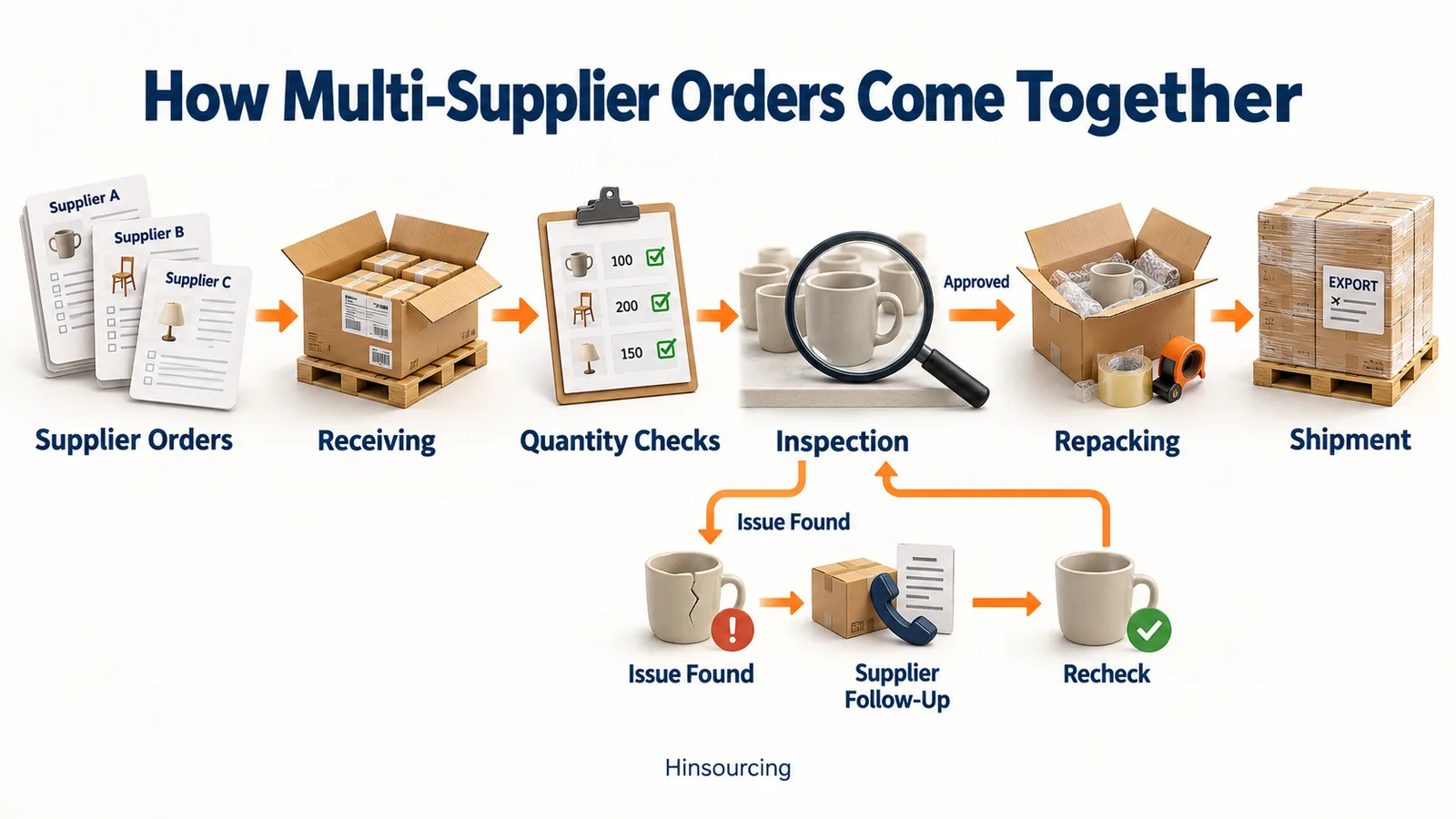
Received, checked, and approved for shipment are different statuses. A warehouse receipt should never be the only evidence you use to release a mixed order.
Why Use a Yiwu Sourcing Agent for Multi-Supplier Orders?
A Yiwu sourcing agent can give you one coordinated view of purchases spread across several suppliers. Within the agreed scope, that includes matching samples to orders, checking deliveries, reporting problems, and preparing goods for shipment. The seven benefits below show what you should expect that work to produce.
1. Keep Products, Samples, and Supplier Details Connected
Imagine returning from a market visit with photos of several similar storage baskets. One was sturdier, another included a liner, and a third came in the color you wanted. If the photos aren’t linked to shop details and samples, asking for the right version later becomes difficult.
An agent can build a purchasing record while the choices are still clear. I’d want it to include:
- Your product code and the supplier’s own reference.
- The shop or company name, booth location, and contact person.
- Photos showing the selected version and distinguishing details.
- Material, dimensions, color, quantity, and packaging requirements.
- The approved sample reference and the date of any changes.
Give each variation its own SKU, or stock-keeping unit, where you need to track it separately. Two colors may share a product name but still need separate order lines. That distinction matters when goods arrive, especially if one color is missing.
The record should also separate the product you approved from alternatives you merely considered. An attractive replacement photo isn’t permission to change the order. Ask the agent to update the approved version only after you agree, and keep the earlier version available so both sides can understand what changed.
2. Compare Quotes on the Same Buying Terms
A useful negotiation starts with a comparable quotation. Before asking an agent to push the price down, make sure the suppliers are pricing the same thing.
Consider this illustrative comparison of two offers for a retail accessory:
| Detail | Supplier A | Supplier B |
|---|---|---|
| Quoted unit | One finished item | A pack of items |
| Packaging | Plain protective bag | Printed retail card |
| Color selection | Buyer chooses the mix | Supplier selects the assortment |
| Domestic delivery | Included to the agreed address | Charged separately |
Neither offer can be judged from the headline number alone. An agent should clarify the differences, request equivalent terms, and show you the remaining trade-offs. Ask whether the quoted minimum applies to the total order, each model, or each color.
There may be room to negotiate packing, quantity splits, delivery arrangements, or sample charges. A supplier’s production minimum may be less flexible. If a lower unit price requires more stock than you can sell, the larger purchase may be a poor deal.
Judge the negotiated offer against your usable quantity and total cost. Don’t assume an agent will always obtain the lowest price, or that the cheapest quote will leave you with the best inventory.
3. Keep Follow-Up Moving After You Leave the Market
The supplier you met may still need to reserve stock, confirm a color, or arrange production. Once you leave Yiwu, those conversations continue. A purchasing agent can follow up in Chinese, clarify uncertain answers, and maintain a schedule across your suppliers.
Ask for updates that separate the promised delivery date from the latest confirmed position. “The supplier says next week” is incomplete if nobody knows whether the goods are finished, packed, or waiting for materials. A useful update identifies what is holding the order up, the next action, and when someone will check again.
Your agreement should make approval limits clear:
The agent can follow up and propose alternatives. Changes to the product, price, quantity, or agreed shipping plan need your approval unless you have expressly delegated that decision.
This matters when a supplier offers a substitute to keep the order moving. A slightly different finish may be acceptable for one product and unacceptable for another. The agent should explain the difference before accepting it, including any effect on matching products or packaging. Keep that decision in the order record rather than leaving it buried in a chat thread.
4. Check Each Delivery Against the Purchase Order
When several suppliers deliver to a collection point, ask for an arrival report linked to your order lines. A photograph of stacked cartons tells you little about what is inside them.

The receiving and inspection plan should address the details your order needs:
- Quantities received, including partial deliveries and outstanding items.
- Model, color, size, or other product variations.
- Comparison with the approved sample and written specifications.
- Visible damage, workmanship, and agreed functional checks.
- Packing quantities, carton markings, and differences from the supplier’s list.
Decide how deeply to check before deliveries begin. Counting cartons, opening selected cartons, counting individual pieces, and testing functions are different assignments. Ask which is included and what the report will show. Visual checks also cannot establish material composition or replace required laboratory testing.
Receiving checks can reveal missing units, wrong variations, weak packaging, inconsistent batches, or bulk goods that don’t match the sample. An agent should record the affected order line and the extent of the check, rather than simply describing the shipment as “good.”
Keep unresolved goods identifiable. If checked and unchecked stock gets mixed together, a later count may tell you how much is present without telling you what has been accepted.
5. Resolve Problems Before Goods Leave China
Finding a discrepancy is only the beginning. The agent also needs to follow the issue with the correct supplier and bring you a workable decision.
Suppose, as a hypothetical example, the order specifies a particular blue finish but part of the delivery arrives in another shade. The report should show the approved reference, the received goods, the quantity checked, and the affected quantity identified so far. Ask whether the supplier can replace it, how long that would take, and whether any additional checking is needed.
A practical issue record can be short:
Order line → discrepancy → supporting evidence → proposed remedy → buyer decision → recheck result.
Until the decision is made, the disputed goods should stay separate from stock approved for packing. If a replacement arrives, someone needs to check it against the original requirement. A supplier’s promise to correct the issue isn’t the same as confirmation that the correction has been made.
Local follow-up can make returns, replacement deliveries, or repacking easier to coordinate while the goods are still in China. It doesn’t guarantee that a supplier will agree to every request. The value is having the facts and options before you commit to sending the disputed goods overseas.
6. Consolidate Goods Without Losing Track of the Order
Consolidation brings deliveries together for shipment. If goods are repacked, the original supplier’s carton numbers may no longer describe what’s inside. The final packing record should show what is in each new carton, including SKU, variation, and quantity. Record final dimensions and weights so the freight quotation reflects the goods you intend to ship.
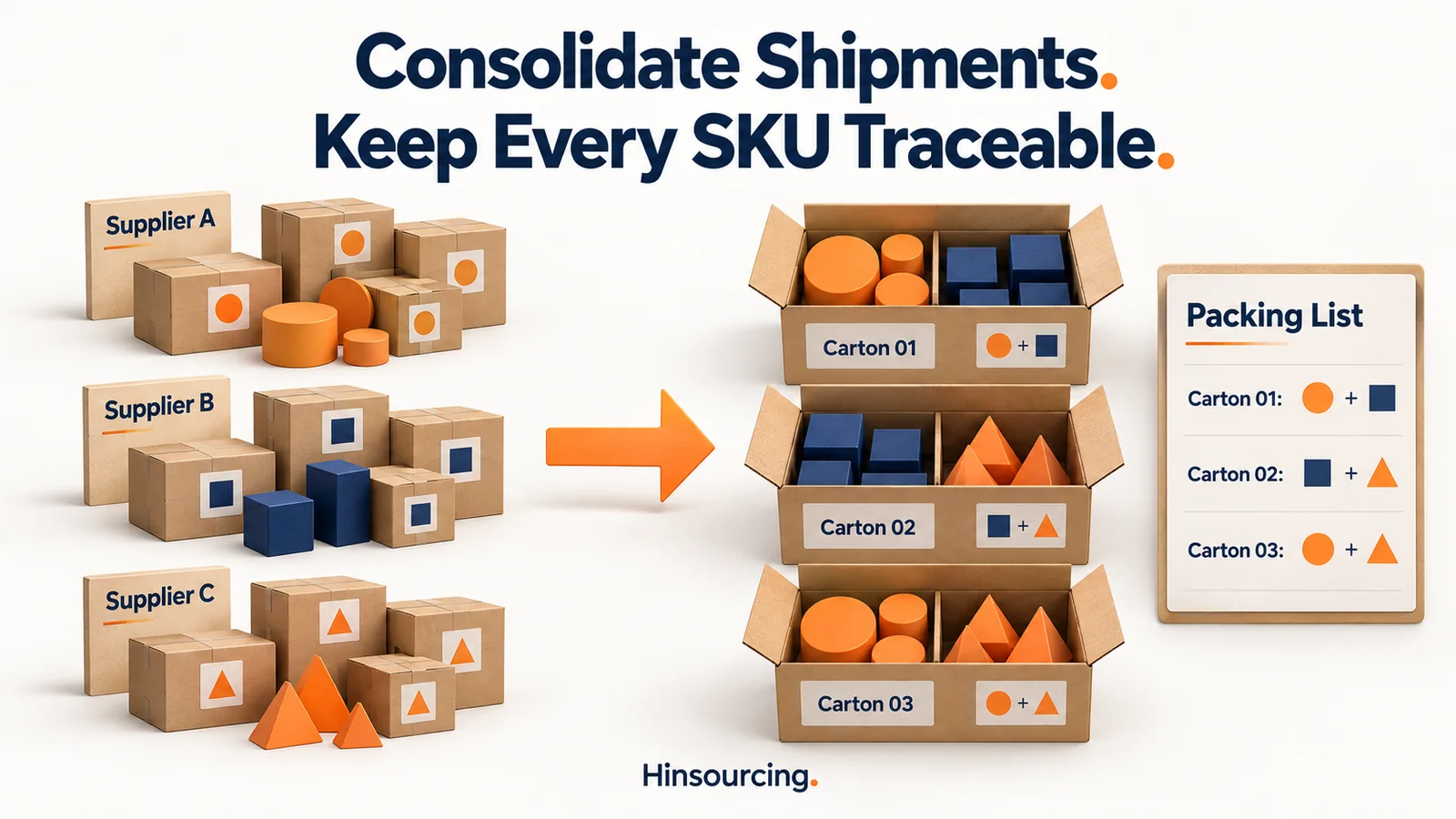
Packing decisions need care. Reducing empty space can help control shipping costs, but removing protection from fragile goods may create a much larger problem. Confirm who approves packaging changes and whether handling, packing materials, and storage are included in the service fee.
Agree on what happens when one supplier is late. There are several possible decisions:
- Wait for the missing goods, after comparing the delay and storage cost.
- Send the approved goods first and price a separate shipment for the remainder.
- Request a change or cancellation for the missing portion, subject to the supplier agreement.
The agent should provide the costs and timing implications rather than choose silently. A low-value missing item may still be essential if it completes a retail set. Conversely, delaying an entire seasonal order for an unrelated item may cost more than a later shipment. Consolidation should support your selling plan, not force every purchase into the same departure.
7. Make Repeat Orders Easier to Check
When a product sells well, you want to reorder the version your customers liked. A previous photo and a message saying “same as last time” leave too much open.
An agent can retain the approved specifications, sample references, packaging files, supplier details, and records of problems corrected on the first order. Those records give the next purchase a starting point and help you explain exactly what must stay consistent.
Before a repeat order, ask for confirmation of:
- Any material, component, finish, or production-source changes.
- The current stock position and quantity available in the approved version.
- Price, minimum quantities, and delivery arrangements for this order.
- Whether previous corrective actions have been carried through.
I would pay particular attention to substitutions described as equivalent. Matching dimensions doesn’t necessarily mean matching strength, appearance, or feel. If a change affects the product your customer receives, request evidence and decide whether a fresh sample is needed.
Repeat-order records are also useful when a supplier becomes unavailable. You can give an alternative supplier a defined requirement rather than ask it to guess from a photograph. That doesn’t guarantee an identical replacement, but it gives you a clearer basis for comparing one.
Which Buyers Benefit Most From a Yiwu Sourcing Agent?
The strongest fit is a buyer with several purchases that need to arrive as a coordinated order. You may need that support whether you’re buying remotely or visiting the market yourself.
| Your buying situation | Support worth discussing |
|---|---|
| Retail replenishment across several categories | Consistent product records and delivery follow-up |
| Wholesale orders assembled from different shops | Quantity checks, packing records, and consolidation |
| Seasonal merchandise with a selling deadline | Early reporting of delays and split-shipment options |
| Ecommerce sets or branded assortments | Component matching, labels, and packing coordination |
A straightforward repeat order from one established supplier may need less support. For technically demanding products, start with the required manufacturing expertise rather than assuming a Yiwu market supplier will suit the job. If your main question is how to purchase without traveling, see our guide to buying from Yiwu remotely.
Hinsourcing's Advice: How Should You Coordinate a Multi-Supplier Yiwu Order?
Finding suitable products in several shops completes only part of the purchase. Delivery dates, received quantities, and packaging suitable for transport still need follow-up. For this kind of order, I’d start with one purchasing record that connects each supplier to the agreed products, specifications, quantities, and delivery dates.
Hinsourcing recommends addressing these five tasks before consolidating goods for shipment:
- Check each incoming delivery. Record received quantities by supplier and product code, distinguishing complete, outstanding, and partial deliveries. A warehouse receipt does not mean quantities and product variations have been checked.
- Inspect products and packaging. Within the agreed inspection scope, compare goods with the approved sample and check color, dimensions, workmanship, and protective packing. Document discrepancies with photos and affected quantities so the supplier has specific information to act on.
- Follow up on problem goods separately. Record a proposed remedy for shortages, incorrect items, or unsuitable packing. Recheck replacement or corrected goods; a supplier’s promise to fix the issue is not confirmation that the work is complete.
- Decide how to handle late deliveries. Don’t let one supplier delay the whole order indefinitely. Compare the timing and cost of waiting with shipping in separate batches, then let the buyer decide.
- Confirm final packing details and charges. After repacking, update each carton’s contents, quantities, dimensions, and weight, and check the basis of the freight quotation. Explain any additional packing, handling, or storage charges before they are incurred.
To me, a useful order report should make it clear how much has arrived, what has been checked, which problems remain, and what decisions are needed next. That information helps buyers plan replenishment and sales, and assess whether their sourcing agent is doing the agreed work properly.
Can a Yiwu Sourcing Agent Help With Private Labeling and Product Bundles?
Yes, if the suppliers and the team handling the order can perform the work you need. Confirm who will produce the packaging, apply labels, assemble sets, and check the finished result. These tasks need an agreed scope and budget.
Align Branding and Packaging Across Suppliers
Use one approved artwork version for each label or package, with dimensions and product references attached. If separate suppliers print the same brand design, ask how color and layout will be compared before you approve production.
Retail packaging and shipping protection serve different purposes. A branded box still needs to fit the actual product and survive the planned handling. Check a packed sample, and confirm any effect on minimum quantities, preparation time, and freight volume before placing the full order.
Check Every Component Before Assembling a Bundle
Suppose a gift set uses a product, an accessory, and a printed card from three suppliers. A missing card can leave an otherwise complete set unready for sale.
Prepare a component list showing what belongs in each set. Approve the first assembled set, then use it as the packing reference. Ask the team to record complete sets, missing components, and leftover materials separately so you can decide how to handle the balance.
Do You Need a Market Guide, a Sourcing Agent, or a Freight Forwarder?
Choose by the work you need done. Service names can overlap, so ask where each provider’s responsibility starts and ends. Our explanation of what a sourcing agent does covers the broader role.
| Type of support | Typical assignment | Question to ask |
|---|---|---|
| Market guide or interpreter | Help you visit shops, communicate, and record selections | Who follows the orders after the visit? |
| Sourcing or purchasing agent | Coordinate agreed supplier, sample, order, and checking tasks | What reports and decisions are included? |
| Freight forwarder | Arrange the agreed transport and related logistics work | Are receiving, inspection, or repacking separate services? |
One company may cover several roles. Make sure the proposal identifies who does each task rather than relying on a phrase such as “full service.”
Is a Yiwu Sourcing Agent Worth the Cost for Your Order?
Several low-value purchases can involve more follow-up than one larger repeat order. To judge the fee, compare the proposed service with the work your team would otherwise need to do and the costs of correcting errors. Include your own time, but don’t treat an agent’s claimed savings as money you’ve already saved.
Compare the Full Service Scope, Not Just the Commission
Ask how the provider earns its income: a fixed fee, an order-based charge, a margin within the product price, or a combination. For a percentage fee, confirm the amount it applies to and any minimum charge.
Check whether the proposal includes:
- Sample handling and domestic transport.
- Receiving or handling charges per supplier or SKU.
- The agreed inspection work and any specialist tests.
- Storage periods, repacking, and packing materials.
- Loading, documents, and freight coordination.
Also ask about supplier-paid income and exchange-rate charges. An all-in quote isn’t automatically a poor deal, but you need enough detail to compare the same scope. A low commission alone doesn’t tell you the final cost.
Ask What You Will Receive for the Fee
For a managed mixed order, ask for examples of the purchasing record, arrival report, issue log, and final packing information you would receive. Agree how often you’ll get updates and which changes need approval. A sample report with customer details removed tells you more than a long list of services.
How Can a Yiwu Sourcing Agent Coordinate Payments and Export Paperwork?
An agent can help keep payment records and shipment information organized across suppliers. Before paying, confirm the purchasing arrangement, who receives each payment, and who prepares and checks the documents. Don’t assume these responsibilities are included because sourcing is included.
Confirm Who Receives Payments and Authorizes Release
Will you pay suppliers directly, or will the agent pay them under an agreed arrangement? Request a record linking each amount to its supplier and order. Confirm currency, conversion terms, transfer charges, payment dates, and how unused funds will be handled.
If the recipient differs from the contracting party, obtain and verify an explanation. Set payment and release conditions before ordering; don’t assume every supplier will accept payment only after inspection.
Match Shipment Documents to the Goods Actually Packed
The commercial invoice and packing information should reflect the actual shipment. Check product descriptions, quantities, carton counts, weights, and the relevant company details after any shortages or repacking have been resolved.
Identify who will coordinate the required transport and export documents, and who will confirm destination requirements with the appropriate specialists. Consolidating products doesn’t make their individual requirements disappear. Product-specific documents and restrictions should be considered before purchase, not left until loading day.
How Do You Choose a Yiwu Sourcing Agent for Multi-Supplier Orders?
Give candidates the same product list and describe the work you want delegated. Ask them to explain how they would handle a late delivery or a mismatch at receiving. The answers should identify people, records, and next actions.
- Who will manage the order, and who covers when that person is unavailable?
- Where will goods be received, and who operates that facility?
- How will each supplier delivery be matched to my SKUs?
- What happens to disputed goods while we agree on a remedy?
- Which changes need my approval, and what information will you share?
- Which charges could arise after the initial quotation?
Be cautious if responsibilities remain vague, the provider can’t show a usable reporting example, or it pressures you to ship goods with unresolved discrepancies. Consider a limited assignment before expanding the relationship. For broader background checks, read our guide to finding a purchasing agent in China.
How Can Hinsourcing Help You Plan a Multi-Supplier Yiwu Order?
At Hinsourcing, we help overseas buyers with supplier selection and purchasing coordination. For a Yiwu project, the starting point is identifying what still needs to be done and agreeing on who will handle it. That may involve supplier follow-up, sample coordination, checks, packing, or shipment preparation.
To discuss your order, prepare:
- Product photos or links, specifications, and quantities.
- Any existing shop contacts, quotations, or sample records.
- Your destination, delivery priorities, and packaging needs.
- The problems you want help resolving.
Discuss your sourcing project with Hinsourcing so we can review the required work, confirm the practical arrangements, and explain the proposed scope before you commit.
FAQs About Using a Yiwu Sourcing Agent
Before appointing an agent, clarify how the arrangement will work with existing suppliers, smaller orders, and problems discovered after delivery.
Can a Yiwu Sourcing Agent Work With Suppliers I Already Found?
Some agents accept this arrangement. Ask for a scope covering the tasks you need, such as follow-up, receiving, inspection, or consolidation. Share the agreed specifications and order history so the agent knows what the supplier has already promised.
Can an Agent Combine Orders From Different Yiwu Suppliers?
Yes, when suitable receiving and shipping arrangements are available. Confirm storage, checking, repacking, and late-arrival rules. Combining deliveries doesn’t mean every product can travel under the same handling conditions or that consolidation will always cost less.
Can a Yiwu Sourcing Agent Reduce Minimum Order Quantities?
An agent can discuss quantity options or find alternative suppliers, but cannot guarantee a lower minimum. Stock availability, color splits, and customization affect what is practical. Ask whether the proposed smaller order still matches the product and packaging you approved.
Does a Yiwu Sourcing Agent Guarantee Product Quality?
Inspection can identify problems within the agreed checks; it doesn’t guarantee a defect-free shipment. Confirm the checking method, acceptance criteria, reporting, and remedies in writing. Laboratory testing or specialist assessment may be needed for questions a visual or functional check cannot answer.
Can a Yiwu Sourcing Agent Source Products Outside Yiwu?
Some can, through their own staff or other arrangements. Ask about experience with your product, who performs the work, and any additional cost. The right production source may be outside Yiwu, particularly when you need specialized materials or processes.
What Happens if I Find a Problem After Delivery?
Report it promptly with the order reference, carton numbers, photographs, and affected quantities. Compare these with the inspection and shipping records. The agent can help investigate and discuss remedies, but responsibility, available compensation, and reporting deadlines depend on the relevant agreements and circumstances.