
Canton Fair at a glance
| Planning Detail | What to Know |
|---|---|
| Venue | Canton Fair Complex, Pazhou, Guangzhou, China |
| Session covered | 140th Canton Fair, Autumn 2026 |
| Exhibition format | Three phases covering different product groups |
| Published daily hours | 9:30 a.m. to 6:00 p.m., China Standard Time, on exhibition days |
| Registration | Use the official Buyer Service System and follow the instructions for your badge category |
The opening hours and venue are listed in the official fair overview. The dates and arrangements below describe Autumn 2026. For a future session, check its current official guide before making travel plans.
Canton Fair Dates and Product Phases
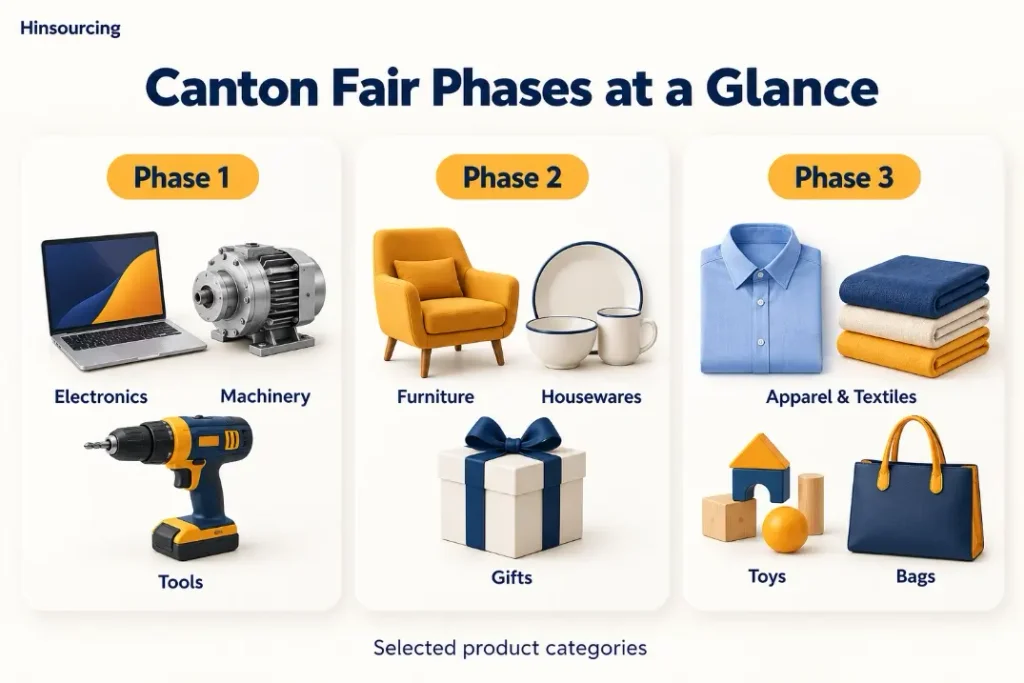
Choose your product phase before booking flights. Each phase lasts five exhibition days, with changeover days between phases. A company buying across several categories may need a longer trip or separate visits.
| Phase | Autumn 2026 Dates | Representative Products |
|---|---|---|
| Phase 1 | October 15-19 | Electronics, electrical appliances, machinery, lighting, tools, hardware, vehicles, and energy products |
| Phase 2 | October 23-27 | Furniture, kitchenware, housewares, ceramics, gifts, decorations, and building materials |
| Phase 3 | October 31-November 4 | Clothing, fabrics, home textiles, footwear, bags, toys, baby products, office supplies, food, and health-related goods |
The changeover periods are October 20-22 and October 28-30. These dates and categories follow the official 140th-session schedule and exhibition-sector list.
The table is a starting point for planning. Check your exact category in the current directory. For example, furniture is in Phase 2, while home textiles are in Phase 3. A retailer sourcing furniture and bedding should account for both phases rather than assuming all home products appear together.
Is the Canton Fair Worth Visiting for Your Business?
A visit is easier to justify when seeing products or meeting suppliers will help you resolve a specific purchasing question. It can be useful if you need to:
- Compare the feel, finish, construction, or operation of competing products.
- Discuss custom development using physical samples and reference materials.
- Find alternatives to an existing supplier.
- Meet several potential suppliers within the phase relevant to your products.
- Identify candidates for further discussions or factory visits.
Imagine you are developing a travel bag. Comparing zippers, lining, handle attachment, and the bag’s shape can improve your specification, even if you do not find an exact match on display.
If you are testing an idea with a limited budget, start by comparing remote sourcing with the cost of a trip. Flights, accommodation, local transport, interpretation or sourcing support, and time away from your business all belong in that comparison. Keep a separate budget for samples and any follow-up checks.
I would also question the value of a visit when your current supplier performs well and you have no new development or sourcing problem to solve. Decide what the trip needs to achieve before committing the budget.
How to Register and Get Your Buyer Badge
Begin with the official Canton Fair Buyer Service System. The 140th-session pre-registration guide illustrates the application steps, including the required uploads and company information.
For a first visit:
- Create or access your account. Complete your personal information and select the applicable identity-document category.
- Prepare the required uploads. Follow the instructions for your identity-document image and personal badge photo.
- Complete the company and verification steps. Join or create your company’s profile as appropriate, bind it to your account, and complete email verification.
- Submit the badge application. Check its status and retain the pre-registration receipt or QR code.
- Choose a collection point. Confirm its eligibility rules and service hours before traveling there.
For the Autumn 2026 edition, the overseas buyer guidance listed an original valid identity document, a company business card, and the pre-registration receipt. Collection arrangements included designated off-site locations and registration offices at the complex. Consult the 140th-session badge collection guide as a past example, then check the instructions for the session you plan to attend.
Overseas buyer badge fees: The official 140th-session badge guide, published September 26, 2026, stated that issuing, replacing, and renewing overseas buyer badges was free for that edition. Check the official fees and accompanying-person rules for the session you plan to attend.
Your buyer badge, an invitation letter, and permission to enter China serve different purposes. Check the entry requirements applicable to your passport and itinerary through the Chinese embassy or consulate responsible for your location. Complete the relevant travel arrangements before departure.

Getting to the Canton Fair Complex
The venue’s published address is Canton Fair Complex, No. 382 Yuejiang Zhong Road, Haizhu District, Guangzhou, Guangdong, China. Save your target exhibition area and booth details along with the address.
Choose your metro station and exit according to the area you want to reach. The Guangzhou government’s transport guide for the 140th Canton Fair lists these routes:
| Station and Line | Exit and Route | Exhibition Area |
|---|---|---|
| Xingangdong, Line 8 | Exit A, then Gate 6 | Areas A and D |
| Pazhou, Line 8 | Exit A or B, then Gate 4 | Area B |
| Pazhou, Line 8 | Exit C, then walk about 300 meters west | Area C |
| Pazhou, Line 11 | Exit E or F, then Gate 3 | Area B |
Check the current floor map before setting off. If you still need to collect a badge, plan around the appropriate registration office first. Exhibition opening hours and registration-counter service hours are different, so check each separately.
When choosing accommodation, compare the route to your first hall as well as the distance on a map. Leave time for station transfers, walking, security checks, and finding your first booth.
How to Prepare and Plan Your Visit
Prepare a Product Brief Suppliers Can Quote Against
A one-page brief, with drawings or reference photos attached, gives suppliers enough information to assess your order. Include:
- Product use and destination market.
- Material, dimensions, construction, and performance requirements.
- Expected quantity, including the split by color, model, or size.
- Branding, labels, accessories, and packaging.
- Target delivery date and relevant testing or documentation needs.
- Essential features and changes you would consider.
Explain what your target price includes. A factory price for an unpacked item is different from the cost of a retail-ready product delivered to your warehouse. Ask suppliers to price your requested version first and list alternatives separately.
Find Exhibitors and Group Your Meetings by Hall
Use the official Canton Fair Buyer Guide to access product searches and the floor map. Search by the product and category you need, then check each candidate’s company details, phase, and booth location.
Before the trip, contact priority exhibitors to ask whether the relevant sample and a person able to answer technical questions will be available. Group appointments by area and hall, and leave room for useful conversations you did not schedule.
Download the information you need for offline use: your brief, appointment list, floor plan, and registration details. Check that you can exchange contact information, save notes, and keep product photographs linked to the right supplier. Ask permission before photographing products or documents.
Allow Time for a Second Conversation
For a focused product search, three days within one phase can be a useful planning starting point. This is a suggested itinerary, not an official requirement; adjust it to your categories and appointments.
| Day | Main Task | What to Leave With |
|---|---|---|
| Day 1 | Visit priority booths and check product fit | A shortlist with product references and contacts |
| Day 2 | Compare samples and discuss detailed requirements | Notes on specifications, MOQ, packaging, and quotation terms |
| Day 3 | Revisit promising suppliers and resolve open questions | Agreed sample requests, follow-up contacts, and response dates |
Schedule all three days within the active dates of your chosen phase. Arrange factory visits separately, allowing for travel and the factory’s confirmed availability.
At the end of each day, review your notes while conversations are fresh. Book any return visits and mark the questions you still need answered.
How to Evaluate Suppliers at the Canton Fair
Start each conversation by checking whether the supplier can handle your product, customization needs, and expected quantity. If the fit is promising, spend more time on the sample, production arrangement, and quotation. This keeps detailed discussions focused on suppliers who could realistically serve your order.
Understand Who Will Make Your Products
Ask which company makes the product, where production happens, and which processes are outsourced. If the exhibitor works with several factories, find out who coordinates quality and handles problems after delivery.
A trading company may suit a mixed assortment. A specialist manufacturer may be more useful for detailed production changes. Choose according to the capabilities and responsibilities your order requires.
Useful questions include:
- Which operations do you carry out at your own premises?
- Can you show a comparable product you currently produce?
- Who will answer technical questions after the fair?
- Which company will appear on the quotation and order documents?
- Can we arrange further verification of the proposed production site?
Keep the exhibitor, manufacturer, and contracting company names separate until their relationship is clear. Our supplier verification and factory audit service explains the checks that can help clarify the business and production arrangement behind an offer.
Compare Quotes for the Same Product Specification
Before negotiating a lower price, confirm what it includes: the product version, minimum order quantity (MOQ), packaging, customization, and delivery basis. Ask whether the minimum applies to the whole order or separately to each model, color, or design.
For example, one supplier might quote a plain insulated bottle in a protective bag, while another includes logo printing and a retail box. This is a hypothetical comparison, but it illustrates why the lowest quoted total may cover a different product. Ask both suppliers to price the same version.
Record sample charges and any tooling or setup costs. Also confirm what starts the production lead time: the deposit, sample approval, packaging artwork, or another agreed condition. That starting point determines how the estimate fits your delivery plan.
Use Samples to Identify What Needs Checking
Handle the relevant sample and examine its material, finish, seams, closures, and accessories. Ask whether it uses the same materials and process proposed in the quotation. Custom fabrics, components, or packaging may require another sample before approval.
Consider a hypothetical fabric purchase based mainly on a 1688 listing. The delivered material could differ from the photos in color or feel. Before placing a larger order, the buyer could compare physical samples against written requirements and record the differences. This is an illustration of a purchasing risk, not a customer outcome.
That remote purchasing case illustrates the value of checking the actual material and recording what was examined. At the Canton Fair, connect your observations to the exact sample and quoted specification so you can follow up on the same product after the show.
Where material, performance, or market requirements need supporting evidence, check that relevant reports apply to the proposed model and specification. A document displayed at a booth may cover a different product or business activity. Arrange specialist review or testing where your order requires it.
A Supplier Comparison Sheet You Can Use
Use one record per supplier, keeping the company name, booth reference, contact person, and product photographs together. Separate what the supplier tells you from what you have checked.
| Comparison Point | What to Record | What to Confirm Next |
|---|---|---|
| Product fit | Model, material, dimensions, requested changes | Whether the quoted version meets your brief |
| Supplier identity | Exhibitor, manufacturer, contracting company | Their relationship and production arrangement |
| Price basis | Quantity, packaging, customization, delivery basis | A written quote for the agreed specification |
| MOQ | Minimum per model, color, or design | Whether your intended assortment is accepted |
| Schedule | Sample time and production estimate | Start conditions, capacity, and milestones |
| Sample concerns | Visible issues and requested changes | Revised sample or supporting evidence |
| Next action | Responsible person and response date | Whether the promised information arrived |
Example entry, for illustration: Sample A-03 is a travel bag with a zipper that catches. The supplier says another zipper is available. Record the proposed change and request a revised sample and quotation from the named contact by an agreed date. Keep the issue open until you review the response.
A booth conversation begins the evaluation. Move suitable candidates forward with specific requests, and investigate unexplained differences in company details, specifications, or payment recipients before committing money.
What to Do After the Canton Fair
Turn your shortlist into a sequence of purchasing decisions. Our guide to buying wholesale from China explains how the wider process fits together.
- Request comparable written quotations. Send each shortlisted supplier the same updated brief. Include changes discussed at the booth, ask them to identify requirements they cannot meet, and record the quotation’s validity period.
- Approve the version you intend to buy. Request a representative sample, identify it by supplier, model, date, and version, and put remaining changes in writing. Keep a reference sample where practical.
- Set the production and inspection terms. Confirm quantities, packaging, payment milestones, timing, change approvals, inspection scope, acceptance criteria, and how problems will be handled.
- Confirm shipping responsibilities and costs. Ask a freight provider for an estimate using packed dimensions, weight, destination, and the agreed delivery basis. Identify which transport and destination charges remain outside the supplier’s quote.
A good sample does not prove that every unit in the shipment will match it. Use sample approval to define the production target, then agree how production and finished goods will be checked.
Prioritize suppliers whose answers are clear and consistent with your brief. If a quotation changes after a detailed review, ask what changed before comparing it with the original booth estimate.
Should You Use a Sourcing Agent for the Canton Fair?
Local support can help when the research or follow-up exceeds your team’s time and capabilities. You might need assistance comparing suppliers, coordinating samples, checking a factory, or following an order after you return home.
An interpreter helps people communicate. Procurement support can also involve clarifying the agreement and pursuing unresolved questions. Our guide to what a sourcing agent does explains the broader role.
At Hinsourcing, we can discuss supplier selection, quotation comparisons, samples, verification, and the follow-up your order needs. You retain the purchasing decisions. Before agreeing to support, establish:
- The tasks included and the records you will receive.
- Who will handle the work after the exhibition.
- Which decisions require your approval.
- How service fees and additional expenses are disclosed.
Confirm availability and scope separately if you need booth accompaniment, interpretation, or visits on your behalf. The assignment should match the work you want handled locally.
Frequently Asked Questions
Can First-Time Buyers Attend the Canton Fair?
Yes. New overseas buyers can apply through the official registration process, provided they meet the applicable requirements and obtain the appropriate badge. Prepare your company information and a clear explanation of the products you want to source.
Can I Reuse a Buyer Badge from a Previous Session?
The official badge guide for the 140th session stated that holders of a valid overseas buyer badge from a previous session could enter after verification, without activation. It also identified exceptions for certain older badges issued on a work-visa basis. For a later edition, check the current rules for your badge category before traveling.
Can I Visit More Than One Phase?
You can plan visits across the phases relevant to your products, following the admission requirements for your badge. The main planning issue is the gap between phases: during Autumn 2026, changeovers fall on October 20-22 and October 28-30. Include accommodation and any confirmed appointments outside the fair in your itinerary.
Can You Buy Small Quantities at the Canton Fair?
It depends on the supplier, product, and customization. Ask for the minimum for your exact version and whether it applies per color or design. Buying a sample and placing a small production order are separate arrangements, so confirm both with the supplier.
Can You Source from Canton Fair Suppliers Without Visiting China?
Yes. The official online platform lets you search for exhibitors and products, contact suppliers, and arrange appointments. Use it to build a shortlist, then arrange physical samples and any further checks your purchase requires. Remote contact can begin the process before you decide whether a trip is worthwhile.
Discuss Your Canton Fair Sourcing Plan
Choose the phase that fits your products, arrive with a clear brief, and leave promising supplier conversations with a specific next action. Your visit should give you better information for the purchasing decisions that follow.
Planning a visit or reviewing suppliers you met at the fair? Send Hinsourcing your product requirements, expected quantity, destination market, and any quotations you want to compare. Tell us whether you need help with supplier checks, sample coordination, or follow-up after the exhibition. We can discuss the relevant work, deliverables, and fees before you decide how to proceed.